Torna indietro   Hardware Upgrade Forum > Off Topic > Discussioni Off Topic > Scienza e tecnica

Mad Catz M.M.O. 7+: lo stesso DNA del R.A.T. 8+ ADV, ma con molti più pulsanti
Con 22 tasti, il pulsante 5D, lo Shift Mode e il sensore PixArt 3395 da 26.000 DPI, il nuovo mouse wireless di Mad Catz si rivolge in modo preciso ai giocatori di MMO e RPG. Ma chi conosce già il R.A.T. 8+ ADV si accorgerà subito di quanto i due prodotti condividano, e di dove invece divergono
Radeon RX 9070 GRE, AMD la porta in tutto il mondo | Recensione Gigabyte Gaming OC
Abbiamo provato la Gigabyte Radeon RX 9070 GRE Gaming OC, nuova proposta RDNA 4 che si inserisce tra GeForce RTX 5060 Ti e RTX 5070. Prestazioni solide in rasterizzazione e ray tracing, frequenze elevate grazie all'overclock di fabbrica e raffreddamento efficace: ecco come si comporta nei nostri test.
Reolink OMVI 3i WiFi: videosorveglianza più intelligente e facile da usare
Con tripla lente, tracking sincronizzato, visione notturna a colori e controllo locale senza abbonamenti, la OMVI 3i WiFi porta la sicurezza domestica a un livello molto più moderno, ma senza trasformarla in un sistema complicato da installare o usare
Tutti gli articoli Tutte le news

Vai al Forum
Rispondi
 
Strumenti
Old 11-09-2009, 08:18   #241
Octane
Senior Member
 
L'Avatar di Octane
 
Iscritto dal: Mar 2002
Città: Treviso
Messaggi: 911
Quote:
Originariamente inviato da AlexGatti Guarda i messaggi
Lo hanno lanciato già? fichissimo, è il primo viaggio per quel lanciatore (che è una versione modificata di uno precedente) ed è già un successo.
Che capacità di carico ha il vettore H-2B e come si confronta con gli altri lanciatori commerciali e con la capacità di carico dello shuttle?
Leggevo che hanno potenziato il primo stadio del vettore installandovi 2 motori (LH2/LOX se non mi sbaglio) anzichè uno.

Io sarei nteressato a comparare il carico utile HTV / ATV (e Progress)
Per quanto ho letto l'HTV ha due peculiarità:
- porta sia carico pressurizzato che non pressurizzato
- attracca sul segmento americano della stazione (che ha portelli più larghi)

Per contro non attracca autonomamente come fanno Progress e ATV
Octane è offline   Rispondi citando il messaggio o parte di esso
Old 11-09-2009, 08:53   #242
AlexGatti
Senior Member
 
L'Avatar di AlexGatti
 
Iscritto dal: Sep 2001
Città: Pesaro
Messaggi: 921
Quote:
Originariamente inviato da Octane Guarda i messaggi
Leggevo che hanno potenziato il primo stadio del vettore installandovi 2 motori (LH2/LOX se non mi sbaglio) anzichè uno.
Inoltre ha 4 booster a combustibile solido invece di due. I quali poi si staccano a coppie (ho visto un'animazione della fase di cutoff e distacco) e, penso, vengono recuperati nell'oceano.


Quote:
Io sarei nteressato a comparare il carico utile HTV / ATV (e Progress)
Per quanto ho letto l'HTV ha due peculiarità:
- porta sia carico pressurizzato che non pressurizzato
- attracca sul segmento americano della stazione (che ha portelli più larghi)

Per contro non attracca autonomamente come fanno Progress e ATV
Eh infatti sarebbe interessante. Mi pare (a occhio) che l'HTV sia piu voluminoso degli altri.
__________________
"Vedi, molte delle verità che affermiamo, dipendono dal nostro punto di vista"
"Se coloro che vi guidano vi dicono: «Ecco! Il Regno è nel cielo», allora gli uccelli del cielo vi saranno prima di voi. Se essi vi dicono: «Il Regno è nel mare», allora i pesci vi saranno prima di voi. Ma il Regno è dentro di voi ed è fuori di voi"
AlexGatti è offline   Rispondi citando il messaggio o parte di esso
Old 11-09-2009, 09:12   #243
Frank1962
Senior Member
 
L'Avatar di Frank1962
 
Iscritto dal: Sep 2001
Città: de_legato
Messaggi: 792
certo che sti giapponesi fanno tutto da soli: si sono fatti un loro "ATV" insieme al razzetto per mandarlo su!! ...noi che siamo l'europa intera abbiamo messo anni a sviluppare un ATV da mandare su con un Arianne 5 che, oltretutto, al suo primo lancio si è disintegrato per il più famoso bug della storia!!
__________________
----------------------------------------------
File reality.sys corrupted, Reboot Universe? Y/N
----------------------------------------------
Frank1962 è offline   Rispondi citando il messaggio o parte di esso
Old 11-09-2009, 13:37   #244
Rand
Senior Member
 
Iscritto dal: Apr 2006
Messaggi: 1464
Quote:
Originariamente inviato da AlexGatti Guarda i messaggi
Inoltre ha 4 booster a combustibile solido invece di due. I quali poi si staccano a coppie (ho visto un'animazione della fase di cutoff e distacco) e, penso, vengono recuperati nell'oceano.
E hanno aumentato il diametro del primo stadio (dai 4 metri dell'H-IIA ai 5.2m del nuovo modello).

Quote:
Originariamente inviato da Octane Guarda i messaggi
Io sarei nteressato a comparare il carico utile HTV / ATV (e Progress)
Facendo un confronto "ignorante" tra i due dati relativi al carico ATV porta circa 8 tonnellate di carico utile, mentre HTV circa 4,5 tonnellate per il primo lancio e 6 tonnellate in quelli successivi.

In realtà il discorso è più complesso visto che hanno caratteristiche parzialmente diverse e sono in generale pensati per complementarsi.

Quote:
Per quanto ho letto l'HTV ha due peculiarità:
- porta sia carico pressurizzato che non pressurizzato
- attracca sul segmento americano della stazione (che ha portelli più larghi)

Per contro non attracca autonomamente come fanno Progress e ATV
Andando a memoria mi vengono in mente:

- ATV può rifornire di propellente i serbatoi della parte russa della stazione. HTV no visto che si connette al segmento americano.
- Come hai detto tu i portelli "americani" sono più larghi, cosa che permette all'HTV di trasportare i rack troppo grossi per passare per quelli russi.
- Sempre come hai detto tu HTV può portare carico non pressurizzato mentre ATV no.
- L'HTV non attracca autonomamente a causa della caratteristiche degli attacchi americani (fatti per connessioni col "braccio robotico" della ISS).
- ATV è in grado di "rialzare" l'orbita della ISS. HTV a quanto ne so no.
Rand è offline   Rispondi citando il messaggio o parte di esso
Old 14-09-2009, 19:59   #245
Rand
Senior Member
 
Iscritto dal: Apr 2006
Messaggi: 1464
Quote:
Armadillo Powers Toward $1 Million Prize

A rocket powered vehicle successfully completed the first step toward qualifying to win a $1 million prize for NASA's Northrop Grumman Lunar Lander Challenge. Armadillo Aerospace's "Scorpius" lander set world records for vertical landings and takeoff flights by flying up 50 meters (164 feet) into the air, maneuvering over to land on a simulated rocky lunar surface 50 meters (164 feet) away, and then rising and flying back to land where it started. The flight included a requirement of at least 180 seconds of flying time. Watch the video from the second qualifying flight here. Armadillo is the first team of three teams looking to nab the prize this year.

"It's a great day here, it was a beautiful flight," said Peter Diamandis, CEO of the XPrize Foundation. "The vehicle from team Armadillo has made its second successful flight . Over the next few months if another team is able to make this level two flight as well, it will be the difference between the landing position and how far off the center of the pad that determines the winner."

Scorpius, weighs about 1900 pounds fully fueled. The vehicle made its flight at the Caddo Mills Airport in Texas, where Armadillo Aerospace's facilities are based.

NASA will award the $1 million prize for Level 2 this year after all the teams entered in the Challenge have a chance to compete. Other teams are Masten Space Systems and Unreasonable Rocket, who hope to make attempts soon, and the deadline for making the flight is October 31, 2009.

Armadillo won Level 1 of last year in October, garnering the $350,000 prize for a flight of 90 seconds.
4chr
Rand è offline   Rispondi citando il messaggio o parte di esso
Old 16-09-2009, 02:03   #246
Rand
Senior Member
 
Iscritto dal: Apr 2006
Messaggi: 1464
Ancora in forse il lancio di Phobos-Grunt nel 2009:

Quote:
Crunch time for Russia Mars probe

Less than two months before the scheduled launch of Russia's flagship planetary spacecraft, officials are set to recommend a delay until 2011.

The Phobos-Grunt mission aims to land on the Martian moon Phobos to collect soil samples and return them to Earth.

Sources within the Russian space industry gave RussianSpaceWeb.com details of the likely postponement.

The Russian space agency Roskosmos is expected to announce the mission's fate within a week.

The agency's decision will be based on results of testing which the spacecraft has been undergoing since July at its assembly facility at NPO Lavochkin in Khimki, near Moscow.

A delay for Phobos-Grunt would also affect China's first Mars probe Yinghuo 1, as the two craft are due to be launched together on the same Zenit rocket.

Tight schedule


According to its latest increasingly tight schedule, the Phobos-Grunt spacecraft had to be shipped to the launch site in Baikonur Cosmodrome on 26 September 2009 in order to catch a narrow astronomical launch window to Mars in October of this year.

A previously announced timeline called for the shipment of the spacecraft to Baikonur in August, only to be pushed back to the middle of September 2009.

The decision to roll out the vehicle to Baikonur would mean a commitment to launch this year, while failure to do so would postpone the mission to 2011.

Industry sources said that despite all efforts, the probe's flight control systems are likely to need more tests before they can be considered reliable enough to survive a complex multi-year mission.

Complex demands

The systems will need to be robust enough to cope with complex manoeuvring in Martian orbit, landing on the surface of Phobos, the takeoff of the return vehicle and the landing of the capsule containing the soil samples on Earth.

A further argument to postpone the mission to 2011 would be lack of duplicate failsafe systems at Russian mission control to guide the spacecraft into deep space.

Currently Russia's only operational deep space antenna capable of sending flight control commands to Phobos-Grunt is in Ussuriyisk near Vladivostok. Any serious problems there would doom the mission.

A second antenna, in Medvezhi Ozera, near St Petersburg, could be capable of controlling the mission - but only after an upgrade, which is not expected to be completed until sometime next year.

Launching the spacecraft with only a single operational flight control antenna would endanger the mission, experts said.

Roskosmos recently reached an agreement with the European Space Agency, Esa, to use its facilities in the Phobos-Grunt project. But European ground control stations would only be capable of receiving data rather than controlling the spacecraft.

Those in favour of postponing the mission to 2011 argue that Russian scientists have not conducted a deep space mission for more than two decades, and available time to prepare the launch in 2009 was inadequate.

In 1988, a pair of Soviet probes was sent to Mars but one failed on its way to the red planet and the other soon after entering orbit. Flight control error was blamed for at least one failure.

Russia's latest probe to Mars, launched in 1996, crashed back to Earth when the launch vehicle failed. Lack of Russian ground control facilities meant the exact cause was never pinpointed.

Despite many previous unofficial reports that the beleaguered project would have to be delayed to at least 2011, the Russian space agency and NPO Lavochkin, the probe's primary developer, have always insisted that the mission would launch in 2009.

Knock-on effect

According to latest reports, the launch of Phobos-Grunt was pushed to the beginning of November 2009, essentially beyond the available launch window to Mars.

It was unclear how such a move would affect the mission, since launching outside of the astronomical window would limit the mass of the payload to be carried to Mars.

Delaying Phobos-Grunt from 2009 to 2011 might also have a knock-on effect on future Russian missions into deep space.

Experts say Phobos-Grunt is relatively well prepared for flight, so it would need little extra money to be ready for 2011.

However the same personnel and facilities employed in the preparation of the Phobos-Grunt project, at NPO Lavochkin and the IKI space research institute in Moscow, will be needed to design subsequent missions such as the Luna-Glob probe, which - according to the official schedule - is due to enter orbit around the Moon in 2011.
Rand è offline   Rispondi citando il messaggio o parte di esso
Old 19-09-2009, 02:11   #247
Rand
Senior Member
 
Iscritto dal: Apr 2006
Messaggi: 1464
Quote:
Russia delays Mars probe launch until 2012: report

MOSCOW — Russia will pushed back its flagship satellite mission to Mars' moon until 2011 in a move which will delay the joint launch of China's first Mars probe, space sources were cited as saying Wednesday.

"The prospects of the spacecraft Phobos' flight to Mars was discussed at a conference of scientist and space industry firms today. The dominant opinion was that this flight would be put off until 2011," one source told the Interfax news agency.

The delay, just two month before the scheduled launch, will be officially announced this week by Russian Space Agency, Roskosmos, the source added.

Russia's Phobos-Grunt unmanned probe aims to land on the Martian moon Phobos to collect soil samples. It was to blast off with the Chinese probe from the Baikonour cosmodrome in Kazakhstan next month.

A later launch date should allow the probe a shorter trajectory for its mission, Interfax reported.

But specialist news site RussianSpaceWeb.com cited industry sources as saying the launch will likely be postponed because the addition of China's 110 kilogramme (242 pound) probe had overloaded the mission.

Russian planners were forced to upgrade from a Soyuz to Zenit rocket causing delays while more tests are needed for the complex mission, it reported.

China's Mars orbiter Yinghuo-1, designed to probe the Martian space environment looking for water, was shipped to Russia in August.
4chr
Rand è offline   Rispondi citando il messaggio o parte di esso
Old 19-09-2009, 10:44   #248
GioFX
Senior Member
 
L'Avatar di GioFX
 
Iscritto dal: Nov 2001
Città: Padova
Messaggi: 1638
SFN:

Japanese cargo ship snagged by space station robot arm

BY STEPHEN CLARK
SPACEFLIGHT NOW
Posted: September 17, 2009
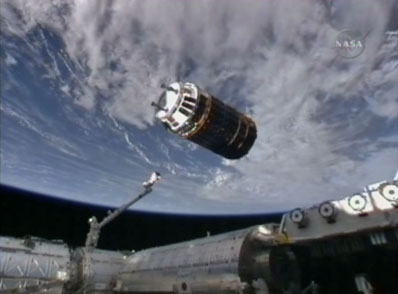


In a precise orbital ballet more than 200 miles above the planet, a bus-sized Japanese cargo ship approached the International Space Station on Thursday and astronaut Nicole Stott plucked the satellite from space using the complex's robot arm.


http://www.spaceflightnow.com/h2b/htv1/090917arrival/
__________________
Cosmos Pure | Core i7 860 | P7P55D-E Deluxe | 16GB DDR3 Vengeance | HD5850 | 2x850PRO 256GB | 2xRE3 250GB | 2xSpinPoint F3 1TB
GioFX è offline   Rispondi citando il messaggio o parte di esso
Old 02-10-2009, 17:26   #249
Rand
Senior Member
 
Iscritto dal: Apr 2006
Messaggi: 1464

Quote:
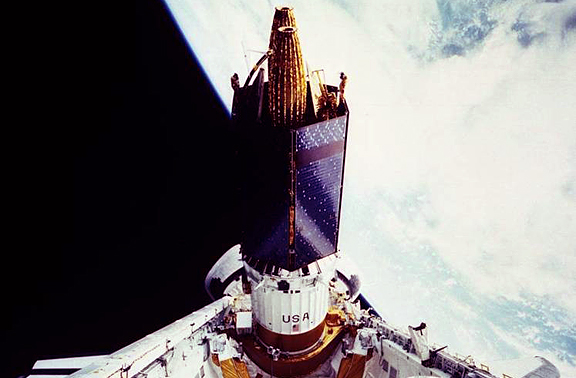
Delta 4-Heavy roars into orbit with DSP-23, the final Defense Support Program missile-warning satellite, at 8:50pm EST from Launch Complex 37B at Cape Canaveral Air Force Station, November 10, 2007. Delta 4-Heavy, over 23 stories tall, is the world's largest rocket by height and most powerful unmanned booster.
link
Rand è offline   Rispondi citando il messaggio o parte di esso
Old 02-10-2009, 17:37   #250
Rand
Senior Member
 
Iscritto dal: Apr 2006
Messaggi: 1464
Quote:
What's up in the solar system in October 2009

Phew! With the MESSENGER flyby over, I can focus now on what's ahead for October. The biggest thing to look forward to, without a doubt, is the planned smash of LCROSS into the Moon, a week from Friday, in the wee hours of the morning (my time) on October 9. However, I'm also excited about the fact that the next flyby of Titan will return Cassini to an orbit in the ring plane so it'll be seeing icy moons regularly again.

In the inner solar system:

After safing following the flyby, MESSENGER is back to "normal mode" but its science command load for the flyby period was permanently cancelled. New science will start on October 3, including some distant departure imagery of Mercury. I'm sure we'll see daily image releases from the team for a week or so, then they'll return to weekly announcements. They have to pace themselves; nothing of much significance will happen on the mission until Mercury orbit insertion on March 18, 2011.


ESA's Venus Express is still in orbit at Venus; its current mission extension runs out on December 31, 2009, but the mission is expected to receive another extension in October taking it through three more years. If it remains healthy, it should therefore still be operating when JAXA's "Planet-C" Venus Climate Orbiter arrives in 2011.


So now NASA's Lunar Reconnaissance Orbiter and its companion craft LCROSS are the only active spacecraft left at the Moon. LRO is (as of September 15) in its final science orbit, but they haven't yet released any images from their new, closer perspective.


LCROSS is now falling toward the Moon for its date with destiny. Its Centaur upper launch stage will crash into the crater Cabeus on October 9 at 4:30 Pacific time / 11:30 UTC (not Cabeus A, as previously announced), and the spacecraft itself will follow behind on its own collision course to a spot about 3 kilometers away, principal investigator Tony Colaprete has told me.


At the Sun:

The ESA/NASA SOHO mission continues to gaze at a very quiet Sun, though late last month, for the first time in, like, forever, there were two sunspots visible at the same time. As always, SOHO's near-real-time data and images are available here. NASA reports that due to the lengthy solar minimum, cosmic ray levels are at record highs.


The twin STEREO spacecraft are currently 61 degrees ahead (STEREO A) and 57 degrees behind (STEREO B) Earth and are also enjoying quiet weather conditions. They've gotten far enough apart that the mission homepage now features a neat rotating view of the two spacecraft's images that covers nearly the entire Sun. The daily STEREO image viewer includes the latest SOHO image, which gives you three slightly different viewpoints on the current appearance of the Sun. Currently SOHO sees the two sunspots I mentioned earlier, and so does STEREO Ahead, but STEREO Behind shows no sunspots.


On to Mars:

Out at Mars, it's late summer in Mars' southern hemisphere (Ls 347°). As I wrote yesterday, Mars Exploration Rover Opportunity has been driving, driving, driving lately, while Spirit's still stuck. JPL's "Free Spirit" website is sounding slightly less sanguine than in the past: "Tests on Earth simulating Spirit's predicament on Mars have reinforced understanding that getting Spirit to rove again will be very difficult." This may all be part of the art of managing expectations, but as days drag on it's getting more difficult to remain optimistic. JPL engineers have snatched success from the jaws of defeat before, though. And in her latest update on the rovers, Here's A. J. S. Rayl reports that they have settled on an extraction plan!


Mars Reconnaissance Orbiter is still in safe mode. Word from a friend at JPL is that they are being super extra cautious with trying to troubleshoot the computer reboots, because for the foreseeable future Mars Reconnaissance Orbiter is the only telecommunications relay we're going to have for future Mars landers (yes, Odyssey is still operating, but that spacecraft is a decade old and can't be relied upon to last forever either). It's frustrating to scientists because as time goes on, dawn is progressively arriving at farther and farther northern locations, and they would really like to be able to watch the northern wastes thaw out. There was a terribly cool announcement from three Mars Reconnaissance Orbiter teams about finding brand-new craters that punch into subsurface ice, which is then observed to sublimate away, which I have been meaning to write about, but have not had time to write about yet. Sorry! Another casualty of the persistent safe mode has been the MARCI team's continuous observation of Mars weather. On the MARCI weather report website, it states that, as of September 6, "The MARCI camera was turned off last week, and no new MARCI data will be available until the latter half of October. Please check back then for an updated weather report." Still no CRISM image releases for over a year.


ESA's Mars Express is still diligently mapping Mars. The Mars Webcam is currently returning high-phase shots of Mars, including some with some high clouds visible on the terminator. They have also posted a nice color version of a recent Mars photo along with a detailed explainer on how it was made -- check it out and try it for yourself! Mars Express' current mission extension takes it through December 31 -- like Venus Express, it's expected to be extended further.

NASA's Mars Odyssey remains the longest-lived spacecraft in orbit at Mars. You can see the latest from its THEMIS instrument here Lately the theme to their images has been dunes, dunes, and more dunes, making gorgeous repeating patterns on the Martian surface.


Exploring Saturn:

Cassini is continuing to watch sunrise on the northern face of Saturn's rings after last month's equinox. There was a lull in activity last month as Saturn passed through conjunction, but raw images are now coming back again, including more neat ones of a distant but fully lit Iapetus and tons and tons of images of spokes. Cassini is now wrapping up rev 118 of its tour. The orbit period is stil 24 days, but a targeted flyby of Titan on October 12 will shrink the orbit again. More importantly, the gravity assist provided by that flyby will drop Cassini's orbit back into the plane of Saturn's rings, affording it many, many more opportunities for close encounters with the other moons than it's had lately. (Though it probably also means that the spectacular ring phenomena we've been watching throughout equinox season will be much, much harder to see -- I'm not sure what, if anything, will be visible from the new, edge-on view.) This month will see nontargeted flybys of Rhea, Mimas, and Tethys in quick succession on October 13 and 14. Looking ahead, in a month, on November 2, comes the first of two very, very close targeted flybys of Enceladus.


Quietly cruising:


The International Cometary Explorer remains on course for a return visit to Earth in 2014. When it does, ICE can be returned to a Sun-Earth L1 halo orbit, or can use multiple Earth swingbys to encounter Comet Wirtanen during its near-Earth apparition in December 2018.


In the asteroid belt, NASA's Dawn has resumed steady thrusting of its ion engines, patiently propelling itself toward a rendezvous with Vesta in July 2011.


NASA's Deep Impact is cruising toward its 2010 flyby of comet 103P/Hartley 2. Deep Impact calibration observations of the Moon recently figured in the Moon Water story. The mission is expected to end in December 2010, after the flyby.


NASA's Stardust is cruising ever onward toward a Feburary 14, 2011 encounter with comet Tempel 1. The September status report indicates the spacecraft is in good health.


As of September 24 JAXA's Hayabusa is fine. Last month marked four years (really?? Wow, time flies) since the Itokawa encounter. It's still on track to return to Earth in June 2010.


A terse note on ESA's Rosetta mission blog reminds us that on November 13, it'll be flying by Earth. I have some more information about that that I'll post once I'm a little less busy. The next big science event for Rosetta will be the flyby of asteroid Lutetia in July of 2010.


NASA's New Horizons reached the midway point between the orbits of Saturn and Uranus on September 8. It has 17.18 AU to go to reach Pluto. It's still on course for a January to July 2015 encounter with the Pluto and Charon system.


And beyond:

Finally, NASA's Voyager 1 and 2 spacecraft were still responding to commands from Earth as of July 31. Both have now crossed the "termination shock," where the solar wind slows down as it impinges upon the interstellar medium.


Some other milestones to take note of this month, taken mostly from JPL's Space Calendar:

* October 4 will be the 50th anniversary of the launch of Luna 3. There'll also be a full Moon -- nice time to look at our nearest neighbor!
* Look for lots of space news during the week of October 4-8, when the Division of Planetary Sciences of the American Astronomical Society will be meeting in Puerto Rico. I hope to do a better job of covering news from that than I did from the European Planetary Science Congress this month.
* October 4-10 is World Space Week.
* October 11 is the 15th anniversary of the fiery death of the Magellan spacecraft, sent tumbling into Venus' atmosphere.
* On October 12, the Moon will occult Mars -- but only as seen from a mostly uninhabited region of the southern Indian Ocean. Still the two should be close to each other in the sky, so watch spaceweather.com for pretty astrophotos.
* On October 12-16, the International Astronautical Congress meets in Daejeon, South Korea.
* October 25 marks the end of daylight saing time for Europe, but not the U.S. Confusion will ensue. (In the U.S. it ends on November 1.)
* There is a Venus Exploration and Analysis Group (VEXAG) meeting in Irvine, California on October 28 and 29.
* October 31: Boo! There'll be a nice bright nearly full Moon for trick or treating this year.
4chr
Rand è offline   Rispondi citando il messaggio o parte di esso
Old 05-10-2009, 18:29   #251
Rand
Senior Member
 
Iscritto dal: Apr 2006
Messaggi: 1464
Quote:
Custom Eyeballs Can Tailor Your Eyesight to Your Career

Need to see a thousand meters in the dark? Want one eye that's perfect for reading and another for long distances? Some eye surgeons are already at work reshaping corneas not only to fix patients' vision, but fit their careers.

Laser eye treatment is two decades old, and adept surgeons have gone far beyond giving patients 20:20 vision. Times Online has profiled several such doctors, who offer to tailor their clients' eyesight to their occupation.

Julian Stevens, who practices at Moorfields Eye Hospital in London, has given special forces members and fighter pilots the aforementioned ability to see a thousand meters in the dark, and he notes that taxi drivers could benefit from a similar procedure. Stephen Trokel, who helped pioneer laser eye surgery, operated on a soprano who wanted to be able to read the music in the front row of the orchestra, as well as a New York Yankees catcher who needed to be able to see the ball coming out of the light. Another group that favors the occupational ocular enhancements? US presidential candidates, several of whom have received "monovision," which allows them to easily read with one eye and see far away with the other. This combination eliminates the need for reading glasses or bifocals, and some politicians hope it creates a sense of youthfulness.

What do we have to thank for this custom technology? The space program. Wavefront technology, which was developed by NASA to improve the focus of the Hubble Space Telescope, has translated neatly to the human eye. The technology allows physicians to map the cornea and iris, enabling surgeons to make small, specific tweaks to the eye that result in custom eyesight made to order.
4chr
Rand è offline   Rispondi citando il messaggio o parte di esso
Old 06-10-2009, 13:03   #252
Rand
Senior Member
 
Iscritto dal: Apr 2006
Messaggi: 1464
Quote:
Squyres wins Carl Sagan Medal for public outreach

For his work making the Mars Exploration Rover mission a compelling saga for millions of people, Steven W. Squyres, the Goldwin Smith Professor of Astronomy and principal scientific investigator for the mission, has received the 2009 Carl Sagan Medal from the American Astronomical Society.

The Sagan medal recognizes a planetary scientist for excellence in public communication. Squyres will receive the medal during the AAS's Division for Planetary Sciences annual meeting, Oct. 4-9, in Puerto Rico.

Quick to share credit with the entire Mars rover mission team at Cornell and NASA's Jet Propulsion Laboratory, Squyres said he has always taken seriously the responsibility of giving people -- the taxpayers who have bankrolled the mission -- a clear window into what they are doing on Mars.

"We feel very strongly that the people who pay have a real right to find out in very clear, simple terms what they're getting for their $900 million," Squyres said.

Since January 2004, when the first rover, named Spirit, bounced down on the red planet, the Rover team has maintained a publicly accessible database of images taken by the rovers. Atypical of most NASA missions, the rover mission has allowed people to access data almost immediately. It was a conscious decision by the rover team, Squyres said, to pipeline the data straight to the Web.

"If I'm asleep and you're awake, you can see the pictures from the rover before I do," he said. "And what that has done is it's really enabled people to share in this voyage of exploration."

Squyres hopes these efforts, including a Web site that provides updates of rover activities, has inspired young people to pursue careers in science and engineering.

"NASA does all kinds of wonderful things in space, from cosmology to gamma ray spectroscopy," Squyres said. "But try explaining gamma ray spectroscopy to a third-grader. It's hard. But you know, these are robots looking at rocks. It's not that complicated. What that means is this mission is almost uniquely accessible to people."

As a Cornell graduate student Squyres '78, Ph.D. '81, worked closely with Sagan. "Carl really pioneered, in a very important way, the way in which scientists interact with the media and the public," Squyres said. "To receive an award that's named after him for trying to do the same sort of thing that he did so brilliantly is a real honor."
4chr
Rand è offline   Rispondi citando il messaggio o parte di esso
Old 06-10-2009, 20:52   #253
dbx
Junior Member
 
Iscritto dal: Mar 2006
Messaggi: 4
Big news!

Il test di VASIMIR a 201 Kw è stato un successo

http://www.youtube.com/watch?v=fvuNUNqW6Sc
dbx è offline   Rispondi citando il messaggio o parte di esso
Old 07-10-2009, 00:00   #254
Rand
Senior Member
 
Iscritto dal: Apr 2006
Messaggi: 1464
Quote:
Originariamente inviato da dbx Guarda i messaggi
Big news!

Il test di VASIMIR a 201 Kw è stato un successo

http://www.youtube.com/watch?v=fvuNUNqW6Sc
Ottimo

Quote:
One backwards leap for Texas

I keep wondering what kind of dumbosity people associated with the Texas Board of Education can come up with next, and I keep being surprised at the depths of teh stoopid. And this time it’s not creationism!

It’s NASA. According to Houston Chronicle blogger Eric Berger, there’s a proposal to remove Neil Armstrong’s name from social studies textbooks.

Yes, you read that correctly. The proposal was suggested by teachers and parents reviewing materials, because Armstrong "is not a scientist".

Wha wha whaaaa?

I could argue that technically that’s correct, since Armstrong’s an engineer, which is different than a research scientist. Still, he did do some modicum of science when he walked on the frakking Moon. I think maybe he should be given the benefit of the doubt on this one*

Plus, his foot was the first planted on another world, and maybe we’re not being too tough on students to know that. And the irony that this is Texas! They have a big city there called Houston which has some NASA ties, as in "Houston, Tranquility Base here. The Eagle has landed."

So, to the Texas Essential Knowledge and Skills review team, this one’s for you:

Rand è offline   Rispondi citando il messaggio o parte di esso
Old 07-10-2009, 17:05   #255
Xile
Senior Member
 
L'Avatar di Xile
 
Iscritto dal: Nov 2003
Città: Utopia Planitia
Messaggi: 3875
Niente su Phoenix?! Ci proveranno a richiamarla?!
__________________

Xile è offline   Rispondi citando il messaggio o parte di esso
Old 07-10-2009, 17:55   #256
jumpjack
Senior Member
 
Iscritto dal: Sep 2004
Messaggi: 1268
Quote:
Originariamente inviato da Xile Guarda i messaggi
Niente su Phoenix?! Ci proveranno a richiamarla?!
Phoenix ha un thread tutto suo:
http://www.hwupgrade.it/forum/showth...0#post29187780

E... cinguetta!
http://twitter.com/MarsPhoenix

Quote:
The team will attempt to contact Phoenix once spring returns to the northern hemisphere. Spring starts Oct 27.
__________________
La scienza è provvisoria
-- Jumpjack --
jumpjack è offline   Rispondi citando il messaggio o parte di esso
Old 09-10-2009, 00:44   #257
Rand
Senior Member
 
Iscritto dal: Apr 2006
Messaggi: 1464
Quote:
Europa Capable of Supporting Life, Scientist Says

The global ocean on Jupiter’s moon Europa contains about twice the liquid water of all the Earth’s oceans combined. New research by Richard Greenberg of the University of Arizona suggests that there may be plenty of oxygen available in that ocean to support life, a hundred times more oxygen than previously estimated.

The chances for life there have been uncertain, because Europa’s ocean lies beneath several miles of ice, which separates it from the production of oxygen at the surface by energetic charged particles (similar to cosmic rays). Without oxygen, life could conceivably exist at hot springs in the ocean floor using exotic metabolic chemistries, based on sulfur or the production of methane. However, it is not certain whether the ocean floor actually would provide the conditions for such life.

Therefore a key question has been whether enough oxygen reaches the ocean to support the oxygen-based metabolic process that is most familiar to us. An answer comes from considering the young age of
Europa’s surface. Its geology and the paucity of impact craters suggests that the top of the ice is continually reformed such that the current surface is only about 50 million years old, roughly 1% of the
age of the solar system.

Greenberg has considered three generic resurfacing processes: gradually laying fresh material on the surface; opening cracks which fill with fresh ice from below; and disrupting patches of surface in place and replacing them with fresh material. Using estimates for the production of oxidizers at the surface, he finds that the delivery rate into the ocean is so fast that the oxygen concentration could exceed that of the Earth’s oceans in only a few million years.
Greenberg says that the concentrations of oxygen would be great enough to support not only microorganisms, but also “macrofauna”, that is, more complex animal-like organisms which have greater oxygen demands. The continual supply of oxygen could support roughly 3 billion kilograms of macrofauna, assuming similar oxygen demands to terrestrial fish.

The good news for the question of the origin of life is that there would be a delay of a couple of billion years before the first surface oxygen reached the ocean. Without that delay, the first pre-biotic chemistry and the first primitive organic structures would be disrupted by oxidation. Oxidation is a hazard unless organisms have evolved protection from its damaging effects. A similar delay in the
production of oxygen on Earth was probably essential for allowing life to get started here.

Richard Greenberg is the author of the recent book “Unmasking Europa: The Search for Life on Jupiter’s Ocean Moon.” He presented his findings at the 41st meeting of the American Astronomical Society’s Division for Planetary Sciences.
4chr
Rand è offline   Rispondi citando il messaggio o parte di esso
Old 10-10-2009, 13:13   #258
marco XP2400+
Senior Member
 
L'Avatar di marco XP2400+
 
Iscritto dal: Sep 2007
Città: napoli city
Messaggi: 1315
ma perchè non esiste una sezione spazio in questo forum ancora lo devo capire!!!
grazie della discussione
marco XP2400+ è offline   Rispondi citando il messaggio o parte di esso
Old 10-10-2009, 19:12   #259
jumpjack
Senior Member
 
Iscritto dal: Sep 2004
Messaggi: 1268
Quote:
Originariamente inviato da marco XP2400+ Guarda i messaggi
ma perchè non esiste una sezione spazio in questo forum ancora lo devo capire!!!
grazie della discussione
perche' è un forum di hardware, non di spazio!
per l'ASTRONAUTICO c'e' un FORUM apposta...
__________________
La scienza è provvisoria
-- Jumpjack --
jumpjack è offline   Rispondi citando il messaggio o parte di esso
Old 15-10-2009, 00:36   #260
Rand
Senior Member
 
Iscritto dal: Apr 2006
Messaggi: 1464

Quote:
Satellite In The Wrong Orbit Works for 26 Years

NASA: After a rocky start and then a stellar 26-year performance, NASA's Tracking and Data Relay Satellite - 1 (TDRS-1) is scheduled for decommissioning on October 28.

Communications equipment that links TDRS-1 to the ground has failed and without this capability it can no longer relay science data and spacecraft telemetry to ground stations located at the White Sands Complex in Las Cruces, N.M., and on Guam.

"Our immediate plans are to develop a strategy to shut down critical payload systems aboard the satellite," said Space Network Project Manager Roger Flaherty at NASA's Goddard Space Flight Center. "Then the team will execute maneuvers to raise TDRS-1's orbit, thus eliminating potential collision dangers with other communications satellites in geosynchronous orbit."

TDRS-1 had many firsts. Its position over the Indian Ocean successfully eliminated the "Zone of Exclusion" in an area where communications with spacecraft were previously impossible, thus providing true global coverage for all TDRS System customers.

In 1998, TDRS-1 garnished world-wide publicity when it provided the first medical teleconferencing link, complete with voice, video and imaging data from the South Pole. It was used again in July 2002 to provide continuous, dropout-free data during a two-hour telemedicine event involving a physician at the Amundsen-Scott South Pole Station and physicians at the Massachusetts General Hospital in Boston.

"Amazing results from a satellite that almost didn't make it to orbit," said Flaherty.

TDRS-1's upper stage failed upon deployment from the space shuttle in April 1983. Engineers at Goddard came to its rescue using the tiny, one-pound thrusters onboard the spacecraft. Over the course of several months they fired the thrusters to nudge TDRS-1 into its geosynchronous Earth orbit. NASA has used the satellite in ways never expected because its orbit has been inclining almost one degree per year since deployment.

Goddard's Space Network Project provides overall management and direction of the operation and maintenance of the TDRS system, which consists of the on-orbit TDRS, the ground terminal on Guam and the ground complex at White Sands, N.M.

For more information about the TDRS Program, go to: http://scp.gsfc.nasa.gov/sn/index.htm
Rand è offline   Rispondi citando il messaggio o parte di esso
 Rispondi


Mad Catz M.M.O. 7+: lo stesso DNA del R.A.T. 8+ ADV, ma con molti più pulsanti Mad Catz M.M.O. 7+: lo stesso DNA del R.A.T. 8+ ...
Radeon RX 9070 GRE, AMD la porta in tutto il mondo | Recensione Gigabyte Gaming OC Radeon RX 9070 GRE, AMD la porta in tutto il mon...
Reolink OMVI 3i WiFi: videosorveglianza più intelligente e facile da usare Reolink OMVI 3i WiFi: videosorveglianza pi&ugrav...
Recensione Vivo X300 Ultra: fotocamera eccezionale, ma prezzo proibitivo Recensione Vivo X300 Ultra: fotocamera ecceziona...
Xiaomi 17T Pro recensione: zoom Leica 5x e batteria silicio-carbonio per l'alternativa ai top Xiaomi 17T Pro recensione: zoom Leica 5x e batte...
Cryorig svela Lull, case con radiatore i...
Plaud Team, la soluzione di trascrizione...
OmniBook Ultra 16 e OmniBook X 14, anche...
G.SKILL porta al Computex 2026 una serie...
Biwin al Computex 2026: RAM DDR5 Origin ...
Dimenticatevi OS e app, per Microsoft ci...
Arctic al Computex 2026: Freezer 61, ven...
Siamo stati nel quartier generale di MSI...
AIO senza pompa: Enermax presenta il fut...
3 mesi gratis di Google AI Pro: ecco la ...
realme 16 5G: ufficiale la data di lanci...
GeForce RTX 5060 a poco più di 30...
Microsoft Build 2026, tutte le novit&agr...
Tomb Raider: Legacy of Atlantis, il rema...
NZXT H6 case e ventole Ultra RGB: New De...
Chromium
GPU-Z
OCCT
LibreOffice Portable
Opera One Portable
Opera One 106
CCleaner Portable
CCleaner Standard
Cpu-Z
Driver NVIDIA GeForce 546.65 WHQL
SmartFTP
Trillian
Google Chrome Portable
Google Chrome 120
VirtualBox
Tutti gli articoli Tutte le news Tutti i download

Strumenti

Regole
Non Puoi aprire nuove discussioni
Non Puoi rispondere ai messaggi
Non Puoi allegare file
Non Puoi modificare i tuoi messaggi

Il codice vB è On
Le Faccine sono On
Il codice [IMG] è On
Il codice HTML è Off
Vai al Forum


Tutti gli orari sono GMT +1. Ora sono le: 00:27.


Powered by vBulletin® Version 3.6.4
Copyright ©2000 - 2026, Jelsoft Enterprises Ltd.
Served by www3v