

|
|||||||


|


|
|
 |
|
|
Strumenti |
 27-02-2008, 19:11
|
#21 | |
|
Senior Member

Iscritto dal: Nov 2001
Città: Padova
Messaggi: 1638
|
Quote:
__________________
Cosmos Pure | Core i7 860 | P7P55D-E Deluxe | 16GB DDR3 Vengeance | HD5850 | 2x850PRO 256GB | 2xRE3 250GB | 2xSpinPoint F3 1TB |
|

|

|

|
06-03-2008, 00:16
|
#22 |
|
Senior Member
Iscritto dal: Nov 2001
Città: Padova
Messaggi: 1638
|
Arianespace Mission Update:
March 3, 2008 Arianespace Flight ATV: launch delayed by 24 hours In order to allow additional checks on the Automated Launch Vehicle Jules Verne, Arianespace and ESA have decided to postpone the launch by 24 hours. The launch is now scheduled during the night of Saturday, March 8 to Sunday, March 9, 2008: Launch Window UTC: 03:59 a.m. Paris, France: 04:59 a.m. Kourou, French Guiana: 00:59 a.m. Moscow, Russia: 06:59 a.m. http://www.arianespace.com/site/news...ate_index.html
__________________
Cosmos Pure | Core i7 860 | P7P55D-E Deluxe | 16GB DDR3 Vengeance | HD5850 | 2x850PRO 256GB | 2xRE3 250GB | 2xSpinPoint F3 1TB |
|
|
|
|
06-03-2008, 20:04
|
#23 | |
|
Senior Member
Iscritto dal: Nov 2001
Città: Padova
Messaggi: 1638
|
Quote:
__________________
Cosmos Pure | Core i7 860 | P7P55D-E Deluxe | 16GB DDR3 Vengeance | HD5850 | 2x850PRO 256GB | 2xRE3 250GB | 2xSpinPoint F3 1TB |
|
|
|
|

|
06-03-2008, 20:10
|
#24 |
|
Senior Member
Iscritto dal: Nov 2001
Città: Padova
Messaggi: 1638
|
Da NasaSpaceFlight.com:
Sophisticated ATV boosts Europe's space programs BY STEPHEN CLARK SPACEFLIGHT NOW Posted: March 5, 2008 This weekend's launch of Europe's Jules Verne cargo ship and last month's addition of the Columbus laboratory module to the international space station are cornerstone achievements in the continent's growth in space, according to senior officials  Credit: ESA Jules Verne is the first of at least five contracted Automated Transfer Vehicle missions to the space station. Blastoff is timed for 0403:04 GMT (11:03:04 p.m. EST) from the European-controlled space base in Kourou, French Guiana. "Europe historically is the exploring continent, and we want to make sure that we don't just explore the world but we explore the world beyond us," said Alan Thirkettle, ESA international space station program manager. Long an operator of highly successful science probes, the European Space Agency is becoming a full-time participant in human spaceflight this year. "There is a big jump between operating unmanned spacecraft in deep space and actually operating a spacecraft in a manned environment," said Bob Chesson, head of ESA's human spaceflight and exploration operations. "It's a big challenge for us and I think we're up to it." Jules Verne will embark on a dual mission to demonstrate the vehicle's readiness and deliver crucial cargo to the space station. "I'm a Briton and it's very difficult for Brits to get excited, but we're very excited and very proud and really looking forward to what we think is going to be a really magnificent mission and one that will service the station very well," Thirkettle said. Along with the newly-launched Columbus lab, the ATV will be one of Europe's primary contributions to the station. ESA and ten of its member states have spent about $7.4 billion on station-related projects since 1995, according to Thirkettle. Europe is budgeting another $5.9 billion for the station through 2018, mostly covering the four remaining ATV missions and operations costs. If everything goes as planned during Jules Verne's six-month mission, the next ATV will launch late next year. Three more ATV's will fly in 2011, 2012 and 2013, ESA officials said. "You don't become a major player unless you can do your own operations, and that will come with ATV," Thirkettle said. The ATV program has cost $1.9 billion since 1995, including the craft's design, development and construction. The cost number also covers the program's ground segment. Each ATV mission produces an individual cost of about $532 million, while each spacecraft is worth about $304 million, according to ESA. France led the program's development, providing nearly 47 percent of the total contributions to the ATV. Germany and Italy supplied 24 percent and 13 percent, respectively, and seven other ESA member states had contributions in the single digits. Europe's involvement in the international space station project is structured by barter agreements with NASA. ESA secured a shuttle launch for Columbus by building the Node 2 and Node 3 modules, and the ATV's cargo-carrying capability will cover ESA's 8.3-percent share of the station's operating costs. Columbus, the ATV and ESA science payloads also help ensure a spot for European astronauts on future station crews. Thirkettle said ESA astronauts will spend at least six months on the station every two years beginning in 2009. Led by the industrial giant European Aeronautic Defence and Space Co., the ATV contractor team included thousands of engineers and technicians in Europe. Russia provided the docking probe and refueling system. "ATV gives very high-tech work to (European) industry, it pays our fees for the station which enables us to do the world-class science and research that we want to do on the station, and it's a gateway to the future exploration ambitions that we have in Europe," Thirkettle said. A space transporter The ship is able to carry more than 16,000 pounds of refueling propellant, water, oxygen, nitrogen and dry cargo. Named after the famed 19th century science fiction writer, Jules Verne will be launching with only about 10,100 pounds of supplies. "We want to retain some flexibility for the various test maneuvers that will be performed during the approach," said John Ellwood, ATV project manager. In development for more than 12 years, the ATV can carry three times more payload mass to the station than Russia's workhorse Progress spacecraft, which has averaged nearly four missions per year since 2001. "We're going to be the largest carrier of cargo to the international space station," Ellwood said. The cargo capacity will be especially needed after the space shuttle's retirement in 2010. The shuttle currently carries most of the station's hardware to orbit. "It is a major contribution to the program, probably more significantly post-2010 when the shuttle is no longer available for us to do much of the logistics work it does," said Mike Suffredini, NASA international space station program manager. With its Russian docking probe extended, the cylindrical craft measures nearly 34 feet long and 15 feet wide, about the size of a London double-decker bus.  Credit: ESA "It is the biggest spacecraft we've built in Europe and by far the most complicated," Ellwood said. Behind the ATV's 518-pound docking system lies the integrated cargo carrier, containing about 1,600 cubic feet of pressurized volume. Derived from the Italian-built, NASA-owned Multi-Purpose Logistics Modules, the pressurized section has room for up to eight standard cargo racks. The 16.1-foot-long cargo carrier also includes an unpressurized module holding spherical tanks for water, gases and refueling propellant. Larger racks housing science experiments can only be flown to the station using the shuttle or Japan's H-2 Transfer Vehicle, which will launch for the first time next year. The HTV will also be able to deliver external payloads. A service module behind the cargo carrier is fitted with four blue power-producing solar arrays. When deployed, the panels form a distinguishing X-shaped pattern spanning more than 73 feet, producing about four kilowatts of power. Four main engines attached to the aft end of the ATV will perform major rendezvous burns and re-boost the space station's orbit. Two of the engines will be used in free flight, while all four can be used for re-boost maneuvers. The propulsion unit includes 28 smaller thrusters for attitude control duties. A backup propulsion system can be activated to independently abort an ATV rendezvous if conditions become unsafe. "We really have two spacecraft in the middle of this enormous great bird," Ellwood said. The service module also contains the ATV's brain, a complex set of computers and avionics that serve as the spacecraft's nerve center. Shields and an insulating white foil layer covering the outer shell of the ATV protect the spacecraft from debris impacts and extreme temperatures. Optical rendezvous sensors and an assortment of S-band, radio, and GPS antennas are also scattered across the freighter's exterior. The spacecraft will communicate with a 60-person team of controllers based in Toulouse, France, through NASA's Tracking and Data Relay Satellite System - a fleet of satellites also used by the space shuttle, space station and a host of other missions. The ATV is "like a combination of a telecoms satellite, navigation vessel and a human spacecraft all rolled into one," Thirkettle said. More ATV missions could be flown if station operations are formally extended past the next decade. Officials have also considered fielding the ATV on commercial flights or evolving the ship to support other types of missions. A joint team formed by EADS Astrium and Lockheed Martin Corp. proposed using an ATV variant launched by Atlas and Delta rockets under a 2005 NASA request for proposals to commercially supply the space station after the shuttle's retirement. NASA didn't select the ATV plan for further study, instead choosing to support smaller burgeoning U.S. aerospace companies. Some officials tout the ATV as a stepping stone to a future crew-carrying spacecraft, but that would require a significant leap from the ship's current design. "It's not just a matter of taking off the cargo carrier and sticking a capsule on top of it," Thirkettle said. A long road to launch Sophisticated ATV boosts Europe's space programs BY STEPHEN CLARK SPACEFLIGHT NOW Posted: March 5, 2008 This weekend's launch of Europe's Jules Verne cargo ship and last month's addition of the Columbus laboratory module to the international space station are cornerstone achievements in the continent's growth in space, according to senior officials. Credit: ESA Jules Verne is the first of at least five contracted Automated Transfer Vehicle missions to the space station. Blastoff is timed for 0403:04 GMT (11:03:04 p.m. EST) from the European-controlled space base in Kourou, French Guiana. "Europe historically is the exploring continent, and we want to make sure that we don't just explore the world but we explore the world beyond us," said Alan Thirkettle, ESA international space station program manager. Long an operator of highly successful science probes, the European Space Agency is becoming a full-time participant in human spaceflight this year. "There is a big jump between operating unmanned spacecraft in deep space and actually operating a spacecraft in a manned environment," said Bob Chesson, head of ESA's human spaceflight and exploration operations. "It's a big challenge for us and I think we're up to it." Jules Verne will embark on a dual mission to demonstrate the vehicle's readiness and deliver crucial cargo to the space station. "I'm a Briton and it's very difficult for Brits to get excited, but we're very excited and very proud and really looking forward to what we think is going to be a really magnificent mission and one that will service the station very well," Thirkettle said. Along with the newly-launched Columbus lab, the ATV will be one of Europe's primary contributions to the station. ESA and ten of its member states have spent about $7.4 billion on station-related projects since 1995, according to Thirkettle. Europe is budgeting another $5.9 billion for the station through 2018, mostly covering the four remaining ATV missions and operations costs. If everything goes as planned during Jules Verne's six-month mission, the next ATV will launch late next year. Three more ATV's will fly in 2011, 2012 and 2013, ESA officials said. "You don't become a major player unless you can do your own operations, and that will come with ATV," Thirkettle said. The ATV program has cost $1.9 billion since 1995, including the craft's design, development and construction. The cost number also covers the program's ground segment. Each ATV mission produces an individual cost of about $532 million, while each spacecraft is worth about $304 million, according to ESA. France led the program's development, providing nearly 47 percent of the total contributions to the ATV. Germany and Italy supplied 24 percent and 13 percent, respectively, and seven other ESA member states had contributions in the single digits. Europe's involvement in the international space station project is structured by barter agreements with NASA. ESA secured a shuttle launch for Columbus by building the Node 2 and Node 3 modules, and the ATV's cargo-carrying capability will cover ESA's 8.3-percent share of the station's operating costs. Columbus, the ATV and ESA science payloads also help ensure a spot for European astronauts on future station crews. Thirkettle said ESA astronauts will spend at least six months on the station every two years beginning in 2009. Led by the industrial giant European Aeronautic Defence and Space Co., the ATV contractor team included thousands of engineers and technicians in Europe. Russia provided the docking probe and refueling system. "ATV gives very high-tech work to (European) industry, it pays our fees for the station which enables us to do the world-class science and research that we want to do on the station, and it's a gateway to the future exploration ambitions that we have in Europe," Thirkettle said. A space transporter The ship is able to carry more than 16,000 pounds of refueling propellant, water, oxygen, nitrogen and dry cargo. Named after the famed 19th century science fiction writer, Jules Verne will be launching with only about 10,100 pounds of supplies. "We want to retain some flexibility for the various test maneuvers that will be performed during the approach," said John Ellwood, ATV project manager. In development for more than 12 years, the ATV can carry three times more payload mass to the station than Russia's workhorse Progress spacecraft, which has averaged nearly four missions per year since 2001. "We're going to be the largest carrier of cargo to the international space station," Ellwood said. The cargo capacity will be especially needed after the space shuttle's retirement in 2010. The shuttle currently carries most of the station's hardware to orbit. "It is a major contribution to the program, probably more significantly post-2010 when the shuttle is no longer available for us to do much of the logistics work it does," said Mike Suffredini, NASA international space station program manager. With its Russian docking probe extended, the cylindrical craft measures nearly 34 feet long and 15 feet wide, about the size of a London double-decker bus. Credit: ESA "It is the biggest spacecraft we've built in Europe and by far the most complicated," Ellwood said. Behind the ATV's 518-pound docking system lies the integrated cargo carrier, containing about 1,600 cubic feet of pressurized volume. Derived from the Italian-built, NASA-owned Multi-Purpose Logistics Modules, the pressurized section has room for up to eight standard cargo racks. The 16.1-foot-long cargo carrier also includes an unpressurized module holding spherical tanks for water, gases and refueling propellant. Larger racks housing science experiments can only be flown to the station using the shuttle or Japan's H-2 Transfer Vehicle, which will launch for the first time next year. The HTV will also be able to deliver external payloads. A service module behind the cargo carrier is fitted with four blue power-producing solar arrays. When deployed, the panels form a distinguishing X-shaped pattern spanning more than 73 feet, producing about four kilowatts of power. Four main engines attached to the aft end of the ATV will perform major rendezvous burns and re-boost the space station's orbit. Two of the engines will be used in free flight, while all four can be used for re-boost maneuvers. The propulsion unit includes 28 smaller thrusters for attitude control duties. A backup propulsion system can be activated to independently abort an ATV rendezvous if conditions become unsafe. "We really have two spacecraft in the middle of this enormous great bird," Ellwood said. The service module also contains the ATV's brain, a complex set of computers and avionics that serve as the spacecraft's nerve center. Shields and an insulating white foil layer covering the outer shell of the ATV protect the spacecraft from debris impacts and extreme temperatures. Optical rendezvous sensors and an assortment of S-band, radio, and GPS antennas are also scattered across the freighter's exterior. The spacecraft will communicate with a 60-person team of controllers based in Toulouse, France, through NASA's Tracking and Data Relay Satellite System - a fleet of satellites also used by the space shuttle, space station and a host of other missions. The ATV is "like a combination of a telecoms satellite, navigation vessel and a human spacecraft all rolled into one," Thirkettle said. More ATV missions could be flown if station operations are formally extended past the next decade. Officials have also considered fielding the ATV on commercial flights or evolving the ship to support other types of missions. A joint team formed by EADS Astrium and Lockheed Martin Corp. proposed using an ATV variant launched by Atlas and Delta rockets under a 2005 NASA request for proposals to commercially supply the space station after the shuttle's retirement. NASA didn't select the ATV plan for further study, instead choosing to support smaller burgeoning U.S. aerospace companies. Some officials tout the ATV as a stepping stone to a future crew-carrying spacecraft, but that would require a significant leap from the ship's current design. "It's not just a matter of taking off the cargo carrier and sticking a capsule on top of it," Thirkettle said. A long road to launch More than 12 years in the making, the long-awaited maiden launch of the ATV has been hit by more than three years of delays since the project was inaugurated. Officials overcame early development difficulties in the first few years of the program, but more recent issues again challenged the ATV team. Hiccups in the ATV's Russian GPS navigation system forced engineers to write new software to trounce the problems in late 2006. Flight software testing also had to be pushed back due to difficulties with a ground facility designed to check the software. Jules Verne was shipped from its testing center in the Netherlands to French Guiana last July to begin several months of final assembly and cargo loading. More than 40 people have worked full time on the spacecraft at Kourou since its arrival, according to ESA officials. Tests at the launch site revealed minor issues with the ATV's docking system and miniscule leaks in the propulsion system last fall. Technicians employed minor fixes to overcome the issues, according to an ESA spokesperson. Another constant factor in the timing of Jules Verne's mission has been international traffic visiting the space station. The ATV can't dock while the space shuttle is present, and arrivals and departures of Russian Soyuz and Progress spacecraft must also be taken into account, Thirkettle said. "The fact is it's a very complicated process to try to line these spacecraft up to come to ISS, mostly because seldom do they actually launch exactly when they think they will," Suffredini said.  Credit: ESA Visiting spacecraft were partially to blame for an ATV delay last year, but officials said last month they would launch as soon as possible and wait in a parking orbit for other missions to wrap up. Workers finished loading dry cargo aboard Jules Verne last fall and closed the pressurized section on Dec. 12. The cargo carrier and service module were mated five days later. Technicians completed fueling Jules Verne and installed the craft's thermal covers in early February. Jules Verne was transported to the final assembly building on Feb. 14 and attached atop the Ariane 5 rocket a few days later. Managers met Feb. 6 and decided to formally postpone the launch from Feb. 22 to March 8, giving engineers time to put finishing touches on the spacecraft. Officials said ground controllers also requested additional time to conduct more mission simulations. ESA did not purchase insurance for Jules Verne's flight, but engineers designed the ATV with several levels of redundancy and put in extra testing to offset the risk. The delay last month was to add a "final level of robustness" to the mission, Thirkettle said. After some final closeout work, the Ariane 5's voluminous payload fairing was mounted around Jules Verne on Feb. 25. The nose cone protects the ship during the final days before launch and through the rocket's flight in the dense lower atmosphere during the early minutes of the mission. Managers decided last weekend to postpone the launch one more day, allowing launch site workers to inspect grounding straps on the separation system that will release Jules Verne from the grasp of the Ariane 5's upper stage. Technicians temporarily removed the payload fairing for the separation system checks. The two fairing halves were attached to the rocket again earlier this week, setting the stage for the launcher's move to the launch pad Friday in advance of picking up the final countdown Saturday afternoon. http://www.spaceflightnow.com/ariane/v181/program.html
__________________
Cosmos Pure | Core i7 860 | P7P55D-E Deluxe | 16GB DDR3 Vengeance | HD5850 | 2x850PRO 256GB | 2xRE3 250GB | 2xSpinPoint F3 1TB |
|
|
|
|
06-03-2008, 20:14
|
#25 | |
|
Senior Member

Iscritto dal: Oct 2000
Città: UK
Messaggi: 7458
|
Quote:

__________________
"Questo forum non è un fottuto cellulare quindi scrivi in italiano, grazie." (by Hire) Le mie foto su Panoramio - Google Earth |
|
|
|
|
|
06-03-2008, 20:32
|
#26 |
|
Senior Member
Iscritto dal: Nov 2001
Città: Padova
Messaggi: 1638
|
Da SpaceFlightNow.com:
Europe's new space freighter prepares for maiden voyage BY STEPHEN CLARK SPACEFLIGHT NOW Posted: March 5, 2008 Lauded as the most advanced spaceship ever built by Europeans, a robotic orbital freighter named Jules Verne will blast off from the Atlantic coast of South America this weekend to begin a three-week chase of the international space station. 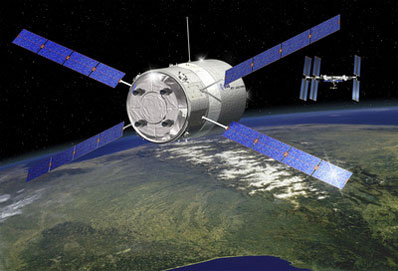 Credit: ESA Liftoff of Jules Verne at the tip of a beefed up Ariane 5 rocket is set for 0403:04 GMT Sunday (11:03:04 p.m. EST Saturday) from the European-controlled spaceport in Kourou, French Guiana. The launch is timed for the instant Earth's rotation brings the ELA-3 launch pad into the space station's orbital path. Senior leaders representing the European Space Agency, Arianespace, contractors, and other international partners met Wednesday in a launch readiness review to clear the mission for flight. "We are very pleased to smoothly pass this milestone four days before launch as scheduled," said John Ellwood, ESA ATV project manager. "Now we really feel to be ready, and our Russian and NASA partners have expressed the same confidence." The 17-story rocket will be rolled from its assembly building to the ELA-3 launch pad in Kourou on Friday. Once the Ariane 5 completes the 1.7-mile trip, workers will connect electrical and fluid lines between the launcher and ground systems in preparation for the final countdown, which will kick off around midday Saturday. See our detailed countdown timeline here. Tipping the scales at 42,700 pounds, Jules Verne is more than two times heavier than any other spacecraft put into orbit by Europe. The first of five Automated Transfer Vehicles, the ship will deliver more than five tons of cargo to the station after going through a shakedown to make sure it is ready to approach the station. The Ariane 5 rocket, a vehicle typically used to loft commercial communications satellites for launch provider Arianespace, was strengthened to handle the hefty mass. Engineers also had to make a few software changes because of the huge payload, and the launch will use an extended 56-foot payload fairing to house Jules Verne during the early minutes of flight. Tipping the scales at 42,700 pounds, Jules Verne is more than two times heavier than any other spacecraft put into orbit by Europe. The first of five Automated Transfer Vehicles, the ship will deliver more than five tons of cargo to the station after going through a shakedown to make sure it is ready to approach the station. The Ariane 5 rocket, a vehicle typically used to loft commercial communications satellites for launch provider Arianespace, was strengthened to handle the hefty mass. Engineers also had to make a few software changes because of the huge payload, and the launch will use an extended 56-foot payload fairing to house Jules Verne during the early minutes of flight.  Credit: ESA The rocket and its prized payload will have two opportunities to get off the ground Sunday and Monday mornings, European time. Under an agreement with NASA, the Ariane 5 will stand down Tuesday to give the shuttle Endeavour a chance to launch. If Endeavour lifts off Tuesday, the Ariane 5 will try again beginning Wednesday morning, according to Kirk Shireman, NASA deputy station program manager. The shuttle and the ATV can't launch on the same day because both vehicles use S-band communications through NASA's Tracking and Data Relay Satellite System, Shireman said. Riding nearly three million pounds of thrust, the Ariane 5 will fly northeast from the Guiana Space Center after liftoff, jettisoning its twin solid rocket boosters less than two-and-a-half minutes later and exhausting its first stage about nine minutes into the launch. Its storable propellant upper stage will fire twice before Jules Verne is cast free from the launcher. See our detailed launch timeline here. Jules Verne will be deployed in a 162-mile-high orbit inclined 51.6 degrees to the equator. After separation, mission responsibility will switch from Kourou to the ATV control center in Toulouse, France.  An artist's concept shows Jules Verne rising into orbit atop the Ariane rocket's upper stage. Credit: EADS Astrium The upper stage will conduct a final burn about 90 minutes later to set a course for destruction as the spent rocket body plummets into the Earth's atmosphere over the Pacific Ocean. Jules Verne will begin its activation sequence moments after the Ariane 5 unleashes the spacecraft, turning on its electrical system, unfurling a communications antenna boom, and preparing for orbital operations. "The ATV is switched on and the propulsion system is primed, the solar arrays are deployed, and we start the GPS, which provides the navigation in the first phase," said Bob Chesson, head of ESA's human spaceflight and exploration operations. Waiting for station traffic to clear Once controllers finish turning the ATV into a fully functional spaceship, attention will turn to its pursuit of the international space station. The first orbital "phasing" maneuver is scheduled for less than 12 hours after launch, beginning a three-week process to bring Jules Verne to the station's vicinity. See our detailed mission timeline here. The craft will spend its first ten days in space gradually shifting its orbit higher as ground controllers put the craft through a rigorous series of tests to confirm it is ready to approach the space station. "The phasing period allows us to catch up with the space station and get it within our sights," Chesson said. The comprehensive checkout will include an attitude control experiment, navigation tests using the ATV's GPS system, and the demonstration of a critical emergency thruster firing to be used if something goes awry during the final rendezvous. The collision avoidance maneuver is an engine burn to push the ATV away from the station at a relative velocity of 11 miles per hour. That test is scheduled for approximately 0800 GMT (4:00 a.m. EDT) March 12. Jules Verne will eventually arrive at a point about 1,200 miles in front of the space station by about March 19. The craft will hold in that orbit to wait out the shuttle Endeavour's visit to the station, which is scheduled to wrap up with an undocking on March 24.  An artist's concept shows Endeavour leaving the space station. Credit: NASA The station's international partners agreed to flight rules dictating that visiting spacecraft are not permitted to dock with the orbiting outpost while a shuttle is present. Despite the conflict of Endeavour's mission, station managers opted to give the go-ahead for the ATV's launch. "We'll launch as soon as ATV is ready, the launcher is ready, and the ground segment is ready," Ellwood said. "We then go to the space station and we have the option of immediately docking to the space station if the conditions are right, or we could loiter close to the space station." The loitering philosophy will burn roughly 50 pounds of propellant per day, giving officials several options in their mission planning. "We're actually more flexible in space than we are on the ground," said Alan Thirkettle, ESA space station program manager. Demo Days pave way for docking Once Endeavour departs the station, ESA controllers will resume putting Jules Verne through a checklist of pre-docking activities. The freighter will begin its push toward the station early on March 27, setting up for the first two "demo days" to showcase the craft's ability to autonomously fly in close proximity to the outpost. "In each of those, we demonstrate various aspects of the ATV and prove that those features are working properly to ensure the safety of the vehicle and the station," Chesson said. With ground controllers looking over the shoulder of Jules Verne, the craft will automatically fly toward the station through waypoints positioned at various distances from the complex. The ground team will give the "go" for the ATV to begin different phases of the rendezvous, but the ship's navigation and flight path will be generated on-board. "The ATV control center monitors it all the time and we are able, if things go wrong, to interrupt in quite a significant way. If we spot a problem, for instance, we can initiate an escape maneuver and go off and do a thorough checkout of the spacecraft and even patch the software if necessary to allow us to make another attempt at rendezvous. There is a lot that the control center can do," Chesson said. Initially positioned at an "interface point" 24 miles behind and three miles below the space station, Jules Verne will close within 2.2 miles during the first day of demonstrations, currently set for March 29. The ATV ground control center will then command the engines to fire in an escape maneuver to take the spacecraft to a safe orbit, wrapping up the nearly four-hour flight test. The first demo day will test the long- and medium-range rendezvous navigation system, which relies on GPS antennas affixed to both the station and Jules Verne to produce accurate and timely range and closing rate information. The data is fed into the ATV's computers to plot a course toward the craft's next holding point.  The first Demo Day is planned for March 29. Credit: NASA/ESA Engineers will analyze telemetry streaming back to Earth from Jules Verne and brief the space station mission management team on March 30. The team will approve the next step in the mission if the spacecraft behaved as expected, Chesson said. A docking dress rehearsal is penciled in for March 31, assuming everything goes as planned on demo day one. Starting again from the interface point 24 miles behind and three miles below the space station, Jules Verne will move to a distance of 817 feet from the complex using GPS navigation. At that point, the ATV's high-tech navigation system will begin using data from a suite of eye-like optical sensors attached to the forward end of the ship. Two videometers, working simultaneously with one in standby mode, will fire pulses of laser light toward the station one-to-ten times per second. Acting as space mirrors, 26 reflectors positioned on the back end of the station's Zvezda service module will beam the laser beams back to the sensors on Jules Verne, creating unique light patterns captured on the ATV's cameras. The patterns will allow the ATV to autonomously determine its orientation, closing rate and distance from the space station. Two other sensors known as telegoniometers will serve as watchdogs during the final rendezvous, Ellwood said. The telegoniometers, similar to police radar guns, will also emit laser light at a different wavelength up to 10,000 times per second toward the reflectors. The light's travel time between Jules Verne and the station will determine range, while the direction of the station will be given by the angles of two built-in mirrors rotating to aim the laser at its target. "We're the first vehicle which will completely automatically, using optical sensors, dock with the space station," Ellwood said. The ATV's optical navigation system underwent a slate of tests on the ground to give engineers confidence the complicated sensors would work in space. ESA tested the system using a mobile platform inside a nearly 2,000-foot-long building in France. The reflectors were attached to the platform and the ATV's optical sensors were placed on a robotic arm to imitate the spacecraft's movement. "We did this very interesting and unique test of actually doing a real docking on the ground," Ellwood said.  The second Demo Day is planned for March 31. Credit: NASA/ESA ESA designed extra redundancy in the ATV's navigation system to mitigate the chances for a guidance failure close to the station, officials said. "This is a unique technology that we've developed in Europe," Ellwood said. "We're really looking forward to seeing how it works." The ATV is also fitted with Russia's Kurs rendezvous radar, a venerable system used to guide Soyuz and Progress capsules to automated dockings. During the docking dress rehearsal, Jules Verne will follow a series of commands to demonstrate its ability to operate in tight quarters with the station. "We will demonstrate the capability of ATV to hold, resume and retreat," Chesson said. "These are maneuvers that we could require if things don't go correctly during the rendezvous." The ship will fly to a distance of less than 40 feet from the Zvezda docking port before pulling back to a point more than 60 feet away. Finally, the station's crew will give an escape command from inside the outpost to confirm they have the capability to abort a botched rendezvous. In addition to the ground control center and astronauts aboard the station, the ATV's flight computers can also order an escape maneuver if they sense the rendezvous is going badly. By the end of demo day two, officials expect the ATV to have proven all key features of its design, including GPS navigation and optical navigation, holds and retreats, ground- and crew-commanded escapes, and fine attitude control, Chesson said. Engineers will also evaluate the performance of flight monitoring software overseeing the ATV's approach to the station. The system has the ability to abort operations if things go wrong. The station mission management team will meet again on April 2 to give a formal "go" for docking if the ATV's demonstrations are successful. "This will be a very exciting time, but we've really got to be sure that the vehicle is behaving exactly as we want," Ellwood said. Officials expect to be able to remove the demonstrations from future ATV missions, reducing the launch-to-docking time to about 8 days, according to ESA. Linking up with the station "What we are doing actually amounts to a controlled collision with the space station - a very soft one," Chesson said. Tentatively set for about 1420 GMT (10:20 a.m. EDT) April 3, Jules Verne's docking with the international space station must occur during a tight window stretching between March 30 and April 5.  Docking is scheduled for April 3. Credit: NASA/ESA The docking window is constrained by unfavorable solar angles that could hinder the ship's rendezvous. The sun's light might interfere with a camera mounted on the Zvezda docking port looking back toward the approaching ATV. Engineers are also concerned that the light could confuse Jules Verne's intricate sensors that rely on clear visual cues between the craft and reflectors on the space station. A Soyuz spacecraft is scheduled to launch to the station with the Expedition 17 crew on April 8. The ATV will also be precluded from docking during the week-long crew handover, which is expected to end in mid-April. Officials want to squeeze Jules Verne's docking before the Soyuz to avoid waiting up to two more weeks for the next rendezvous opportunity. The shuttle must also undock from the station early enough to allow the ATV to spend a week near the station for its rendezvous demonstrations. "If the shuttle launches on the 11th or 12th (of March), we still have a shot at those demo days," Shireman said. "If the shuttle doesn't get off by the 12th, then what happens is the ATV will still launch, but it will wait until after the Soyuz joint mission is complete, and we'll do the demo days there." Threading the needle between narrow docking windows will become even more common as the station continues to grow. At least five types of visiting vehicles could be flying to the station by the end of next year. "There's quite a traffic flow going to the ISS. We're thinking about launching an air traffic controller here soon," Shireman joked. Much like demo day two, the docking sequence will begin at the interface point before flying through the 2.2-mile hold point and arriving at the 817-foot mark behind the station, where navigation control will transition from GPS to optical instruments. The Toulouse control center will evaluate the ATV's progress and issue "go" commands for the spacecraft to automatically move to hold points at roughly 65 feet and 30 feet, before giving approval for final approach and docking.  Credit: ESA The ATV will aim for a narrow corridor just one-half inch wide at the station's rear docking port. The diameter is roughly the size of a Euro coin or a U.S. dime. "We do a sort of dance with the space station. They're under their own control system. We're under our control system. We're like a pair dancing on the floor. We come in very, very slowly so that we do not collide," Ellwood said. Russian cosmonaut Yuri Malenchenko and NASA astronaut Peggy Whitson will monitor the rendezvous from a control station inside Zvezda. Although station crews can take over manual control if the automatic docking system fails on Russian spacecraft, no such course of action exists for the ATV. "All they can do is actually press a red button and send us away if they feel it would be unsafe," Ellwood said. The station's crew will follow the approach through a network of video cameras and a live radio link beaming data from the ATV to their console in Zvezda. Whitson and Malenchenko trained two weeks in Germany to prepare for Jules Verne's mission. Multiple failures must occur before the crew would be asked to intervene during docking, said Jean-Francois Clervoy, an ESA astronaut advising the ATV project. Malenchenko, the prime crew member in charge of ATV docking operations, can order an abort until the ATV reaches three feet from the Zvezda rear port. After that point, an emergency maneuver could do more harm than good, according to Chesson. Engine plumes from Jules Verne's thrusters could damage the station when they are fired at close range. The abort cutoff point also takes into account the crew's reaction time, Chesson said. Jules Verne's Russian-built docking probe will contact the station at a closing speed of one-sixth of a mile per hour, engaging Zvezda's cone and forming a loose connection between the two craft. The ATV's extended docking probe will retract a few minutes later to bring the two craft together. Electrical and fluid connectors will be mated, and eight latches will lock to create an airtight seal. Delivering its cargo After Jules Verne is firmly connected to Zvezda and controllers finish pressure checks in the docking system, the crew will enter the ship. The cargo carrier hatch, measuring about 31 inches in diameter, will be opened for the crew to access the craft's cache of supplies. "This is when the ATV mission in support of the international space station really starts," Chesson said.  This cutaway graphic shows the interior of the ATV craft docked to the Zvezda module. Credit: ESA The crew will offload more than 2,500 pounds of dry cargo aboard Jules Verne, including 1,100 pounds of food, 300 pounds of spare parts for the newly-delivered Columbus module, and storage support hardware for the Russian segment. The station residents will also receive about 176 pounds of fresh clothing, according to ESA. The ATV will also carry two 19th century manuscripts of Jules Verne novels for a commemorative ceremony on the station. After removing the dry cargo, the crew will begin stuffing Jules Verne's logistics carrier with waste material. "We'll be using it a bit like the cupboard," Ellwood said. The crew will hook up lines to transfer nearly 600 pounds of water for drinking, cleaning and food rehydration. Astronauts must also manually open valves to move 46 pounds of oxygen into the station's air supply, according to an EADS fact sheet. Once fresh water is pumped inside the station, the crew can transfer liquid waste back into the water tanks. About 1,900 pounds of hydrazine and nitrogen tetroxide housed inside Jules Verne's refueling tanks will flow into Zvezda. The propellant will be used for the station's primary propulsion system on the Russian segment of the complex. The ATV will exhaust about 60 percent of its own 12,900-pound fuel supply during its flight to the station, leaving about 5,000 pounds of propellant to raise the station's altitude, steer the complex clear of orbital debris, and provide attitude control when the outpost's gyroscopes are down. Jules Verne must also keep a fuel reserve for the craft's suicidal de-orbit burn at the end of the mission. Engineers on the ground will control refueling and re-boost operations. All told, Jules Verne carries about 10,100 pounds of supplies for the station, including dry cargo and fluids. After spending about four months at the international space station, Jules Verne will back away from the complex in the first week of August. The ATV is designed to stay at the station for up to six months, and officials could decide to extend the mission until October, according to an ESA spokesperson.  ATV's mission ends with a plunge into the atmosphere. Credit: ESA Two engine firings slow the ship's speed enough to slip into the atmosphere, destroying the craft and up to 14,000 pounds of the station's discarded waste over the South Pacific. "That fiery end of the ATV mission really concludes the operations of Jules Verne," Chesson said. The risks of automated dockings ESA officials say they have worked incessantly to decrease the mission's potential risk to the station and its crew, especially since Jules Verne is a first-of-a-kind spacecraft flying to such an important destination. Similar to technology used on NASA's DART satellite and the Pentagon's Orbital Express mission, the optical sensors on the ATV are the ship's prime source of navigation information during the final approach sequence to the station. DART's 2005 mission, designed to operate without any input from the ground, ended in failure due to a cascading list of consequences stemming from a late change in the craft's software. The computer improperly processed navigation data from DART's GPS and optical sensors, causing the spacecraft to lose its orientation and go off course. "It wasn't looked at across the entire system to see the effect of that change across the entire system," Suffredini said. "It's a lesson for us all to keep in mind whenever we are dealing with complicated spacecraft like this." The U.S. military's Orbital Express mission successfully demonstrated autonomous rendezvous and docking using a visual guidance sensor last year, but like the ATV, controllers were actively keyed into the process through each step. "DART was a totally automated vehicle. We turned it on and sent it on its way, and sure enough it had an interesting life. That is not the case with the ATV," Suffredini said. "It is automated, so it knows what it's supposed to do, but along the way, particularly on this flight, it's going to take certain steps and stop. We're going to look at the data, ensure it is acting the way we expect it to act and we can implement an abort and have it fly away from the space station while we figure out whatever issue that we were worried about at the time," Suffredini said. Suffredini said all station partners were consulted regarding ATV safety issues. The partners all signed off on the mission's risk, and control centers in Houston and Moscow will track the rendezvous, he said. "It is a first time, but I think with all of the work that's been done on the ground and with the demonstration that's being done on orbit, and the fact that in the end we're using the docking mechanism of the Russian segment, so the final thing is a proven system. The combination of all of those things gives us a sufficient feeling of confidence that this is a working vehicle," Thirkettle said. Suffredini, Thirkettle's NASA counterpart, agreed: "We talked a long time early in the program about whether or not we needed to try to create a target for the ATV to dock to, and we agreed with this approach to ensuring that we will fully understand what the spacecraft is actually going to do in orbit, and that we practice these specific aborts or escape scenarios to ensure that they would work, that approaching the ISS on its first flight was a safe thing to do." "We'll have a bigger smile on our face when it's actually achieved, of course," Thirkettle said. http://www.spaceflightnow.com/ariane/v181/preview.html
__________________
Cosmos Pure | Core i7 860 | P7P55D-E Deluxe | 16GB DDR3 Vengeance | HD5850 | 2x850PRO 256GB | 2xRE3 250GB | 2xSpinPoint F3 1TB Ultima modifica di GioFX : 06-03-2008 alle 20:44. |
|
|
|
|
07-03-2008, 09:14
|
#27 | |
|
Senior Member

Iscritto dal: Mar 2002
Città: Treviso
Messaggi: 911
|
Quote:
 
|
|
|
|
|
|
07-03-2008, 11:34
|
#28 | |
|
Senior Member

Iscritto dal: Sep 2001
Città: de_legato
Messaggi: 792
|
Quote:
__________________
---------------------------------------------- File reality.sys corrupted, Reboot Universe? Y/N ---------------------------------------------- |
|
|
|
|
|
07-03-2008, 12:55
|
#29 | |
|
Senior Member
Iscritto dal: Oct 2000
Città: UK
Messaggi: 7458
|
Quote:
__________________
"Questo forum non è un fottuto cellulare quindi scrivi in italiano, grazie." (by Hire) Le mie foto su Panoramio - Google Earth |
|
|
|
|
|
07-03-2008, 18:36
|
#30 | |
|
Senior Member
Iscritto dal: Nov 2001
Città: Padova
Messaggi: 1638
|
Quote:
__________________
Cosmos Pure | Core i7 860 | P7P55D-E Deluxe | 16GB DDR3 Vengeance | HD5850 | 2x850PRO 256GB | 2xRE3 250GB | 2xSpinPoint F3 1TB |
|
|
|
|
|
08-03-2008, 01:10
|
#31 |
|
Senior Member
Iscritto dal: Nov 2001
Città: Padova
Messaggi: 1638
|
Arianespace Mission Update:
March 7, 2008 Ariane 5 moves to the launch pad with its ATV payload for the International Space Station An historic Arianespace mission is ready for final countdown following today’s rollout of its Ariane 5 ES vehicle to the launch pad at Europe’s Spaceport in French Guiana. This launcher – which carries Europe’s Automated Transfer Vehicle (ATV) resupply spacecraft – is scheduled for an early morning March 9 liftoff on Ariane 5’s first flight in support of the International Space Station. The Ariane 5’s rollout occurred this afternoon, with the vehicle emerging from its Final Assembly Building at 2:45 p.m. and arriving in the Spaceport’s ELA-3 launch zone approximately 90 min. later. For this 33rd commercial flight of the workhorse Arianespace launcher, the Ariane 5 ES version will fly a mission profile specific to its delivery of ATV into a circular low Earth orbit. The launcher’s EPS upper stage is to be ignited three times, in contrast to the single burn for typical Ariane 5 missions that carry telecommunication satellite payloads to geostationary transfer orbit. The flight’s first EPS operation will be an eight-minute burn to place the upper stage and its ATV payload into an initial elliptical orbit with a perigee of 130 km. and a 260-km. apogee. Its second ignition, to occur 45 minutes later, will be a 30-second burn that circularizes the orbit and positions the EPS upper stage for its deployment of the ATV. A final EPS ignition is planned 90 minutes later, propelling the upper stage on a safe atmospheric re-entry for splashdown in the Pacific Ocean. Liftoff of the Ariane 5 ES with its ATV payload is now set for March 9 at 1:03 a.m. local time in French Guiana. This is several minutes later than the previous timing, reflecting a small readjustment involved in the orbital positioning of ATV for its subsequent rendezvous with the International Space Station in early April. The ATV mission is the first of seven Ariane 5 flights planned for 2008 as Arianespace ramps up the cadence to meet growing international demand for its commercial launch services. Preparations for the year’s second flight are well advanced, with the initial build-up of this mission’s heavy-lift Ariane 5 ECA version nearing completion in the Spaceport’s Launcher Assembly Building. The ability to prepare two Ariane 5s simultaneously at the Spaceport is part of its designed-in flexibility, and is one of the keys that allows Arianespace to respond to its customers’ mission timing needs. This second Ariane 5 flight of 2008 will carry a dual payload of commercial telecommunications satellites that includes the Star One C2 spacecraft for Brazilian operator Star One. Other Ariane 5 launches in 2008 will orbit the Herschel and Planck scientific payloads, as well as TerreStar 1 – the largest geostationary commercial communications satellite ever built. --- http://www.arianespace.com/site/news...ate_index.html
__________________
Cosmos Pure | Core i7 860 | P7P55D-E Deluxe | 16GB DDR3 Vengeance | HD5850 | 2x850PRO 256GB | 2xRE3 250GB | 2xSpinPoint F3 1TB |
|
|
|
|
08-03-2008, 01:12
|
#32 |
|
Senior Member
Iscritto dal: Nov 2001
Città: Padova
Messaggi: 1638
|
La diretta per il lancio inizia alle ore 04:03 (ora italiana):
http://www.videocorner.tv/index.php?langue=en http://www.esa.int/SPECIALS/ATV/SEM35OK26DF_0.html
__________________
Cosmos Pure | Core i7 860 | P7P55D-E Deluxe | 16GB DDR3 Vengeance | HD5850 | 2x850PRO 256GB | 2xRE3 250GB | 2xSpinPoint F3 1TB Ultima modifica di GioFX : 08-03-2008 alle 01:14. |
|
|
|
|
08-03-2008, 12:36
|
#33 | |
|
Senior Member

Iscritto dal: Aug 2005
Messaggi: 5852
|
Quote:
 Vedo se riesco ad essere a casa per quell'ora Vedo se riesco ad essere a casa per quell'ora
__________________
 HP DV5-1120el || Cpu Intel P7350 2,0 Ghz / VGA Nvidia GeForce 9600m-gt / Ram 4 GB DDR2-800 / HD Fujitsu SATA-II 250 GB / Windows 10 Pro 64 bit / ADSL Infostrada 20 mega ULL fast / Nvidia drivers 341.74 HP DV5-1120el || Cpu Intel P7350 2,0 Ghz / VGA Nvidia GeForce 9600m-gt / Ram 4 GB DDR2-800 / HD Fujitsu SATA-II 250 GB / Windows 10 Pro 64 bit / ADSL Infostrada 20 mega ULL fast / Nvidia drivers 341.74
|
|
|
|
|
|
08-03-2008, 12:50
|
#34 | |
|
Senior Member
Iscritto dal: Oct 2000
Città: UK
Messaggi: 7458
|
Quote:

__________________
"Questo forum non è un fottuto cellulare quindi scrivi in italiano, grazie." (by Hire) Le mie foto su Panoramio - Google Earth |
|
|
|
|
|
08-03-2008, 12:53
|
#35 | |
|
Senior Member
Iscritto dal: Nov 2001
Città: Padova
Messaggi: 1638
|
Quote:
__________________
Cosmos Pure | Core i7 860 | P7P55D-E Deluxe | 16GB DDR3 Vengeance | HD5850 | 2x850PRO 256GB | 2xRE3 250GB | 2xSpinPoint F3 1TB |
|
|
|
|
|
08-03-2008, 12:54
|
#36 | |
|
Senior Member
Iscritto dal: Oct 2000
Città: UK
Messaggi: 7458
|
Quote:
__________________
"Questo forum non è un fottuto cellulare quindi scrivi in italiano, grazie." (by Hire) Le mie foto su Panoramio - Google Earth |
|
|
|
|
|
08-03-2008, 14:04
|
#37 | |
|
Senior Member
Iscritto dal: Nov 2001
Città: Padova
Messaggi: 1638
|
Quote:
__________________
Cosmos Pure | Core i7 860 | P7P55D-E Deluxe | 16GB DDR3 Vengeance | HD5850 | 2x850PRO 256GB | 2xRE3 250GB | 2xSpinPoint F3 1TB |
|
|
|
|
|
08-03-2008, 14:05
|
#38 | |
|
Senior Member
Iscritto dal: Oct 2000
Città: UK
Messaggi: 7458
|
Quote:
__________________
"Questo forum non è un fottuto cellulare quindi scrivi in italiano, grazie." (by Hire) Le mie foto su Panoramio - Google Earth |
|
|
|
|
|
09-03-2008, 03:59
|
#39 |
|
Senior Member
Iscritto dal: Nov 2001
Città: Padova
Messaggi: 1638
|
0358 GMT (10:58 p.m. EST Sat.)
Minus-5 minutes and counting. Status panels in the control center remain green, indicating all systems are "go" for liftoff tonight.
__________________
Cosmos Pure | Core i7 860 | P7P55D-E Deluxe | 16GB DDR3 Vengeance | HD5850 | 2x850PRO 256GB | 2xRE3 250GB | 2xSpinPoint F3 1TB |
|
|
|
|
09-03-2008, 04:00
|
#40 |
|
Senior Member
Iscritto dal: Nov 2001
Città: Padova
Messaggi: 1638
|
0359 GMT (10:59 p.m. EST Sat.)
Minus-4 minutes. Pressurization is now underway for the main cryogenic stage's liquid oxygen and hydrogen tanks. Also, final pyrotechnic arming is starting.
__________________
Cosmos Pure | Core i7 860 | P7P55D-E Deluxe | 16GB DDR3 Vengeance | HD5850 | 2x850PRO 256GB | 2xRE3 250GB | 2xSpinPoint F3 1TB |
|
|
|
|
|


| Strumenti | |


|
|

Tutti gli orari sono GMT +1. Ora sono le: 23:24.