


|
|||||||


|


|
|
 |
|
|
Strumenti |

 13-05-2005, 09:49
|
#162 | |
|
Senior Member

Iscritto dal: Nov 2001
Città: Padova
Messaggi: 1638
|
Quote:
Tutti i pacchetti scientifici della missione Mars Express sono stati attivati ad eccezione del MARSIS (Mars Advanced Radar for Subsurface and Ionosphere Sounding, un radar altimetro ad alta frequenza costituito da 2 antenne dipolari ed una monopolare, http://www.marsis.com). Questo strumento doveva essere attivato e commissionato già nell'aprile del 2004, ma è stata inizialmente (e poi ripetutamente) ritardata la sua messa in servizio a causa del risultato degli ultimi test della fase di deployment... in pratica si è visto che l'unfolding dell'antenna principale (lunga 23 m) poteva destabilizzare la navicella. E' stato messo a punto quindi un piano per ridurre al minimo questa eventualità e infatti il dispiegamento del primo braccio dell'antenna è andato bene se non per il fatto che uno dei segmenti finali (il 10°) si è dispiegato ma non si è bloccato correttamente nella posizione definitiva a causa della temeperatura, cosa che infatti si è risolta facendo riscaldare il braccio dell'antenna dopo aver fatto ruotare Mars Express verso il sole...
__________________
Cosmos Pure | Core i7 860 | P7P55D-E Deluxe | 16GB DDR3 Vengeance | HD5850 | 2x850PRO 256GB | 2xRE3 250GB | 2xSpinPoint F3 1TB |
|

|

|
|
13-05-2005, 10:01
|
#163 |
|
Senior Member

Iscritto dal: Oct 2000
Città: UK
Messaggi: 7458
|
Eh vabbè, ma tiratela di meno
 Hai letto comunque che Opportunity è impantanato?
__________________
"Questo forum non è un fottuto cellulare quindi scrivi in italiano, grazie." (by Hire)  Le mie foto su Panoramio - Google Earth |
|
|
|
|
13-05-2005, 10:25
|
#164 | ||
|
Senior Member
Iscritto dal: Nov 2001
Città: Padova
Messaggi: 1638
|
Quote:
  Quote:

__________________
Cosmos Pure | Core i7 860 | P7P55D-E Deluxe | 16GB DDR3 Vengeance | HD5850 | 2x850PRO 256GB | 2xRE3 250GB | 2xSpinPoint F3 1TB |
||
|
|
|
|
08-06-2005, 23:03
|
#165 |
|
Senior Member
Iscritto dal: Nov 2001
Città: Padova
Messaggi: 1638
|
European Space Agency approves Mars boom deploy
EUROPEAN SPACE AGENCY NEWS RELEASE Posted: June 7, 2005 Following in-depth analyses performed after the deployment of the first MARSIS antenna boom on board Mars Express, the European Space Agency has decided to proceed with the deployment of the second 20-metre antenna boom.  The second antenna of the Mars Express radar MARSIS (indicated by the red arrow) is due to be deployed in mid-June. Credit: ESA The full operation will be performed during a time frame starting 13 June and nominally ending on 21 June. A delay in the execution of the second boom deployment was necessary, due to problems encountered with the first deployment in early May this year. During the deployment, one of the antenna hinges (the tenth) got stuck in an unlocked position. Analysis of data obtained from earlier ground testing suggested a potential solution. The Mars Express spacecraft control team at ESA¹s Spacecraft Operations Centre (ESOC) succeeded in unblocking the hinge by exposing the cold side of the boom to the Sun. This warmed the hinges and the boom quickly became unstuck. In the end, the first boom deployment was completed on 10 May. The lessons learnt during the first boom deployment were used to run new simulations and determine a new deployment scenario for the second boom. This scenario contains an additional sun-heating phase, to get the best possible thermal conditions for all hinges. The deployment of the third (7-metre) third MARSIS boom is not considered critical. It will be commanded only once the ESA ground control team have re-acquired signal from the spacecraft, and made sure with a sequence of tests that the second boom is correctly locked into position and the spacecraft is well under control. After this event MARSIS, the Mars Express Sub-Surface Radar Altimeter, will enter into a commissioning phase for the next few weeks, before starting to look at Mars¹s ionosphere during martian daylight, and to probe down below the Martian surface during the martian night.
__________________
Cosmos Pure | Core i7 860 | P7P55D-E Deluxe | 16GB DDR3 Vengeance | HD5850 | 2x850PRO 256GB | 2xRE3 250GB | 2xSpinPoint F3 1TB |
|
|
|
|
10-07-2005, 17:37
|
#166 |
|
Senior Member
Iscritto dal: Nov 2001
Città: Padova
Messaggi: 1638
|
...
__________________
Cosmos Pure | Core i7 860 | P7P55D-E Deluxe | 16GB DDR3 Vengeance | HD5850 | 2x850PRO 256GB | 2xRE3 250GB | 2xSpinPoint F3 1TB Ultima modifica di GioFX : 10-07-2005 alle 23:59. |
|
|
|
|
10-07-2005, 17:40
|
#167 |
|
Senior Member
Iscritto dal: Nov 2001
Città: Padova
Messaggi: 1638
|
...
__________________
Cosmos Pure | Core i7 860 | P7P55D-E Deluxe | 16GB DDR3 Vengeance | HD5850 | 2x850PRO 256GB | 2xRE3 250GB | 2xSpinPoint F3 1TB Ultima modifica di GioFX : 11-07-2005 alle 00:00. |
|
|
|
|
10-07-2005, 19:05
|
#168 |
|
Senior Member
Iscritto dal: Oct 2000
Città: UK
Messaggi: 7458
|
Hai sbagliato thread

__________________
"Questo forum non è un fottuto cellulare quindi scrivi in italiano, grazie." (by Hire) Le mie foto su Panoramio - Google Earth |
|
|
|
|
10-07-2005, 23:57
|
#169 |
|
Senior Member
Iscritto dal: Nov 2001
Città: Padova
Messaggi: 1638
|
acci... grassie gp, è che inserendo il topic della nuova missione nell'elenco non ho modificato il link preso da questo thread
 ! !
__________________
Cosmos Pure | Core i7 860 | P7P55D-E Deluxe | 16GB DDR3 Vengeance | HD5850 | 2x850PRO 256GB | 2xRE3 250GB | 2xSpinPoint F3 1TB |
|
|
|
|
11-07-2005, 09:40
|
#170 | |
|
Senior Member
Iscritto dal: Oct 2000
Città: UK
Messaggi: 7458
|
Quote:

__________________
"Questo forum non è un fottuto cellulare quindi scrivi in italiano, grazie." (by Hire) Le mie foto su Panoramio - Google Earth |
|
|
|
|
|
11-07-2005, 11:31
|
#171 | |
|
Senior Member
Iscritto dal: Nov 2001
Città: Padova
Messaggi: 1638
|
Quote:

__________________
Cosmos Pure | Core i7 860 | P7P55D-E Deluxe | 16GB DDR3 Vengeance | HD5850 | 2x850PRO 256GB | 2xRE3 250GB | 2xSpinPoint F3 1TB |
|
|
|
|
|
22-07-2005, 11:29
|
#172 |
|
Senior Member

Iscritto dal: Nov 2000
Città: Sospeso nell'incredibile
Messaggi: 830
|
Roma, 21 luglio 2005 - Due o tre settimane ancora, poi la scienza potrebbe svelare se su Marte c'è acqua. A dieci giorni dall'inizio del suo funzionamento scientifico, il radar Marsis ha infatti mandato i primi segnali e le prime importanti informazioni dal pianeta rosso, da cui gli scienziati hanno ora estratto le prime immagini mai catturate al mondo dall'uomo del sottosuolo di Marte.
A diffondere oggi queste prime straordinarie immagini è l 'Agenzia Spaziale Italiana che gestisce, con un team internazionale, il radar Marsis, uno strumento inventato e interamente realizzato dal nostro Paese. Montato a bordo della sonda europea dell'Esa Mars Express, il radar Marsis (Mars Advanced Radar for Subsurface and Ionosphere Sounding) è stato ideato da Giovanni Picardi, docente del Dipartimento di Info-Com dell'Università di Roma La Sapienza, che è anche principal investigator del progetto. «Queste immagini ci dicono che Marsis funziona, è già questo un dato importante. Ma, una volta lette e interpretate, queste immagini potranno dirci anche se c'è presenza di acqua nel sottosuolo di Marte. E, se sarà riscontrata presenza di acqua, significa che potrebbero esserci le condizioni per anche trovare forme di vita autoctona», spiega Enrico Flamini, dell'Unità di Osservazione dell'Universo dell'Asi e tra i massimi esperti italiani di Marte. «La presenza di acqua, inoltre, -spiega ancora Flamini- significherebbe che, in caso di esplorazione umana del pianeta rosso, ci sarà possibilità di sopravvivenza per gli astronauti che vi andranno». «Ci vorranno due, forse tre settimane per avere risposte da queste immagini e dai dati forniti da Marsis perché -dice Flamini- Non si tratta di ricezione di immagini fotografiche come avviene con altri strumenti e quindi ormai di collaudata e di immediata comprensione per gli scienziati. Da Marsis arrivano invece informazioni del tutto nuove e diverse e che, per questo, richiedono tempi più lunghi per l'interpretazione». «È la prima volta in assoluto, infatti, - sottolinea lo scienziato italiano - che uno strumento del genere sta funzionando su un pianeta. L'analisi dei dati forniti dal radar necessita per questo molto tempo. Marsis -spiega ancora Flamini- è un radar sub-superficiale in grado di misurare anche il contenuto delle cariche elettriche presenti nell'atmosfera di Marte». Marsis, dopo l'apertura delle sue lunghe antenne, sta ormai lavorando a pieno ritmo nello spazio da circa 16 giorni e ad ogni orbita , e ne fa tre in un'intera giornata, in totale ne ha già realizzate 50 circa, passa vicino alla superficie di Marte riuscendo, come una sorta di sonar, a mandare segnali che sondano in profondità la crosta marziana. Le immagini diffuse oggi, inoltre, sono estratte dai segnali acquisiti da Marsis che, come una sorta di continuo 'elettrocardiogramma', vengono inviate ai diversi centri di ricezione a terra ed elaborate dagli scienziati. .«Per far arrivare sotto la superficie di Marte le onde del radar -continua Flamini - è necessario che la superficie del pianeta da sondare sia in ombra, e questo perchè il Sole crea un grosso disturbo elettromagnetico. Ecco perché - aggiunge - Marsis resterà acceso fino a metà agosto, poi sarà spento, per essere riattivato a dicembre prossimo, cioè fino a quando il pericentro del satellite europeo Mars Express, al cui interno si trova Marsis, tornerà ad essere in una zona di ombra». |
|
|
|
|
22-07-2005, 11:44
|
#173 |
|
Senior Member
Iscritto dal: Oct 2000
Città: UK
Messaggi: 7458
|
Ma che strano, sul sito della missione non ne parla...
__________________
"Questo forum non è un fottuto cellulare quindi scrivi in italiano, grazie." (by Hire) Le mie foto su Panoramio - Google Earth |
|
|
|
|
29-07-2005, 22:57
|
#174 |
|
Senior Member
Iscritto dal: Nov 2000
Città: Sospeso nell'incredibile
Messaggi: 830
|
nell'attesa dei risultati di marsis godiamoci questa immagine di un lago ghiacciato sul polo nord marziano
 http://www.esa.int/SPECIALS/Mars_Exp...KA808BE_1.html 
|
|
|
|
|
29-07-2005, 23:03
|
#175 |
|
Senior Member
Iscritto dal: Oct 2000
Città: UK
Messaggi: 7458
|
 issimo... issimo...Domattina mentre faccio colazione me le guardo...
__________________
"Questo forum non è un fottuto cellulare quindi scrivi in italiano, grazie." (by Hire) Le mie foto su Panoramio - Google Earth |
|
|
|
|
24-09-2005, 19:25
|
#176 |
|
Senior Member
Iscritto dal: Nov 2001
Città: Padova
Messaggi: 1638
|
Europe space officials extend Mars Express mission
EUROPEAN SPACE AGENCY NEWS RELEASE Posted: September 23, 2005 ESA's Mars Express mission has been extended by one Martian year, or about 23 months, from the beginning of December 2005. The decision, taken by ESA's Science Programme Committee, allows the spacecraft orbiting the Red Planet to continue building on the legacy of its own scientific success. Coordinated from the beginning with the Mars science and exploration activities of other agencies, Mars Express has revealed an increasingly complex picture of Mars. Since the start of science operations in early 2004, new aspects of Mars are emerging day by day, thanks to Mars Express data. These include its present-day climate system, and its geological 'activity' and diversity. Mars Express has also started mapping water in its various states. In building up a global data set for composition and characteristics of the surface and atmosphere, Mars Express has revealed that volcanic and glacial processes are much more recent than expected. It has confirmed the presence of glacial processes in the equatorial regions, and mapped water and carbon dioxide ice, either mixed or distinct, in the polar regions. Through mineralogical analysis, it found out that large bodies of water, such as lakes or seas, might not have existed for a long period of time on the Martian surface. Mars Express has also detected methane in the Martian atmosphere. This, together with the possible detection of formaldehyde, suggests either current volcanic activity on Mars, or, more excitingly, that there are current active 'biological' processes. This hypothesis may be reinforced by the fact that Mars Express saw that the distribution of water vapour and methane, both ingredients for life, substantially overlap in some regions of the planet. Furthermore, the mission detected aurorae for the first time on the Red Planet. It has made global mapping of the density and pressure of the atmosphere between 10 and 100 kilometres altitude, and studied atmospheric escape processes in the upper layers of the atmosphere. This is contributing to our understanding of the weather and climate evolution of the planet. There is still much to be discovered by the extraordinary set of instruments on board Mars Express. First, the 23-month extension will enable the Mars Express radar, MARSIS, to restart Martian night-time measurements in December this year. MARSIS will continue its subsurface studies mainly in the search for liquid and frozen water. By combining subsurface, surface and atmospheric data, Mars Express will provide an unprecedented global picture of Mars and, in particular, its water. So far, the High Resolution Stereo Camera has imaged only 19% of the Martian surface at high resolution. In the extended phase, it will be able to continue the 3D high-resolution colour imaging. After the Viking missions, Mars Express is building today's legacy of Mars imagery for present and future generations of scientists. Thanks to the extension, Mars Express will also be able to study for a second year the way the atmosphere varies during different seasons, and to observe again variable phenomena such as frost, fog or ice. Finally, Mars Express will be able to revisit those areas where major discoveries, such as new volcanic structures, sedimentary layering, methane sources, nightglow and auroras, have been made, thus allowing to confirm and understand all aspects related to these discoveries. ESA's Mars Express mission was successfully launched on 2 June 2003 from Baikonur, Kazakhstan, on board a Russian Soyuz rocket with a Fregat upper stage. Besides being Europe's first mission to Mars, Mars Express is the first fully European mission to any planet. Following the Mars Express spacecraft commissioning at Mars in January 2004, most experiments on board began their calibration and testing phase while already acquiring scientific data. This phase lasted until June 2004 when all the commissioned instruments started their routine operations. The MARSIS radar antenna deployment was postponed for technical reasons until May 2005, and it became operational in July 2005. Further to providing an impressive wealth of scientific results on its own, Mars Express has also successfully co-operated with NASA's Mars Exploration Rovers, in terms of co-ordinated scientific observations and to test Mars Express in relaying the rover data to Earth. Further scientific collaboration between Mars Express and both rovers and Mars Odyssey is expected during the remainder of the nominal mission and the extended mission, and with NASA's Mars Reconnaissance Orbiter mission during the extended mission.
__________________
Cosmos Pure | Core i7 860 | P7P55D-E Deluxe | 16GB DDR3 Vengeance | HD5850 | 2x850PRO 256GB | 2xRE3 250GB | 2xSpinPoint F3 1TB |
|
|
|
|
20-11-2005, 19:55
|
#177 |
|
Senior Member
Iscritto dal: Nov 2001
Città: Padova
Messaggi: 1638
|
Mars Express radar data analysis is on the move
ESA NEWS RELEASE Posted: November 19, 2005 The Mars Express radar, MARSIS, has now been deployed for more than four months. Here we report on the activities so far. For the operational period up to now, Mars Express has been making its closest approaches to Mars predominantly in the daytime portion of its orbit. The MARSIS radar's scientists are mainly collecting data about the upper layers of the Martian atmosphere, or 'ionosphere', which is the highly electrically conducting layer that is maintained by sunlight. They are also continuing the laborious analysis of all data gathered during the first night-time observations last summer, especially in the search for and interpretation of possible signals from subsurface layers. This includes the search for a possible signature of underground water, in frozen or liquid state. Radar science is a complex business - it is based on the detection of radio waves reflected by boundaries between different materials. By analysis of these 'echoes', it is possible to deduce information about the kind of material causing the reflection, such as estimates of its composition and physical state. Different materials are characterised by their 'dielectric constant', that is the specific way they interact with electromagnetic radiation, such as radio waves. When a radio wave crosses the boundary of different layers of 'material', an echo is generated and carries a sort of 'fingerprint' from the specific materials. From the time delay for an echo to be received by the radar instrument, the distance or the depth of the layers of material producing the echo can be deduced. While the Mars Express point closest approach is in daylight, MARSIS is only operating at higher frequencies within its capability because the lower-frequency radio signals get disturbed. With these higher frequencies, MARSIS can study the ionosphere and the surface, while some shallow subsurface sounding can still be attempted. During night-time observations, like those performed briefly last summer immediately after deployment, it is possible for MARSIS to use all frequencies for scientific measurements, including the lowest ones, suitable for penetrating under the soil of Mars. Tuning to different frequencies for different targets in different conditions is not the only secret of MARSIS. The instrument, responding to signals reflected from any direction, requires scientists also do a huge amount of analysis work to remove these interfering signals from the echoes. A typical example of what they look for is 'clutter backscattering', which are reflections apparently coming from the subsurface, but actually produced by irregularities in the surface terrain that delay the return of the echo. For this 'cleaning' work, the team also makes use of 'surface echo simulator' computer programs. In the first months of operations, MARSIS performed its first ionospheric sounding. The data are converted into typical plots, called 'ionograms', where the altitude at which the echo was generated, deduced by the echo time delay, is given for each transmitted frequency. The intensity of the various echo signals detected is indicated in different colours. In parallel to the analysis of surface and subsurface signals, the scientists are studying all ionograms to draw the first conclusions on the nature and behaviour of the ionosphere of Mars, and of its interaction with the planet and the surrounding environment. On 19 September 2005, ESA took the decision to extend the Mars Express mission by one additional Martian year (23 months). The rationale for the decision was also based on giving MARSIS the possibility to continue subsurface observations as of December this year. By then, the pericentre (point of closest approach to the planet) of the Mars Express orbit will be in the Martian night-time.
__________________
Cosmos Pure | Core i7 860 | P7P55D-E Deluxe | 16GB DDR3 Vengeance | HD5850 | 2x850PRO 256GB | 2xRE3 250GB | 2xSpinPoint F3 1TB |
|
|
|
|
01-12-2005, 23:08
|
#178 |
|
Senior Member
Iscritto dal: Nov 2001
Città: Padova
Messaggi: 1638
|
Mars Express finds buried craters, underground ice
EUROPEAN SPACE AGENCY NEWS RELEASE Posted: November 30, 2005 For the first time in the history of planetary exploration, the MARSIS radar on board ESA's Mars Express has provided direct information about the deep subsurface of Mars. First data include buried impact craters, probing of layered deposits at the north pole and hints of the presence of deep underground water-ice. The subsurface of Mars has been so far unexplored territory. Only glimpses of the Martian depths could be deduced through analysis of impact crater and valley walls, and by drawing cross-sections of the crust deduced from geological mapping of the surface. With measurements taken only for a few weeks during night-time observations last summer, MARSIS - the Mars Advanced Radar for Subsurface and Ionospheric Sounding - is already changing our perception of the Red Planet, adding to our knowledge the missing 'third' dimension: the Martian interior. First results reveal an almost circular structure, about 250 km in diameter, shallowly buried under the surface of the northern lowlands of the Chryse Planitia region in the mid-latitudes on Mars. The scientists have interpreted it as a buried basin of impact origin, possibly containing a thick layer of water-ice-rich material. To draw this first exciting picture of the subsurface, the MARSIS team studied the echoes of the radio waves emitted by the radar, which passed through the surface and then bounced back in the distinctive way that told the 'story' about the layers penetrated. These echo structures form a distinctive collection that include parabolic arcs and an additional planar reflecting feature parallel to the ground, 160 km long. The parabolic arcs correspond to ring structures that could be interpreted as the rims of one or more buried impact basins. Other echoes show what may be rim-wall 'slump blocks' or 'peak-ring' features. The planar reflection is consistent with a flat interface that separates the floor of the basin, situated at a depth of about 1.5 to 2.5 km, from a layer of overlying different material. In their analysis of this reflection, scientists do not exclude the intriguing possibility of a low-density, water-ice-rich material at least partially filling the basin. "The detection of a large buried impact basin suggests that MARSIS data can be used to unveil a population of hidden impact craters in the northern lowlands and elsewhere on the planet," says Jeffrey Plaut, Co-Principal Investigator on MARSIS. "This may force us to reconsider our chronology of the formation and evolution of the surface." MARSIS also probed the layered deposits that surround the north pole of Mars, in an area between 10º and 40º East longitude. The interior layers and the base of these deposits are poorly exposed. Prior interpretations could only be based on imaging, topographic measurements and other surface techniques. Two strong and distinct echoes coming from the area correspond to a surface reflection and subsurface interface between two different materials. By analysis of the two echoes, the scientists were able to draw the likely scenario of a nearly pure, cold water-ice layer thicker than 1 km, overlying a deeper layer of basaltic regolith. This conclusion appears to rule out the hypothesis of a melt zone at the base of the northern layered deposits. To date, the MARSIS team has not observed any convincing evidence for liquid water in the subsurface, but the search has only just begun. "MARSIS is already demonstrating the capability to detect structures and layers in the subsurface of Mars which are not detectable by other sensors, past or present," says Giovanni Picardi, MARSIS Principal Investigator. "MARSIS holds exciting promise to address, and possibly solve, a number of open questions of major geological significance," he concluded. Mars Express was launched on 2 June 2003 and has been orbiting Mars since December 2003. On 19 September, ESA took the decision to extend the mission by one additional Martian year (23 months), as of December 2005.
__________________
Cosmos Pure | Core i7 860 | P7P55D-E Deluxe | 16GB DDR3 Vengeance | HD5850 | 2x850PRO 256GB | 2xRE3 250GB | 2xSpinPoint F3 1TB |
|
|
|
|
02-12-2005, 20:10
|
#179 | |
|
Bannato

Iscritto dal: May 2001
Città: Versilia
Messaggi: 1503
|
scusa se mi intrometto...
Quote:
 Tratto da: http://www.newscientist.com/article.ns?id=dn8397 |
|
|
|
|
|
02-12-2005, 20:12
|
#180 |
|
Bannato
Iscritto dal: May 2001
Città: Versilia
Messaggi: 1503
|
Questo invece un possibile cratere sepolto visto da Marsis
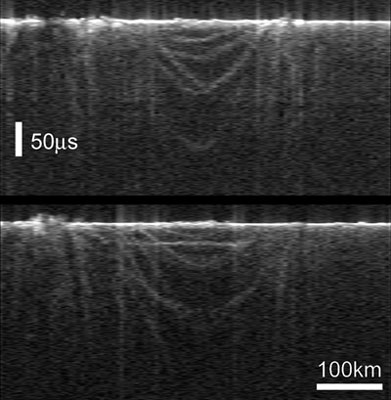 La posizione del cratere 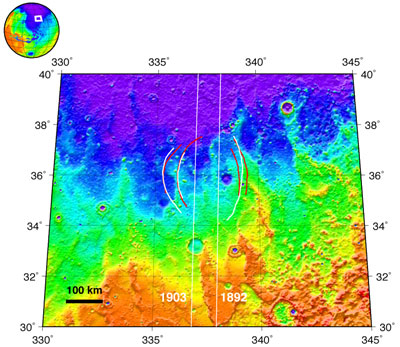 Tratto da: http://www.spaceref.com/news/viewpr.html?pid=18411 |
|
|
|
|
|


| Strumenti | |


|
|

Tutti gli orari sono GMT +1. Ora sono le: 11:43.