


|
|||||||


|


|
|
 |
|
|
Strumenti |
 16-04-2005, 20:15
|
#41 |
|
Senior Member

Iscritto dal: Nov 2001
Città: Padova
Messaggi: 1638
|
NASA managers elated with shuttle fueling test
BY WILLIAM HARWOOD STORY WRITTEN FOR CBS NEWS "SPACE PLACE" & USED WITH PERMISSION Posted: April 14, 2005  Space shuttle Discovery undergoes the special tanking test at pad 39B today. Credit: NASA TV/Spaceflight Now The space shuttle's redesigned fuel tank sailed through a critical tanking test today, giving NASA managers increased confidence about launching Discovery on the first post-Columbia shuttle mission next month. "We had an outstanding day today," said Wayne Hale, deputy manager of the shuttle program and chairman of NASA's mission management team. "After a long period of preparation, we're beginning to see our operations come to fruition. "Today, we saw the newly modified external tank perform in an outstanding manner, we saw Discovery, which has gone through about three years of modifications, perform in an outstanding manner. And I have to also say the launch pad, the facility, which has gone through a major modification and extensive re-work, performed almost without flaw of any consequence." Engineers pumped more than 500,000 gallons of supercold rocket fuel into Discovery's external tank today and then monitored the tank and the shuttle's systems down to the T-minus 31-second mark in a mock countdown. It was the first such tanking operation since Columbia's launch Jan. 16, 2003. "Today's test was a major milestone," said launch director Mike Leinbach. "The next one is launch, and I'm really looking forward to that one." The goals of the exercise were to give the launch team a chance to rehearse launch-day procedures, to verify the operation of critical launch pad systems and to demonstrate the tank's foam insulation could stand up to the stress of ultra-low temperatures without any major ice buildups. During a debris verification review late last week, engineers discussed all possible sources of launch debris and retired all but three. The remaining open items involve the possibility of ice buildups around liquid oxygen feed line fittings near the so-called intertank region and pressurization line support fittings at the tip of the tank. Post-Columbia impact testing shows even small pieces of ice, shaking off during launch, could cause serious damage to the shuttle's wing leading edge panels or its nose cap. Columbia was destroyed during re-entry Feb. 1, 2003, because of damage done by the impact of foam insulation during launch 16 days earlier. The insulation has now been been modified to minimize such debris shedding. During today's test, ice buildups in the areas of concern were minimal and Hale said engineers are hopeful additional testing will close the remaining open items on the debris impact list. "Ice is a biggie," Hale said. "One of the things we were very interested to look at today was the performance of the tank and ice growth on the tank," Hale said. "It performed very well, that is heartening news. But that is not all the story. "We're doing some testing at Redstone Arsenal and other places regarding the potential for ice to shed off the tank during the ascent and we think there are a number of ways we're going to come to a good conclusion on that. But there is work remaining before us on that." Discovery's launch window opens May 15 and closes June 3. The next window opens July 13. Leinbach said now that the tanking test is over, the pad processing flow is fairly standard with no other unusual tests. Between now and May 15, he said, the pad processing flow includes three days with no work planned. "That's good news for us," he said. "Even better news for us is the test we performed today was the last non-standard activity we have at the launch pad. From here on out, it's standard pad processing. ... From here on out the rest of the pad flow is well understood. The fact that we have 'just' three days, if you want to say it that way, is not that bad." But the time needed to resolve the remaining debris concerns forced NASA, in part, to delay a planned design certification review from Friday to next Tuesday. Another debris review is planned late next week and that information must then flow into NASA's flight readiness review process and to an independent panel charged with monitoring NASA's implementation of post-Columbia safety upgrades. The review panel, headed by former Apollo astronaut Thomas Stafford and former shuttle commander Richard Covey, had hoped to present its final report to NASA's administrator a full month before launch to give the agency time to respond. That no longer appears plausible, but no firm dates have been set. Hale would not speculate on when the work might get finished, saying only that NASA will not launch Discovery until it is safe to do so. But he was clearly encouraged by the results of today's tanking test. "Both the debris verification review, the upcoming design certification review and the tanking test that we did today are key items on the way to being ready to go fly," he said. "We're not done yet, but these are key things that we needed to get accomplished. We're whittling down the to-do list of things we must do before we can we can certify the vehicle for flight readiness."
__________________
Cosmos Pure | Core i7 860 | P7P55D-E Deluxe | 16GB DDR3 Vengeance | HD5850 | 2x850PRO 256GB | 2xRE3 250GB | 2xSpinPoint F3 1TB |

|

|
|
20-04-2005, 22:54
|
#42 |
|
Senior Member
Iscritto dal: Nov 2001
Città: Padova
Messaggi: 1638
|
WEDNESDAY, APRIL 20, 2005
1956 GMT (3:56 p.m. EDT) NEW DATE. NASA has set Sunday, May 22 as the new target launch date for space shuttle Discovery. Liftoff on that day will be approximately 1:03:49 p.m. EDT. The one-week delay gives the space agency more time to complete final reviews and analysis in the run-up to the returning the shuttle fleet to flight. We'll be updating all of our pages noted in the left-hand column of the Mission Status Center -- the flight plan, mission timelines, etc. -- to reflect the new launch date. Da http://www.space.com/missionlaunches...14_delay.html: NASA Delays First Post-Columbia Launch By Tariq Malik Staff Writer posted: 20 April 2005 05:47 pm ET NASA has pushed back the date for its first space shuttle launch since the Columbia tragedy, delaying the flight one week to allow more time to complete much-needed paperwork and analyses, the space agency said Wednesday. The Discovery orbiter and its STS-114 crew will launch no-earlier than May 22, shuttle program manager Bill Parsons said during a teleconference with reporters. Previously, NASA officials had set the opening of Discovery’s launch window at May 15. “The May 15 launch date was just a target and we always knew that we would have to revisit it,” Parsons said, adding that the shuttle will be launched when it is ready and not on a deadline. The decision to reschedule Discovery’s launch window was already under discussion going into the mission’s design certification review meeting Tuesday, shuttle officials said “It was obvious that … there was still a certain amount of analysis that needed to be done, of paperwork that needed to be done,” Parsons said. The launch delay will allow time for NASA to complete a final debris verification review for Discovery’s flight next week and perform additional launch load analyses for the shuttle’s new orbital boom - a sensor-laden system that the STS-114 crew will use to scan their protective thermal protection tiles for damage. Parsons said the additional time will also allow shuttle officials to deliver paperwork to the Stafford-Covey Return to Flight Task Force, an independent panel evaluating the space agency’s launch preparations. The task force postponed a late-March meeting due to the need for paperwork. “We’re hoping to present to them on the 4th, 5th and 6th of May,” he said, adding that a flight readiness review meeting is scheduled for May 10. A long effort NASA has spent more than two years redesigning orbiter components and developing new tools and procedures to enhance space shuttle safety. Discovery’s STS-114 mission, a test flight, is NASA’s first opportunity to shakedown those modifications. Among those changes – and one reason for Discovery’s initial May 15 to June 3 launch window - is a flight rule calling for a daylight launch and well-lit conditions external fuel tank separation. Discovery only has one, five-minute period in which to lift off during each launch window day, though shuttle officials are confident that they step up to the task. Wayne Hale, NASA’s deputy shuttle program manger, said that all of Discovery’s lighting restrictions will be aided by a new plan to reboost the space station in its orbit. “It’s very fortunate that the orbital mechanics worked out that way,” Hale said of the station’s reboost, during which it will burn propellant. “It not only sets us up for the launch window, but also prepares the station for a Progress cargo rendezvous in June.” More time for training Discovery’s launch delay will give mission managers time to conduct one last simulation of the spaceflight and help lighten some of the training requirements for the STS-114 crew. “Their [training] schedule was trending toward the higher side of what we allow,” Hale said. “Over the next few days the crew is going to take advantage of that extra time and get rest for launch.” A dress rehearsal of Discovery’s launch countdown is slated for May 4.
__________________
Cosmos Pure | Core i7 860 | P7P55D-E Deluxe | 16GB DDR3 Vengeance | HD5850 | 2x850PRO 256GB | 2xRE3 250GB | 2xSpinPoint F3 1TB |
|
|
|
|
07-05-2005, 14:25
|
#43 |
|
Senior Member
Iscritto dal: Nov 2001
Città: Padova
Messaggi: 1638
|
Discovery will switch to new fuel tank before July blastoff
BY WILLIAM HARWOOD STORY WRITTEN FOR CBS NEWS "SPACE PLACE" & USED WITH PERMISSION NASA managers today decided to stage a second tanking test next weekend or shortly after to troubleshoot problems with the shuttle Discovery's external fuel tank. The shuttle then will be hauled back to the Vehicle Assembly Building where engineers will attach the ship to a different set of boosters and a fresh external tank, officials said late today. The shuttle will be returned to the launch pad in mid June for launch on the first post-Columbia mission around July 13, the opening of the next available space station launch window. But that date could slip if program managers order yet another tanking test after rollout to verify the performance of the new fuel tank. NASA had hoped to launch Discovery on the first post-Columbia mission this month, but managers decided last week to delay the flight to the July window because of lingering concerns about the potential threat of ice on the external fuel tank and because of two problems that cropped up during a tanking test April 14. The ice issue will be addressed by a heater around a liquid oxygen feedline bellows assembly similar to the one used to prevent ice buildups on the struts holding the nose of the shuttle to the external tank. The other two issues with the current tank are more subtle. During the tanking test last month, two of four hydrogen sensors inside the tank, which are used to control the main engine shutdown sequence when the shuttle reaches space, failed to operate properly. Engineers have not yet pinned down what caused the problem, but all four must be operational for a launch to proceed. In addition, a valve used to bleed off pressure in the hydrogen tank cycled more often than usual. NASA managers spent the week debating a variety of processing options, including whether to stick with the current tank, whether to carry out one or two additional tanking tests and whether to swap out Discovery's tank and boosters for a set being assembled for the second post-Columbia flight (STS-121). During a meeting late today, shuttle managers decided to implement a version of the latter scenario. Here is a timeline of major processing milestones (dates are approximate "no earlier than" targets and as such should be taken with a grin of salt):
* Discovery's rollback depends on when the new tank/booster stack is completed. Engineers hope to finish the work ahead of schedule, allowing them to move rollback up by several days or more. Before Discovery is returned to the pad, engineers must decide whether an additional tanking test is needed to verify the performance of the new tank. Such a test would add several days to the processing schedule, pushing launch to around July 18. But if the test is not required, July 13 remains a viable launch target. Discovery's launch window opens July 13 and closes July 31. The next launch window opens Sept. 9 and closes Sept. 24. A three-day window is available Nov. 8-10, a four-day window opens Jan. 4 and a lengthy window opens March 3 and closes March 19. The launch window is based on an internal NASA requirement to launch at least the first two post-Columbia missions in daylight. But the issue is complicated by a requirement to also ensure the external tank separates half a world away in enough light to allow documentary photography. To reach the space station, the shuttle must launch within five minutes of the moment Earth's rotation carries the launch pad into the plane of the station's orbit. When all of those requirements are met, along with others involving temperature constraints on the station, only a limited number of launch windows is available. Engineers assess space shuttle launch schedule BY WILLIAM HARWOOD STORY WRITTEN FOR CBS NEWS "SPACE PLACE" & USED WITH PERMISSION Posted: May 4, 2005 The shuttle Discovery's crew strapped in today for a dress rehearsal countdown while program managers continued assessing what work needs to be done - and whether it can be completed in time - for a July 13 launch attempt.  Space shuttle Discovery and her crew undergo a countdown rehearsal at pad 39B today. Credit: NASA TV/Spaceflight Now In a traditional pre-flight milestone, commander Eileen Collins, pilot James Kelly, Stephen Robinson, Soichi Noguchi, Andrew Thomas, Wendy Lawrence and Charles Camarda donned their bright orange pressure suits and began climbing aboard Discovery shortly after 8 a.m. EDT (1200 GMT). The countdown proceeded to the T-minus four-second mark when it ended with a simulated abort and main engine shut down at 11 a.m. EDT (1500 GMT). The test went smoothly and other than a minor communications glitch caused by a switch in the wrong position, no major problems were encountered. "We had a very successful test. It felt to me like it was a real launch day," Collins told reporters this afternoon.The terminal countdown demonstration test, or TCDT, was already scheduled when NASA managers last week decided to delay the first post-Columbia mission from May 22 to no earlier than July 13, the opening of the next available space station launch window. The launch delay was ordered because of concern about the possibility of ice buildups around a bellows assembly that allows the external tank's 17-inch-wide liquid oxygen line to flex slightly during fueling and launch. At issue is whether such ice could break off and damage the shuttle's heat-shield tiles or wing leading edge panels during ascent. Wanting more time to assess the overall ice threat, and to install a heater on the liquid oxygen feedline bellows, program managers opted to delay launch. They also needed more time to troubleshoot two potentially serious problems that cropped up during a test April 14 when the external tank was loaded with a half-million gallons of supercold rocket fuel. Two of four sensors in the liquid hydrogen tank that detect low levels and help control the engine shutdown sequence failed to operate properly. In addition, a pressure relief valve cycled more often than expected, indicating a problem of some sort in another system. The feedline bellows heater assembly must be installed back at the Vehicle Assembly Building. But engineers have not yet decided when to move Discovery off its oceanside launch pad. They are considering another tanking test before rollback to gather additional data on the fuel depletion sensors and the relief valve. They also are considering whether to move Discovery to a different set of boosters and a fresh external fuel tank currently being assembled for the second post-Columbia mission. The tank for that mission includes additional instrumentation not available in Discovery's current tank. As of this writing, no such decisions have been made. But given the amount of work left to do, sources say it will be difficult to meet the July 13 launch target.
__________________
Cosmos Pure | Core i7 860 | P7P55D-E Deluxe | 16GB DDR3 Vengeance | HD5850 | 2x850PRO 256GB | 2xRE3 250GB | 2xSpinPoint F3 1TB Ultima modifica di GioFX : 07-05-2005 alle 14:29. |
|
|
|
|
07-05-2005, 15:23
|
#44 |
|
Senior Member

Iscritto dal: Jun 2001
Città: Treviso
Messaggi: 1158
|
uffa, ancora a rimandare!

__________________
Non ho niente altro da offrire alle altre persone, se non la mia stessa confusione something cold is creepin' around, blue ghost is got me, I feel myself sinkin' down L'arte non insegna niente, tranne il senso della vita |
|
|
|
|
20-05-2005, 11:07
|
#45 |
|
Senior Member
Iscritto dal: Nov 2001
Città: Padova
Messaggi: 1638
|
Another shuttle fueling test scheduled for Friday
BY WILLIAM HARWOOD STORY WRITTEN FOR CBS NEWS "SPACE PLACE" & USED WITH PERMISSION Posted: May 19, 2005 NASA's launch team readied the shuttle Discovery today for a second fueling test Friday to help find the cause of two vexing problems that cropped up during a similar test in April. Other shuttle engineers, meanwhile, are assessing a clearance issue between the shuttle's main Ku-band TV antenna and a new on-orbit inspection boom that could delay the transmission of post-launch images of the ship's redesigned external tank. As part of NASA's post-Columbia safety upgrade program, a 50-foot-long boom equipped with a television camera and laser sensors was installed on the right, or starboard, side of Discovery's cargo bay. The boom, picked up by the shuttle's robot arm in orbit, will be used to inspect Discovery's wing leading edge panels and heat shield tiles for any signs of launch impact damage. Just in front of the orbiter boom sensor system, or OBSS, on the starboard sill of the cargo bay is the shuttle's Ku-band dish antenna, which is used to send high-speed data and television signals from the orbiter to the ground via NASA communications satellites. Once in orbit, the antenna is deployed by swinging it out over the side of the cargo bay sill so it can lock onto and track the appropriate satellite. The antenna normally is deployed on the first day of a shuttle mission and in Discovery's case, flight controllers were counting on a flight day 1 deploy to downlink photographs of the external tank to look for signs of foam shedding. But an analysis of clearances between the antenna and the OBSS shows that as the dish swings out, it could come within six tenths of an inch of the forward end of the boom, sources said. And that doesn't include the boom's insulation blankets. That tiny margin could shrink to just three tenths of an inch in orbit due to thermal issues. The shuttle Atlantis has a similar problem. No one wants to risk damage to the Ku-band antenna, which is critical to the conduct of a mission, and NASA managers plan to meet next week to reassess the matter. But neither the boom nor the antenna can be easily repositioned. Barring a dramatic change, Discovery's crew could be forced to delay deployment of the Ku-band antenna until the second day of the mission, after the OBSS has been picked up by the robot arm. While downlink of external tank video and photographs would be delayed by one day, officials said the overall impact would be relatively minor. And it would not affect transmission of data from new wing leading edge sensors using the shuttle's S-band radio system on flight day 1. The clearance issue could have a more noticeable impact toward the end of the mission. Managers are debating two possible options: Stowing the antenna before Discovery undocks from the international space station or stowing the OBSS prior to undocking and then redeploying it the day before entry to re-stow the antenna. The first option would end normal television from the shuttle for the remainder of the flight while the second option would add complexity and additional failure scenarios. Agency officials do not yet know why the clearance issue took so long to come to light. A contractor analysis earlier this year concluded there was more than an inch of clearance and as such, no problem. But measurements carried out by the astronaut office showed the actual clearance was half the earlier estimate. The shuttle was designed so a robot arm could be installed on either side of the cargo bay. The OBSS was installed using those pre-existing mounting points. In that sense, the clearance problem has been there ever since the shuttle was built. But NASA never mounted anything on that side of the bay before the OBSS aboard Discovery. The clearance issue is just one of several nagging problems facing the shuttle launch team as it readies Discovery for takeoff on the first post-Columbia mission. Launch currently is targeted for July 13, the opening of a window that extends through July 31. Launch had been planned for May 22, but the flight slipped to the July window because of late-breaking concerns about ice formation on the external tank, and its potential for impact damage during ascent, and because of problems that were noticed during a tanking test April 14. During that exercise, two of four fuel depletion sensors, also known as engine cutoff sensors, in the liquid hydrogen tank failed to operate properly. In addition, a hydrogen pressure relief valve cycled more often than normal. The cutoff sensors are used to make sure the shuttle's three main engines do not run out of hydrogen while running, which would cause a potentially catastrophic oxygen-rich shut down. All four sensors are required to be operational for a countdown to proceed. As for the relief valve, it operated within specification but its behavior was clearly unusual and engineers want to understand why. One possible explanation involves the operation of a new post-Columbia heater installed at the base of the bipod struts that hold the nose of the shuttle to the tank. NASA managers earlier decided to move Discovery back to the Vehicle Assembly Building and attach it to a tank and booster set being prepared for the second post-Columbia flight. That tank will be equipped with a new heater to ease concerns about ice buildups on an oxygen feedline bellows assembly. Still unresolved is what to do about potential ice buildups on brackets near the top of the tank. Engineers have suggested using infrared spotlights to prevent or minimize ice formation, but additional tests are required to determine the plan's feasibility. In the meantime, NASA managers ordered a second tanking test Friday to collect additional data before Discovery is moved back to the Vehicle Assembly Building. The currently-installed bipod heaters will be on for part of the test and then turned off to find out whether the heaters influence the operation of the pressure relief valve. Here is a tanking test timeline (all times in EDT): May 19 08:00 p.m....Rotating service structure retraction 11:30 p.m....Final loading preps begin May 20 02:30 a.m....Pad cleared of personnel 04:00 a.m....Mission management team meets for go/no-go decision 04:30 a.m....Begin a 1-hour built-in hold 05:30 a.m....Resume countdown 05:30 a.m....Begin propellant line chilldown (fueling begins) 08:30 a.m....Fueling complete; stable replenish mode begins 08:30 a.m....Begin a 1-hour 45-minute built-in hold 10:15 a.m....Resume countdown with bipod heater on 01:35 p.m....Countdown is stopped at T-minus 31-second mark 01:35 p.m....Recycle countdown to T-minus 20-minute mark 01:45 p.m....Resume countdown with bipod heater off 02:45 p.m....Final cutoff at T-minus 31-second mark 02:45 p.m....Begin propellant drain back and boiloff May 21 03:00 p.m....Rotating service structure moved back around shuttle The launch team plans to test fire one of Discovery's three auxiliary power units, which generates the ship's hydraulic power, on May 23. The next day - May 24 - the orbiter will be moved back to the Vehicle Assembly Building for attachment to the new tank and boosters on June 7. Discovery's space station cargo is scheduled to be moved to launch pad 39B on June 9 with Discovery following suit on June 14. If all goes well, the shuttle will be ready for launch July 13 as currently planned. But engineers are still debating whether to stage a third tanking test to make sure the new tank operates normally when loaded with a half-million gallons of supercold propellants. If a separate, stand-alone test is required it likely would be staged around June 22, setting the stage for a launch attempt around July 19. But some engineers have suggested extending Discovery's countdown and inserting a tanking test a few days before the July 13 launch target. A decision on whether to stage a third tanking test is expected early next month.
__________________
Cosmos Pure | Core i7 860 | P7P55D-E Deluxe | 16GB DDR3 Vengeance | HD5850 | 2x850PRO 256GB | 2xRE3 250GB | 2xSpinPoint F3 1TB |
|
|
|
|
20-05-2005, 23:11
|
#46 |
|
Senior Member
Iscritto dal: Nov 2001
Città: Padova
Messaggi: 1638
|
NASA Chief to KSC: Shuttles' End is Coming
By Chris Kridler FLORIDA TODAY posted: 20 May 2005 03:57 pm ET CAPE CANAVERAL, Fla. - New NASA administrator Mike Griffin, visiting Kennedy Space Center today, made it clear the shuttle would be replaced, and soon. "I report to the president," he told journalists. "The president has said we’re retiring the orbiter by 2010, and that’s what we’re doing." The agency should have a transition plan ready by summer’s end, he said, that would outline how much of the International Space Station might actually be finished by the time the shuttles are done. As a replacement for the shuttles is built, some jobs inevitably will change at Kennedy Space Center, and some will be lost, he said. "Not everyone will transition," he said. "One of the main issues with the orbiter is how much it takes to care and feed the fleet." Griffin also spoke with employees, acknowledging that for some, the transition wouldn’t be fun. "You enter a period where you need to watch out for yourself, and you need to look out for new opportunities." The space program has to evolve, he said. His goal is to narrow the gap between the end of the shuttles and the launching of the next ship. "If it takes more than five years, then it does," Griffin said. "It will take what it takes." He said this was one of several visits he has made to KSC over the years while working with rockets and shuttle payloads, and it’s "the greatest place in the world to be. Wish I could figure out a way to put NASA headquarters here."
__________________
Cosmos Pure | Core i7 860 | P7P55D-E Deluxe | 16GB DDR3 Vengeance | HD5850 | 2x850PRO 256GB | 2xRE3 250GB | 2xSpinPoint F3 1TB |
|
|
|
|
08-06-2005, 23:17
|
#47 |
|
Senior Member
Iscritto dal: Nov 2001
Città: Padova
Messaggi: 1638
|
NASA nixes third tanking test for shuttle Discovery
BY WILLIAM HARWOOD STORY WRITTEN FOR CBS NEWS "SPACE PLACE" & USED WITH PERMISSION Posted: June 6, 2005 NASA managers today ruled out a third tanking test for the shuttle Discovery, keeping launch of the first post-Columbia mission on target for July 13. The launch window extends to July 31 and as of this writing, engineers have five days of contingency time in the launch processing schedule to handle unexpected problems between now and the opening of the window. Space shuttle Discovery is lowered to the ground after being removed from its original external tank and solid rocket boosters. Credit: NASA-KSC Still to come: final disposition of questions about the risk posed by ice debris during launch; a final report by the Stafford-Covey Return to Flight Task Group regarding NASA's implementation of post-Columbia safety upgrades; and a formal flight readiness review to clear Discovery for flight. The debris verification review, which will quantify the threat posed by ice debris based on a flurry of recent tests and extensive analysis, is targeted for June 24, followed by the Stafford-Covey group's final meeting and the two-day flight readiness review, which will be held at the Kennedy Space Center. Among the debris threats still on the table is the question of possible ice buildups around brackets near the top of the external tank. Assuming no show stoppers emerge during the meetings later this month, commander Eileen Collins and her crew will fly to Kennedy July 9 for the start of the countdown to blastoff of the 114th shuttle mission. Liftoff July 13 is targeted for 3:51 p.m. EDT (1951 GMT). NASA had hoped to launch Discovery in May, but problems cropped up during a fueling test April 14 that contributed to a decision to delay the flight to mid July. During that test, two of four liquid hydrogen fuel depletion sensors (also known as engine cutoff sensors) failed to operate properly and a pressure relief valve that helps maintain hydrogen tank pressurization in the final two minutes of the countdown cycled more often than usual. At the same time, the ongoing ice debris verification review raised questions about potentially dangerous buildups of ice around a liquid oxygen feedline bellows assembly that could shake off during launch and damage the shuttle's fragile heat shield tiles or wing leading edge panels. NASA managers ultimately decided to delay launch and to move Discovery to a different set of boosters and a modified external tank equipped with a heater on the feedline bellows to prevent ice formation. Engineers are still debating the threat posed by ice around brackets at the top of the tank. The new tank also features an older-style single-screen diffuser, which injects a jet of helium gas into the hydrogen tank to help keep the supercold fuel circulating at the proper temperature. It also provides the pressurization needed after the tank is isolated from ground systems one minute 52 seconds prior to launch. Engineers believe the unusual valve cycling during the April 14 tanking test was due to a newer style dual-screen diffuser. During the April 14 test and a second tanking test May 20, the valve cycled 13 times. Based on past experience, it was expected to cycle eight or nine times. By switching back to the older single-screen diffuser, engineers are confident the problem will not recur during the launch countdown. But testing continues to make sure. As for the engine cutoff sensors, NASA managers now believe the intermittent operation in April most likely was do to a wiring issue that was resolved during troubleshooting. The sensors worked properly during the May 20 tanking test and engineers believe the sensors in Discovery's new tank will behave normally as well.
__________________
Cosmos Pure | Core i7 860 | P7P55D-E Deluxe | 16GB DDR3 Vengeance | HD5850 | 2x850PRO 256GB | 2xRE3 250GB | 2xSpinPoint F3 1TB |
|
|
|
|
08-06-2005, 23:53
|
#48 |
|
Senior Member
Iscritto dal: Nov 2001
Città: Padova
Messaggi: 1638
|
__________________
Cosmos Pure | Core i7 860 | P7P55D-E Deluxe | 16GB DDR3 Vengeance | HD5850 | 2x850PRO 256GB | 2xRE3 250GB | 2xSpinPoint F3 1TB Ultima modifica di GioFX : 09-06-2005 alle 00:00. |
|
|
|
|
30-06-2005, 23:12
|
#49 |
|
Senior Member
Iscritto dal: Nov 2001
Città: Padova
Messaggi: 1638
|
ITS OFFICIAL! LAUNCH DATE SET FOR JULY 13TH
THURSDAY, JUNE 30, 2005 NASA has cleared the Space Shuttle to Return to Flight. After a two-day Flight Readiness Review meeting at NASA's Kennedy Space Center in Florida, senior managers approved a July 13 launch date for Discovery. Commander Eileen Collins and her crew are scheduled to lift off at 3:51 p.m. EDT on the first U.S. space flight since the February 2003 loss of the Shuttle Columbia. "After a vigorous, healthy discussion our team has come to a decision: we're ready to go," NASA Administrator Michael Griffin said after the meeting. "The past two and half years have resulted in significant improvements that have greatly reduced the risk of flying the Shuttle. But we should never lose sight of the fact that space flight is risky. "The Discovery mission, designated STS-114, is a test flight," Griffin said, noting that astronauts will try out a host of new Space Shuttle safety enhancements. In addition, Discovery will carry 15 tons of supplies and replacement hardware to the International Space Station. July 13 is the beginning of three weeks of possible launch days that run through July 31. NASA's Associate Administrator for Space Operations, William Readdy, chaired the Flight Readiness Review, the meeting that traditionally sets launch dates and assesses the Shuttle's fitness to fly. "Today's decision is an important milestone in returning the Shuttle to service for the country. Our technical and engineering teams are continuing their in-depth preparations to ensure that Eileen and her crew have a successful mission," he said.
__________________
Cosmos Pure | Core i7 860 | P7P55D-E Deluxe | 16GB DDR3 Vengeance | HD5850 | 2x850PRO 256GB | 2xRE3 250GB | 2xSpinPoint F3 1TB |
|
|
|
|
30-06-2005, 23:15
|
#50 |
|
Senior Member
Iscritto dal: Nov 2001
Città: Padova
Messaggi: 1638
|
Da Space.com:
Shuttle Launch Set for July 13 By Tariq Malik Staff Writer posted: 30 June 2005 4:45 p.m. ET NASA’s first space shuttle to fly since the Columbia disaster will launch as planned on July 13, shuttle officials said Thursday. After more than two years of training and re-training, the seven astronauts of NASA’s STS-114 mission are now set to ride the space shuttle Discovery spaceward as soon as their 19-day launch window opens. “We are currently go for launch on July 13,” said NASA chief Michael Griffin during a press conference at Kennedy Space Center in Cape Canaveral, Florida. Griffin and other shuttle program and launch managers announced the decision after a two-day flight readiness review. “It’s just an outstanding day to be this close to get the shuttle flying again,” said NASA launch director Michael Leinbach told reporters. “It’s a great, great feeling.” NASA’s three remaining space shuttles have been grounded since Feb. 1, 2003, when the Columbia orbiter broke apart as it reentered the Earth’s atmosphere, killing its seven-astronaut crew. The orbiter's heat-resistant skin was damaged at liftoff by a chunk of external tank insulation foam, which punctured its left wing leading edge and allowed hot atmospheric gases to enter during reentry, investigators later found. Earlier this week, an independent task group found that NASA was unable to meet three of the 15 recommendations Columbia investigators believed should be addressed before the agency launched its next shuttle flight. The task group said NASA is still unable to completely prevent orbiter damage from ice or foam debris at launch, and that its on-orbit shuttle repair techniques were still too nascent to be considered reliable. Griffin and other NASA shuttle officials said the space agency has managed to lower those risks for Discovery’s flight. Discovery’s STS-114 flight, commanded by veteran astronaut Eileen Collins, will culminate two and a half years of redesigns and modifications to enhance orbiter and external tank safety. “We went literally from stem to stern on the vehicle…to make sure that we did come back smarter and surer of a safe result,” said Bill Parsons, NASA’s shuttle program manager, during the briefing. Griffin said the he spent almost two hours speaking with Collins and her crew about the launch decision. “The crew is go for launch, and they want us to be go for launch,” Griffin said. “They want to return to flight, but they don’t want us to rush to flight.”
__________________
Cosmos Pure | Core i7 860 | P7P55D-E Deluxe | 16GB DDR3 Vengeance | HD5850 | 2x850PRO 256GB | 2xRE3 250GB | 2xSpinPoint F3 1TB Ultima modifica di GioFX : 30-06-2005 alle 23:17. |
|
|
|
|
08-07-2005, 21:37
|
#51 |
|
Senior Member
Iscritto dal: Nov 2001
Città: Padova
Messaggi: 1638
|
NASA News release
LCD Timeline Launch-3 Days (Sunday, July 10): Countdown begins at the T-43 hours (6 p.m.) Launch-2 Days (Monday, July 11) Remove mid-deck and flight-deck platforms (2 a.m.); Complete preparation to load power reactant storage and distribution system (5 a.m.); Activate and test navigational systems (7 a.m.); Flight deck preliminary inspections complete (10 a.m.) Enter first built-in hold at T-27 hours for four hours (10 a.m.) Resume countdown (2 p.m.); Begin loading of cryogenic reactants into Discovery's fuel cell storage tanks (3:30 p.m.) Enter 4-hour built-in hold at T-19 hours (10 p.m.) Launch-1 Day (Tuesday, July 12) Resume countdown (2 a.m.); Final preparations of Shuttle's three main engines for tanking and flight (2 a.m.); Fill pad sound suppression system water tank (3 to 6 a.m.) Enter planned hold at T-11 hours for 12 hours, 55 minutes (10 a.m.); Begin star tracker functional checks (10:50 a.m.); Move Rotating Service Structure to the park position (7 p.m.) Resume countdown at T-11 hours (11 p.m.) Launch Day (Wednesday, July 13) Enter planned 2-hour built-in hold at T-6 hours (3:55 a.m.); Verification of launch commit criteria prior to cryogenic loading of External Tank(ET) Resume countdown (5:55 a.m.) Begin load ET with 500,000 gallons of cryogenic propellants (approx. 6:05 to approx. 8:55 a.m.); Final Inspection Team to launch pad Enter planned 3-hour built-in hold at T-3 hours (8:55 a.m.); Perform inertial measurement unit preflight calibration; Align Merritt Island Launch Area tracking antennas Resume countdown at T-3 hours (11:55 a.m.) Crew departs Operations and Checkout Building for the pad (12 p.m.); Crew entry into orbiter (approx. 12:30 p.m.); Crew air-to-ground voice checks with Launch and Mission Control; Close Discovery's crew hatch (about 1:35 p.m.) Enter planned 10-minute hold at T-20 minutes (2:35 p.m.); NASA Test Director conducts final launch team briefings; inertial measurement unit preflight alignments Resume countdown at T-20 minutes (2:45 p.m.); Transition the orbiter's onboard computers to launch configuration; backup flight system to launch configuration Enter estimated 40-minute hold at T-9 minutes (2:56 p.m.); Launch director, Mission Management Team and NASA test director conduct final polls for go/no go to launch Resume countdown at T-9 minutes (about 3:36 p.m.) (more likly resume at 3:42 to launch in plane) Start automatic ground launch sequencer (T-9:00 minutes); Retract orbiter crew access arm (T-7:30); Ignition of three Shuttle main engines (T-6.6 seconds); ignition and liftoff (T-0) STS-114 CREW & LAUNCH DAY ACTIVITIES (TV events (#)-times may vary) Commander Eileen Collins; pilot James Kelly; payload commander Soichi Noguchi; mission specialists Stephen Robinson, Andrew Thomas, Wendy Lawrence, Charles Camarda 5:45 a.m. Crew wake up; 6:15 a.m. Breakfast #10:15 a.m. Crew snack #11:20 a.m. Weather Briefing #11:20-11:50 a.m. Don flight suits #12:00 p.m. Depart for launch pad #12:30 p.m. Arrive at white room; begin entering Shuttle #1:45 p.m. Close crew hatch #3:51 p.m. Launch For NASA TV schedules, viewing and information on the Web, visit: http://www.nasa.gov/ntv
__________________
Cosmos Pure | Core i7 860 | P7P55D-E Deluxe | 16GB DDR3 Vengeance | HD5850 | 2x850PRO 256GB | 2xRE3 250GB | 2xSpinPoint F3 1TB |
|
|
|
|
10-08-2005, 13:13
|
#52 |
|
Moderatrice

Iscritto dal: Nov 2001
Città: Vatican City *DILIGO TE COTIDIE MAGIS* «Set me as a seal on your heart, as a seal on your arm: for love is strong as death and jealousy is cruel as the grave.»
Messaggi: 12406
|
Lo Shuttle atterra ma la Nasa sospende le missioni
La navicella dopo due settimane di timori è rientrata alla base militare di Edwards in California. I responsabili del programma: «Non possiamo prevedere quando l’uomo tornerà a volare» 10 Agosto 2005 di Maurizio Molinari NEW YORK. Con alle spalle tredici giorni di test nello spazio il «Discovery» è atterrato ieri sulla pista della base aerea di Edwards, in California, portando a compimento la prima missione del programma Shuttle dopo il disastro del «Columbia», avvenuto due anni e mezzo fa. Superati i timori di danni alle piastrelle termiche che proteggono la navetta grazie a tre passeggiate spaziali, la navicella comandata da Eileen Collins ha vissuto il suo ultimo brivido quando è entrata nell'atmosfera sopra le Isole Cook trovandosi obbligata da una forte tempesta a rinunciare all'arrivo in Florida di prima mattina per atterrare piuttosto a Edwards allorché in California era ancora buio. Quando le ruote si sono fermate il centro di controllo ha salutato l'equipaggio con un «congratulazioni per il volo spettacolare, benvenuti a casa, amici» ed il comandante ha replicato: «Siamo felici di essere tornati, grazie a tutti per il lavoro ben fatto». Il top manager del programma Shuttle, Bill Parson, ha ricordato gli astronauti (sei americani ed un israeliano) che morirono nell'ultima missione: «Portando a casa in salvo il Discovery oggi abbiamo reso omaggio all'equipaggio del Columbia». Due ore dopo è stata Eileen Collins a prendere la parola, con gli altri sei membri dell'equipaggio (tutti americani tranne un giapponese) schierati alle sue spalle, definendo «fantastiche» le condizioni del «Discovery». Ed il presidente George W. Bush da Crawford ha parlato di un «grande risultato». Ma durante le ultime ore il personale tecnico della Nasa era stato con il fiato sospeso: «C'è stata ansia durante l'intera giornata - sono state le parole di LeRoy Cain, direttore dei voli - ed abbiamo avuto un paio di anomalie che si sono rivelate insignificanti». Alla fine tutti i riflettori sono stati per il comandante. Cinquantanove anni, nata a Elmira, New York, ex colonnello dell'Us Air Force ed appassionata di golf, letture e fotografia è stata proprio Eileen Collins la protagonista del volo a cui la Nasa ha affidato il salvataggio del programma Shuttle. Lei ha risposto alla sfida unendo le capacità operative e l'esperienza dello spazio - nel 1993 comandò proprio il «Columbia» diventando la prima donna ad aver mai pilotato uno Shuttle fuori dall'atmosfera - ad una notevole abilità nella comunicazione. Quando dopo il decollo si scoprì che sotto la pancia del «Discovery» qualche piastrella termica poteva essersi staccata è stata lei a rassicurare l'America, offrendo in diretta tv il sorriso casalingo unito ad un forte carattere. E quando alla vigilia della terza passeggiata spaziale è stato Bush a chiamarla per rendere omaggio al «coraggio di chi rischia per continuare l'esplorazione dello spazio» è stata ancora lei a ringraziare cordialmente, facendo sapere che era arrivato il momento di rimettersi a lavoro. La madre, Rose Marie Collins, non ha mai dubitato che Eileen ce l'avrebbe fatta a riportare sulla Terra la navicella ed allontanare l'incubo di una nuova tragedia. Ed allorché la Nasa ha comunicato che l'atterraggio sarebbe avvenuto in California, mentre i grandi network commentavano il cambiamento di programma con allarme, la signora Rose Marie spiegava tranquillamente alle agenzie di stampa che lo Shuttle era in una botte di ferro perché la figlia conosceva «a memoria» la pista di Edwards per esserci atterrata più volte ai comandi di aerei cargo C-141 quando vestiva la divisa dell'Us Air Force. A Rochester, dove Marie Rose vive, tutti conoscono bene quanto sia saldo il rapporto fra madre e figlia, confermato da uno scambio di email avvenuto tre giorni fa. Marie Rose scrisse «figlia mia ti penso sempre, augurandoti il meglio» e Eileen rispose «I love you, too, Mom», anche io ti voglio bene mamma. Non è tuttavia detto che la missione portata a compimento riesca ad allontanare ogni nube dallo Shuttle. «Non sono ancora in grado di affermare quando una navicella potrà tornare a volare» ha affermato Michael Griffin, amministratore della Nasa, confermando la decisione di sospendere la partenza di «Atlantis» in settembre fino a quando non si riuscirà a porre rimedio al tallone d'Achille che condannò il «Columbia» ed ha fatto temere anche per il «Discovery»: il distacco di parti di materiale isolante dalla rivestitura del contenitore di carburante durante il decollo. http://www.lastampa.it/redazione/Esteri/shuttle.asp Certo, non è una rivista scientifica ma è meglio di niente! L'ho letto a colazione e visto che c'è anche online tanto vale aggiungerlo... 
__________________
«Il dolore guida le persone a distanze straordinarie» (W. Bishop, Fringe)
How you have fallen from heaven, O star of the morning, son of the dawn! You have been cut down to the earth, You who have weakened the nations! (Isaiah 14:12) |
|
|
|
|
21-08-2005, 10:02
|
#53 |
|
Senior Member
Iscritto dal: Nov 2001
Città: Padova
Messaggi: 1638
|
NASA successfully completes shuttle SRB test firing
NASA NEWS RELEASE Posted: August 16, 2005 NASA's Space Shuttle program successfully fired its first Production Rate Motor Tuesday, Aug. 16, at a Utah test facility. The two-minute static, or stationary, firing of the rocket motor was performed at ATK Thiokol Inc., an Alliant Techsystems company, in Promontory, north of Salt Lake City. 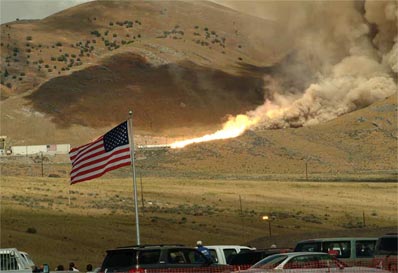 A two-minute static firing of the shuttle program's first Production Rate Motor was successfully tested Aug. 16. Credit: ATK Thiokol Download a larger image here The firing of the Production Rate Motor was one of several annual tests conducted by the Reusable Solid Rocket Motor Project Office at NASA's Marshall Space Flight Center in Huntsville, Ala., to qualify any proposed changes to the rocket motor and to guarantee that new materials meet safety requirements. These annual tests closely replicate a Space Shuttle launch. The Aug. 16 test demonstrated process, material and design changes made to the Reusable Solid Rocket Motors produced during the past two years. The motor firing also will allow NASA to further evaluate the performance of new sensors that read and retain detailed information -- much faster than instruments now used -- on pressures generated in the motor during a Shuttle launch. "Testing such as this is important to ensure continued quality and performance," said Jody Singer, manager of the Reusable Solid Rocket Motor Project, part of the Space Shuttle Propulsion Office at the Marshall Center. The test satisfied 48 objectives, including the evaluation of new sensors, or Intelligent Pressure Transducers. Produced by Stellar Technology, Inc. of Amherst, N.Y., the transducers also were tested earlier this year on a modified motor at the Marshall Center. In addition to evaluating the performance of the new sensors, the test also monitored an operational pressure transducer recently qualified for flight and flown on STS-114: Space Shuttle Return to Flight launched July 26. These transducers, also made by Stellar Technology, help determine the time of separation of the Solid Rocket Boosters from the Orbiter. The Production Rate Motor test also will allow NASA and ATK Thiokol engineers to further examine a more environmentally friendly insulation material and to gather information on a pressure-sensitive adhesive that may soon be used on the motor's joints. Another objective of the test was to assess the performance of the propellant bore -- the hole down the middle -- of the rocket motor. When a motor is ignited, a controlled burn begins down its middle, creating the motor's thrust. The test results will show how motors react during the first few seconds following ignition and provide engineers more information on the firing stability of motors -- crucial information for human spaceflight. Additionally, a powerful X-ray was used during the test to scrutinize how the motor nozzle performs during launch and ascent. Static firings are part of the ongoing verification of components, materials and manufacturing processes required by the Space Shuttle program. Test data will be analyzed and the results for each objective provided in a final report. Following the test, the motor's metal casings and its nozzle components will be refurbished for reuse. ATK Thiokol manufactures the Shuttle's Solid Rocket Motor. The Shuttle's Reusable Solid Rocket Motor is the largest solid rocket motor ever flown, the only one rated for human flight and the first designed for reuse. It is the primary component of the Shuttle's twin Solid Rocket Boosters. These solid propellant rockets take the Shuttle to an altitude of 28 miles at a speed of 3,094 mph before they separate and fall into the ocean to be retrieved, then refurbished and prepared for another flight.
__________________
Cosmos Pure | Core i7 860 | P7P55D-E Deluxe | 16GB DDR3 Vengeance | HD5850 | 2x850PRO 256GB | 2xRE3 250GB | 2xSpinPoint F3 1TB |
|
|
|
|
21-08-2005, 10:09
|
#54 |
|
Senior Member
Iscritto dal: Nov 2001
Città: Padova
Messaggi: 1638
|
Next shuttle launch: March 2006
BY WILLIAM HARWOOD STORY WRITTEN FOR CBS NEWS "SPACE PLACE" & USED WITH PERMISSION Posted: August 18, 2005 As expected, NASA managers today announced the next space shuttle flight will be delayed until at least next March to give engineers time to fix the external tank foam insulation problems that marred shuttle Discovery's launch last month. At the same time, NASA Administrator Michael Griffin said he welcomed highly critical observations included in the final report of the Stafford-Covey Return to Flight Task Group, an advisory panel charged with assessing the agency's implementation of post-Columbia safety recommendations. In a strongly worded "minority report," seven of the task group's 26 members blasted NASA's management of the post-Columbia shuttle program, blaming poor leadership for ongoing, pervasive "cultural" problems and an erosion of engineering rigor that raise questions about the agency's willingness to fly without a thorough understanding of the risks involved. Griffin told reporters today that he asked panel chairmen Thomas Stafford and Richard Covey to include the group's observations in the task group's final report, "because frankly, I think we would do a disservice to ourselves and to our stakeholders and, frankly, to the taxpayers by creating an appearance that we do not wish to hear what people have to say if it should be negative." "I think we do ourselves proud when we take all the comments that are given, we study them, we evaluate and we investigate them and we decide which ones make sense to us and that we wish to move forward on and which ones where we don't think the advisers got it right. I think that's the proper way to treat advice. "I have conferred with the folks as recently as yesterday who provided those comments to us and I believe they fully understand the spirit of openness and honest acceptance that we're trying to convey to their issues." But Griffin, as he has done on earlier occasions, made it clear it's up to NASA managers, not an advisory panel, to decide how the civil space program should be conducted. "I've tried to put out a message on a number of occasions that NASA line management is in charge of the civil space program," Griffin said. "NASA will decide what to do with the shuttle and other issues. So we are accountable and responsible for what we do here in the civil space program. "Advisory groups advise. We welcome the advice because it is very hard, when you're immersed in the day to day struggle to figure out the right thing, do the right thing and make the hard decisions, it's very hard to pull back and look at things from a big picture perspective. And so NASA often uses knowledgeable but external advisers to help us shape our decision making. "But at the end of the day, those groups are not accountable and not responsible for what they suggest," Griffin said. "They provide information that we use to evaluate our course of action and that's what we will do with the Stafford-Covey task group report or any other report we commission." Bill Gerstenmaier, newly appointed head of space operations at NASA headquarters, said the decision to push the next shuttle flight back to the March time frame was unavoidable given the work needed to fix the external tank foam shedding problem. Because of a NASA-imposed requirement to launch the next flight in daylight, and to ensure the tank is jettisoned in daylight to permit photo documentation, NASA only had two launch windows left this year: Sept. 22-25 and Nov. 7-10. Another brief window was available Jan. 4-7, 2006. "The last time I talked to you, I said September was pretty unlikely from a launch opportunities standpoint," Gerstenmaier said today. "We then looked at November and looked at January and kind of from an overall standpoint, we think really March 4 is kind of the time frame that we're looking at." The target window opens March 4 and closes March 19. Engineers are hopeful the opening can be moved up one day, to 3:46 p.m. March 3, but that remains to be seen. The next window opens May 3 and runs through May 22 and the window after that runs from June 30 to July 19. The new launch target "was driven by a variety of reasons," Gerstenmaier said. "One was the foam investigation, it looks like we're going to have to do some repair at Michoud (La.) on the tanks and then that will kind of pushes us into the first of the year." Engineers still don't know what caused a large piece of foam to separate from a so-called "PAL ramp" on Discovery's external tank. But NASA now plans to ship the next tanks in the launch sequence back to Lockheed Martin's Michoud Assembly Facility near New Orleans where the PAL ramps likely will be removed and then rebuilt from scratch. One benefit of the launch delay is that NASA can now use Discovery for the next mission instead of Atlantis as originally planned. The original plan called for Atlantis to be used for the second and third post-Columbia missions, in large part because Atlantis is lighter than Discovery and the third payload is made up of heavy solar array components. "Now we can switch the launch order," Gerstenmaier said. "Instead of going Atlantis-Atlantis and having to turn that same vehicle around, we can now go Discovery, Atlantis and then back to Discovery and that's a much better overall flight sequence." The foam problems driving the launch delay were an unexpected and embarrassing setback for NASA. The agency spent two-and-a-half years recovering from the Columbia disaster, addressing the issue of foam debris shedding and beefing up safety across the board. Despite the foam problems and the critical nature of the Stafford-Covey minority report, Griffin expressed confidence in the shuttle program's management. "Let me address the more important question of is there some crisis in confidence. No, there's not," Griffin said. "There may be, there may very well be, in accordance with the comments made in the Stafford-Covey report, some issues that we need to address regarding engineering process and engineer management, engineering discipline, those sorts of things. "We've worked hard at NASA over the last two-and-a-half years to improve that situation that led to the loss of Columbia. But we don't suppose that we're done and one of the reasons why I was very receptive to the minority report was because we can't get done unless we're willing to listen to all of the hard truths. So we're going to be looking at our engineering processes. "But let me illustrate what I see. For good or ill - and obviously it was for ill - we in NASA didn't look in detail at foam shedding from the tank for 113 flights. And shame on us. Absolutely, everyone in and out of NASA learned a lesson, I hope, about that. And that is an incident, that is a process that will be examined in textbooks for years to come. We flew 113 flights without seriously addressing the issue of how much foam was coming off the tank, why, where and what it was doing. "OK. So on the first flight after being hit very hard, as hard as an agency can be hit by a mistake with the loss of seven lives ... on the first flight after we started really paying attention to the foam, almost everything we did worked. There are, I think, five areas where it didn't work right. And one of them with the PAL ramp foam was a big piece and it was very embarrassing. But ... almost everything did work right. "So do I have a crisis of confidence in the team that made almost every thing work right? Of course not," Griffin said. "We're going to take the data and see where it leads us and we're going to fix those things that we didn't get right. But In a very important sense, this was the first try that the tank team, shuttle team, the NASA team ever really made to reduce the foam shedding to a minimal and acceptable level. I think they did pretty darn well for the first try. And that's how I'd like people to view it."
__________________
Cosmos Pure | Core i7 860 | P7P55D-E Deluxe | 16GB DDR3 Vengeance | HD5850 | 2x850PRO 256GB | 2xRE3 250GB | 2xSpinPoint F3 1TB |
|
|
|
|
20-09-2005, 22:21
|
#55 |
|
Senior Member
Iscritto dal: Nov 2001
Città: Padova
Messaggi: 1638
|
NASA plans to resume work at Michoud Assembly Facility
NASA NEWS RELEASE Posted: September 17, 2005 Recovery efforts at NASA's Michoud Assembly Facility in New Orleans are progressing better than originally anticipated, almost three weeks after Hurricane Katrina struck. Power has been restored to the entire complex where space shuttle external fuel tanks are made. Temporary repairs have been made to damaged buildings. Due to the progress, the Space Shuttle program has decided to keep tank work at Michoud. The program had explored the option of moving some tank work to NASA's Kennedy Space Center, Fla. Officials determined that by the time Kennedy's facilities were outfitted to do tank work, Michoud would already be operational. The agency is now assessing the work force needed to start and maintain minimal operations at Michoud. The main priority will be to ensure temporary housing for NASA civil servants and contractors whose homes were destroyed by Katrina. Preparations are also under way to ship two external tanks from Kennedy back to Michoud by barge. External tank #120 is expected to arrive at Michoud in early October. It will be examined and portions of it dissected to better understand why foam came off during Space Shuttle Discovery's launch last July. External tank #119 will be sent back to Michoud in late October. NASA is still working to contact 76 of more than 2,000 Michoud employees. The toll free phone number for employees to check in and for help locating employees who work at either Michoud or the Stennis Space Center, Miss., is: 877/470-5240 NASA has a public Web site to convey important contact information for NASA employees and contractors impacted by Katrina and for general public information at: http://www.nasa.gov/eoc NASA also can take email inquiries from the public about general storm recovery activities. Use "Assistance -- Katrina" in the subject line, and send to: [email protected]
__________________
Cosmos Pure | Core i7 860 | P7P55D-E Deluxe | 16GB DDR3 Vengeance | HD5850 | 2x850PRO 256GB | 2xRE3 250GB | 2xSpinPoint F3 1TB |
|
|
|
|
01-10-2005, 23:06
|
#56 |
|
Senior Member
Iscritto dal: Nov 2001
Città: Padova
Messaggi: 1638
|
Da Space.com:
NASA Devises Shuttle External Tank Foam Fix By Todd Halvorson FLORIDA TODAY posted: 1 October 2005 12:35 p.m. ET CAPE CANAVERAL - NASA has a plan to fix its problem-plagued external fuel tanks, and the agency is studying the possibility of launching its next two shuttle missions in May and July. NASA aims to replace an external tank foam ramp that shed a one-pound piece of insulation on the agency's first post-Columbia mission, prompting managers to put future flights on hold. NASA shuttle chief Wayne Hale met with managers Thursday and asked them to determine what it would take to launch a second test flight in May and an International Space Station assembly mission in July. Hale "was very straight-forward in saying, 'Look, these are not launch dates, but I just want you guys to come back and tell me what it would take to get there, if we can get there,' " said Kyle Herring, a spokesman for NASA's Johnson Space Center in Houston. NASA's next mission officially is targeted for a March launch. But foam insulation problems and hurricane damage to agency facilities have made that all but impossible. "I think that May would be the earliest, based on two hurricanes that not only caused damage at some of the facilities but also displaced the work force," Herring said. Hurricane Katrina damaged NASA's Stennis Space Center in Bay St. Louis, Miss., and Michoud Assembly Facility in New Orleans. The agency estimates its repair and recovery costs will be about $1.1 billion. Shuttle engines are tested at Stennis. Tanks are made at the Louisiana factory. Hurricane Rita forced NASA to close JSC last week, but no serious damage was done. Katrina destroyed or damaged the homes of many of the 3,500 NASA and contractor employees who work at Stennis and Michoud. Many still are living in temporary housing. "The work force is the first and foremost priority -- making sure that they are safe, and that they are taken care of. At the same time, a lot of those people who are affected are also motivated to get back to the business of flying space flights," Herring said. "Even with the devastation to their lives, it's been kind of remarkable that they have stepped up and are back at work and are trying to balance that with their own personal issues." The 2,000 workers at Louisiana plant will play a key role in fixing an external tank foam ramp that shed a one-pound piece of insulation during Discovery's July 26 launch. In a haunting reminder of the Columbia accident, the foam nearly hit the shuttle's right wing. A 1.67-pound chunk of foam from Columbia's tank punched a hole in that shuttle's left wing, enabling hot gasses to rip the ship apart during atmospheric reentry. The foam that doomed Columbia was designed to keep ice from building up on and potentially breaking off of an area where metal struts connect the tank to the nose of the orbiter. A heater replaced the so-called bipod ramp as part of a $205 million post-Columbia effort to fix the tank. On Discovery's flight, foam broke off a protuberance air load ramp that runs along the side of the 15-story tank. Its purpose: To ensure smooth airflow and minimize vibration around nearby pipes and cables. NASA plans to remove the 37-foot ramp, replacing it with a new type of foam that will be applied with more exacting techniques designed to prevent shedding. The area will be outfitted with instrumentation to better understand aerodynamic forces that could cause damage in flight. Engineers think the change will work because the first 10 feet of the ramp was removed and replaced in that same fashion prior to Discovery's flight. The work was done so that a safety modification could be made beneath the ramp, and no foam was shed from the reworked area. The tank for NASA's next shuttle mission is being brought by barge back to the New Orleans factory and is expected to arrive there Sunday. Engineers plan to use high-tech inspection gear to examine the ramp. Then they'll remove it and dissect it to try to learn more about the foam shedding phenomenon. A return to Kennedy Space Center by January would put NASA in position to launch in May. Published under license from FLORIDA TODAY. Copyright © 2005 FLORIDA TODAY. No portion of this material may be reproduced in any way without the written consent of FLORIDA TODAY.
__________________
Cosmos Pure | Core i7 860 | P7P55D-E Deluxe | 16GB DDR3 Vengeance | HD5850 | 2x850PRO 256GB | 2xRE3 250GB | 2xSpinPoint F3 1TB |
|
|
|
|
07-10-2005, 13:30
|
#57 |
|
Senior Member
Iscritto dal: Nov 2001
Città: Padova
Messaggi: 1638
|
Endeavour comes to life
NASA NEWS RELEASE Posted: October 6, 2005 Engineers cheered as electricity coursed through Space Shuttle Endeavour today for the first time in two years. The powering of Endeavour signaled the end of the orbiter's major modification period at NASA's Kennedy Space Center, Fla.  Carmen Prater, with United Space Alliance, works on the flight deck of the orbiter Endeavour. Credit: NASA-KSC "Having three operational vehicles in the fleet affords the shuttle program great schedule flexibility, as we move toward flying safely and completing the international space station," said Space Shuttle Program Manager Wayne Hale. Engineers and technicians spent 900,000 hours performing 124 modifications to the vehicle. These included recommended return to flight safety modifications, bonding more than 1,000 thermal protection system tiles and inspecting more than 150 miles of wiring. Eighty five of the modifications are complete and 39 are still underway. Two of the more extensive modifications included the addition of the multi-functional electronic display system (glass cockpit), and the three-string global positioning system. The glass cockpit is a new, full-color, flat-panel display system that improves interaction between the crew and orbiter. It provides easy-to-read graphics portraying key flight indicators like attitude display and mach speed. Endeavour was the last vehicle in the fleet to receive this system. The three-string global positioning system will improve the shuttle's landing capability. It will allow Endeavour to make a landing at any runway long enough to handle the shuttle. The previous system only allowed for landings at military bases. "When Endeavour was powered up, the team cheered at the completion of all of their hard work and accomplishments during the modification period," said Tassos Abadiotakis, Endeavour's vehicle manager. "The team worked tirelessly to ensure the vehicle progressed though the modification period on time and on budget." Shuttle major modification periods are scheduled at regular intervals to enhance safety and performance, infuse new technology and allow thorough inspections of the airframe and wiring. This was the second of modification period performed entirely at Kennedy. Endeavour's previous modification was completed in March 1997. Endeavour is beginning 10-12 months of launch processing and power-up testing for a future flight, possibly late next year.
__________________
Cosmos Pure | Core i7 860 | P7P55D-E Deluxe | 16GB DDR3 Vengeance | HD5850 | 2x850PRO 256GB | 2xRE3 250GB | 2xSpinPoint F3 1TB |
|
|
|
|
11-10-2005, 09:13
|
#58 |
|
Senior Member
Iscritto dal: Nov 2001
Città: Padova
Messaggi: 1638
|
Da http://www.space.com/spacenews/busin...y_051010.html:
Revised NASA Shuttle Plan Includes Most Station Hardware By Brian Berger Staff Writer NASA expects to fly 19 space shuttle missions between 2006 and the orbiter fleet’s planned retirement in 2010, completing by then a six-person International Space Station that would include most but not all of the hardware being built by the U.S. space agency’s international partners. NASA’s revised space station plan, the result of several months of internal study, is slated for public release later in October. A preview of the so-called Shuttle/Station Configuration Options Team (S/SCOT) study provided to Space News shows that NASA intends to launch Europe’s Columbus laboratory module and the Japanese Experiment Module before retiring the shuttle. But NASA’s revised space station plan would eliminate the Russian Solar Power Platform and the Centrifuge Accommodation Module that the Japan Aerospace Exploration Agency had agreed to build for NASA under a barter agreement. Both the Russian power platform and the centrifuge module are designed to launch aboard the space shuttle. NASA spokeswoman Debra Rahn said Oct. 6 that NASA’s international partners were briefed the previous week on the revised space station assembly plan. "We have initiated discussions with all the partners on the results of the Shuttle/Station Configuration Options Team study," Rahn said. Bill Gerstenmaier, NASA associate administrator for space operations, held high-level consultations with senior officials of the space station partners in late September, Rahn said. Those telephone meetings are being followed by more formal bilateral sessions between NASA Administrator Mike Griffin and his international counterparts, she said. Rahn said Griffin held the first of those meetings with the head of the Russian Federal Space Agency, Anatoly Perminov, while the two were at the Baikonur Cosmodrome in Kazakhstan for the Oct. 1 launch of a Soyuz capsule carrying a new two-person crew and U.S. space tourist Greg Olson to the space station. She said Griffin informed Perminov that NASA will not be able to launch the Russian Solar Power Platform. Keiji Tachikawa, president of the Japan Aerospace Exploration Agency, was in Washington the week of Oct. 3 where he attended at least two receptions held in his honor and met with U.S. lawmakers. Rahn said Griffin did not meet with Tachikawa during his Washington visit because the two already have a formal meeting scheduled during the International Astronautical Congress in Fukuoka, Japan, the week of Oct. 17. A formal Heads of Agency meeting involving Griffin and all of his space station counterparts is tentatively planned for December or January at a location still to be determined, Rahn said. The last such high-level space station meeting occurred in January in Montreal. At that meeting, NASA told the partners it planned to conduct 28 space shuttle flights by 2010, a manifest that included about 10 space station logistics and utilization flights but no mission to service the Hubble Space Telescope. But not long after being sworn in as NASA administrator in April, Griffin began expressing doubts about the feasibility of the 28 flight manifest, even as he emphasized the agency’s resolve to retire the shuttle fleet before the end of 2010. Griffin testified before Congress this spring that he thought NASA could eliminate all or nearly all of the logistics and utilization flights in the manifest and concentrate instead on using the shuttle solely for assembly flights requiring the orbiter’s payload bay. According to the preview of the S/SCOT study results, NASA thinks it can accomplish 18 flights to the space station beginning with STS-121 — the second so-called Return to Flight mission it now hopes to launch in May — plus one mission to service Hubble, for a total of 19 flights. One of the assumptions underlying the new station assembly plan is that the shuttle orbiter fleet will be retired before Oct. 1, 2010, the start of the U.S. federal government’s new budget year. Building the international space station is taking much longer than NASA and its partners ever expected. An assembly plan finalized in September 1997, one year before on-orbit construction actually began, envisioned completing the orbital outpost by late 2003. The first piece of the space station, the Russian-built Zarya Control Module, was launched Nov. 20, 1998, aboard a Proton rocket. It was followed two weeks later by the U.S. Unity Node launched aboard NASA’s Space Shuttle Discovery. Space station assembly then hit a 19-month hiatus while Russia struggled to finish the next major component, the Zvezda Service Module. The space shuttle fleet made 13 flights to the space station before the Space Shuttle Columbia’s fatal accident in February 2003. NASA has deployed no major hardware at the station since November 2002, when the Space Shuttle Endeavour delivered the outpost’s first U.S.-built solar arrays. NASA does not expect to resume space station assembly flights before July 2006, the agency’s current planning date for attempting its third post-Columbia flight. Although STS-121 is bound for the space station, the mission’s primary purpose is to validate changes made after the Columbia accident, not deliver major hardware to the station.
__________________
Cosmos Pure | Core i7 860 | P7P55D-E Deluxe | 16GB DDR3 Vengeance | HD5850 | 2x850PRO 256GB | 2xRE3 250GB | 2xSpinPoint F3 1TB |
|
|
|
|
11-10-2005, 16:23
|
#59 | |
|
Senior Member

Iscritto dal: Mar 2002
Città: Treviso
Messaggi: 911
|
Quote:
 (ovviamente non appena termineranno i rimanenti upgrades) Ultima modifica di Octane : 11-10-2005 alle 16:27. |
|
|
|
|
|
15-10-2005, 22:29
|
#60 |
|
Senior Member
Iscritto dal: Nov 2001
Città: Padova
Messaggi: 1638
|
NASA hopeful tests can pave way to May shuttle launch
BY WILLIAM HARWOOD STORY WRITTEN FOR CBS NEWS "SPACE PLACE" & USED WITH PERMISSION Posted: October 14, 2005 NASA managers are hopeful an exhaustive series of upcoming tests will help engineers pin down what caused foam insulation to fall off the shuttle Discovery's external tank during launch last July and, if all goes well, clear the way for another launch next May. "We have not set an official launch date," shuttle program manager Wayne Hale told reporters today. "I want to make that very clear. The shuttle launch date for the next shuttle flight has been, in the lingo that the Eastern Range uses, 'indeterminate' since the foam incident on STS-114. "We are, however, working toward technical solutions of our problems. ... We have a number of critical things ahead of us that we have to evaluate before we set an official launch schedule. However, based on the discussions that we had at the program board yesterday, it appears that the May launch window is something that we can begin to work toward now." The launch window opens May 3 and closes May 23. The next window runs from July 1 through July 20 and the next window after that opens Aug. 28 and closes Sept. 14. The launch windows are based the shuttle's ability to reach the international space station and on a requirement to launch, and have the external tank separate, in daylight for photo documentation. When Discovery blasted off in July, NASA had hoped to launch the second post-Columbia mission in September. But during the shuttle's climb to space, relatively large pieces of foam insulation fell away from five areas of the tank, including a potentially dangerous chunk from a so-called protuberance air load, or PAL, ramp. The PAL ramp is a long aerodynamic barrier made up of hand-sprayed foam designed to smooth the flow of supersonic air across an external cable tray and two pressurization lines. In the wake of Discovery's launch on mission STS-114, shuttle flights were put on hold. NASA managers did not announce a new target date for the second post-Columbia flight beyond saying launches would be delayed until at least next March. Then came Hurricane Katrina, which devastated New Orleans and the Gulf Coast. Lockheed Martin processes shuttle external tanks at its Michoud Assembly Facility near New Orleans and while damage was surprisingly slight, the 2,000-member workforce was seriously impacted. Hale said today the storm and its aftermath set tank processing back at least three months. Some five hundred workers are back on the job at Michoud, but the full work force is not expected back on station until early December. Even so, Hale said engineers are optimistic they will nail down the causes of the foam shedding in time to support a May launch. "We are at the point where we believe we have an understanding of the parameters of those problems well enough in hand so we can get internal working schedules to the rest of our elements," Hale said. "Of course, any schedule we have is going to be critically dependent on the work that goes on at Michoud. And that's why the discussion of the work force and the work force returning to Michoud is critical to our scheduling effort. We believe we understand how that is going to take place over the next few weeks." Richard Gilbrech led a "tiger team" of engineers charged with assessing the foam issue. He said today the team focused on three areas: the launch environment, that is, the forces acting on the foam during ascent; the materials used in the foam; and the way the foam was applied, removed for subsequent modifications and re-applied. The launch environment was not a factor, the team concluded; the stresses acting on the tank were essentially the same as on previous flights. The materials used in the foam also were unchanged from previous flights with one major exception: the PAL ramp foam was made up of BX-265, a foam formulation slightly different from earlier tanks to comply with the latest environmental regulations. "The third thing we looked at was processing, was there anything in the way this tank was processed that might give us a clue as to why we had lost foam," Gilbrech said. "The major finding we found was this tank was reworked to a level none of the other tanks prior had been, and we suspect that handling damage, or collateral damage - which is basically risk to the foam from technicians that have to be there and doing their work - we think is a potential contributor. "I want to make it clear that we found no negligence on the part of the workers at the ET project. They were doing their work per procedure. It's just that we didn't really have an appreciation for the significance this handling damage could have in terms of foam loss." The PAL ramp foam debris was the largest chunk to fall off Discovery's tank. Engineers believe it probably was the result of a combination of factors, including voids in the foam, possible cracks caused by thermal stresses in the ramp foam and the underlying foam it was applied to and inadvertent crush damage caused by engineers and technicians at Michoud working near the area during processing. But Gilbrech said engineers do not believe "crushed foam alone could have been the cause of the foam coming off. We believe it was potentially a combination of (factors)." Said Bill Gerstenmaier, chief of space operations at NASA headquarters: "I think it's really wrong to try to pick out one potential root cause and say that's the underlying problem or that's the smoking gun. Foam is very complicated. The failure mechanism is likely some combination of things and it's really wrong to try to pick out one and then try to focus all your efforts on that. That will actually set you 8up for more problems in the future." The foam that doomed Columbia came off another aerodynamic ramp intended to keep ice from forming around the two bipod struts that attach the nose of the shuttle to the tank. The ramps were removed for Discovery's flight and replaced with heater strips. Surprisingly, foam popped away from the now-rampless bipod area during Discovery's launch. As it turns out, engineers believe air inside the heater wiring channel condensed due to the ultra-low temperatures of the tank. The liquid nitrogen then changed back into a gas during launch and popped off overlying foam. Changes are planned to eliminate that threat in the future. Another area of foam loss during Discovery's flight was from so-called ice-frost ramps, foam that covers the attachment fittings holding pressurization lines in place. Engineers may resolve that problem by drilling small holes in the foam, allowing pathways for trapped air to escape. This technique already is used elsewhere on the tank. Foam also fell away from a flange area near the top of the hydrogen section of the tank and from the broad acreage foam covering most of the tank's exterior. Gilbrech said the intertank flange foam may have separated because of previous work in that area, but he did not specify what might be the cause of the acreage foam loss other than to say tests were being designed to resolve the issue. The tank intended for the next shuttle flight is ET-119, which was recently shipped back to Michoud from the Kennedy Space Center. It currently is undergoing extensive inspections and X-ray analysis. The PAL ramps eventually will be removed, sliced every eighth of an inch to look for voids. They will be replaced using improved techniques with special care taken to ensure no inadvertent damage. "That tank we have to do a number of things to, at the minimum removing and replacing the PAL ramps, re-working the bipod closeout area where we think the wire may have actually allowed cryogenic ingestion of air to condense in an area," Hale said. "We have a number of things that we've got to do before we're ready to do that work." But Hale repeated that he is optimistic about making the May window. "I think we have done enough analytical work to lay out a series of tests that over the next couple of months are going to give us a very clear and convincing understanding of why we lost the foam that we did on the external tank and allow us to design new techniques that will allow us to re-apply foam in areas in such a way that it won't come off even from some of these very complex interconnected causes. So we're addressing all those. "What has taken us from July until October, if you want to think about it, is to come to that level of understanding of the work that's got to go forward to provide an engineering, rigorous understanding of the causes and solutions to foam coming off. What we're all here to report is a great deal of progress and a sense of optimism that we do have an understanding of the work that lies ahead of us."
__________________
Cosmos Pure | Core i7 860 | P7P55D-E Deluxe | 16GB DDR3 Vengeance | HD5850 | 2x850PRO 256GB | 2xRE3 250GB | 2xSpinPoint F3 1TB |
|
|
|
|
|


| Strumenti | |


|
|

Tutti gli orari sono GMT +1. Ora sono le: 23:39.