


|
|||||||


|


|
|
 |
|
|
Strumenti |
 20-10-2005, 14:22
|
#61 | |
|
Senior Member

Iscritto dal: Mar 2002
Città: Treviso
Messaggi: 911
|
NASA Makes Progress on Foam Loss
Da NASA.gov:
Quote:
EDIT: vabbe' lo aveva gia' postato GioFX.. 
Ultima modifica di Octane : 20-10-2005 alle 14:25. |
|

|

|
|
28-10-2005, 09:27
|
#62 |
|
Senior Member

Iscritto dal: Nov 2001
Città: Padova
Messaggi: 1638
|
Da Nasaspaceflight.com:
NASA still aiming for 19 flights 10/27/2005 3:43:00 PM By: Chris Bergin A document acquired by this site has given revised details on the remaining flights of the Space Shuttle, with changes to the target launch dates and confirmation that Atlantis will be the first Orbiter to be retired in 2008. Running through to 2009 - to give the STS (Space Transportation System) program a buffer zone to the targeted retirement in 2010 - the October 19th Flight Assignment Working Group (FAWG) Planning Manifest 05D-12 points to four flights in 2006. Discovery's Return to Flight 3 mission STS-121 has been forwarded to earlier in the re-start of Shuttle operations to May 3, 2006, with Atlantis on her STS-300 stand-by rescue mission - if required - for June 15. This mission is at the mercy of testing and re-engineering work on External Tanks ET-119 and ET-120 - both currently at the Michoud Assembly Facility (MAF) in New Orleans. Atlantis' primary launch processing is for STS-115, which is now due to launch on July 1. Atlantis' launch will see the re-start to ISS (International Space Station) assembly missions, adding the P3/P4 Truss to the outpost. The youngest Orbiter in the fleet, Endeavour, joins the fleet in active flight operations on October 1 on STS-116, carrying SpaceHab and the P5 ISS element. This will be the first Shuttle mission to incorporate SSPTS (Station/Shuttle Power Transfer System) capability, allowing for flight duration to last 15 days. A fourth mission is planned for 2006, with Atlantis once again in action on STS-117 with a target launch date of December 7. Atlantis will be carrying the S3/S4 ISS element. On the manifest is six 2007 missions, starting with Endeavour on March 15 on STS-118, and ending with Atlantis on STS-124 on November 29. Atlantis' 14th of June STS-120 will mark the completion of the US Core of the ISS. 2008 sees another six launches, starting and ending with Endeavour's STS-121 on February 7 - ending with her STS-130 mission on December 4. This year will also mark the retirement of Atlantis. OV-104 would have been due for her Orbiter Major Maintenance (OMM) period in 2008, thus deciding her own retirement automatically, given the two years it takes to re-fit the Orbiters - a pointless exercise given the 2010 retirement target. Three missions follow STS-130, with Discovery launching on STS-131 (March 19), Endeavour on STS-132 (May 14), and the final ever Space Shuttle mission coming with Discovery's STS-133 on August 20, 2009. However, it needs to be stressed that all dates are flexible and open to changes, with the 2009 end date on the manifest more likely to give some breathing space should any delays during previous missions begin to accumulate over the years post STS-121. Also worth noting is the current funding questions that have been raised of late. NASA appears to have several options open to themselves, with a possibility of only flying missions that complete the US Core section of the ISS. That would bring the manifest down to eight flights, likely over the same time period to relax funding concerns. What is expected to remain - although not listed on the manifest with a specific mission - is the Hubble Space Telescope servicing mission. That will not be part of the ISS assembly missions, given the different orbits of the ISS and Hubble. Sources note that mission will involve Endeavour, sometime in 2007/08. Below is the list of launches noted on the latest manifest. 2006 STS-121 – Discovery – May 3 [STS-300 – Atlantis – June 15] STS-115 – Atlantis – July 1 STS-116 – Endeavour – October 1 STS-117 – Atlantis – December 7 2007 STS-118 – Endeavour – March 15 STS-119 – Discovery – May 3 STS-120 – Atlantis – June 14 STS-122 – Endeavour – August 23 STS-123 – Discovery – October 11 STS-124 – Atlantis – November 29 2008 STS-125 – Endeavour – February 7 STS-126 – Discovery – April 3 STS-127 – Atlantis – May 22 STS-128 – Endeavour – July 3 STS-129 – Discovery – October 2 STS-130 – Endeavour – December 4 2009 STS-131 – Discovery – March 19 STS-132 – Endeavour – May 14 STS-133 – Discovery – August 20 ....... The Shuttle targeted launch dates were not for the next 7 flights however they will be in about 2 weeks if MSFC does good work.: STS-121 (ULF1.1) OV-103 RTF NET May 3, 2006 STS-115 (12A) OV-104 Trusses P3/P4 NET July 1 (CSCS launch NET June 15 STS-116 (12A.1) OV-105 Space Hab, Truss P5 and ICC NET Oct. 01 STS-117 (13A) OV-104 Trusses S3/S4 NET Dec. 7 STS-118 (13A.1) OV-105 Space Hab and Truss S5 NET March 15, 2007 STS-119 (15A) OV-103 Truss S6 NET May 03 STS-120 (10A) OV-104 Node 2 NET June 14
__________________
Cosmos Pure | Core i7 860 | P7P55D-E Deluxe | 16GB DDR3 Vengeance | HD5850 | 2x850PRO 256GB | 2xRE3 250GB | 2xSpinPoint F3 1TB |
|
|
|
|
04-12-2005, 18:55
|
#63 |
|
Senior Member
Iscritto dal: Nov 2001
Città: Padova
Messaggi: 1638
|
NASA Likely To Fly Next Shuttle Sans Foam Ramp
By Brian Berger Space News Staff Writer posted: 2 December 2005 5:37 p.m. ET WASHINGTON - NASA is leaning toward flying its next space shuttle mission without the protective foam ramp that broke away from Discovery's external tank during its July return to flight, according to a spokesman for the U.S. space agency. Shuttle officials plan to meet again this month to evaluate the Protuberance Air Load (PAL) ramp issue and possibly reach a decision. "The data from the ongoing engineering analysis on the PAL ramp seems to be pointing in the direction of not flying with the PAL ramp for STS-121," said NASA spokesman Allard Beutel, referring to Discovery's next mission, tentatively slated for May 2006. Beutel said eliminating the PAL ramp would not in and of itself jeopardize the May launch opportunity, provided that wind tunnel testing now being planned for February confirms that it is safe to fly without the structure. The PAL ramp was added to the external tank early the program's history to provide a windbreak for a cable tray that runs along the tank. NASA Space Shuttle Program Manager Wayne Hale raised the possibility of eliminating the ramp from the STS-121 tank during a Nov. 22 update on work the agency has done to eliminate foam shedding. "In the long run, we have decided we would like to remove this fairly large piece of foam, just eliminate the hazard that it might cause," Hale said at the press briefing. "We think we have a very strong case to be ready to take that ramp off by the third flight tank. Some folks believe we can accelerate that and potentially even remove it for the STS-121 tank." Several days after that press briefing, Beutel said, shuttle officials received new data that showed that recently discovered PAL ramp cracks on tanks undergoing inspection ran deeper than previously thought. The new data persuaded Hale that NASA should give serious consideration to removing the PAL ramp before STS-121. Hale shared this view with colleagues in a Nov. 29 e-mail first reported by the Washington Post. Hale's Nov. 29 e-mail said nothing about schedule impact, according to Beutel, but in a separate internal memo, written in early September in the immediate aftermath of Hurricane Katrina, Hale concluded that flying STS-121 without a PAL ramp was not a realistic option since all the testing and analysis involved would delay the mission until late 2006. Beutel, however, said shuttle officials now think they can safely remove the PAL ramp without forfeiting the May launch window. "They've had a couple more months to work this and after studying this problem up and down the chain they are thinking that the PAL ramp removal is more feasible than they did just a couple of months ago," Beutel said. Wind tunnel tests are being planned for February to evaluate the aerodynamic effects of removing the PAL ramp. In order to preserve the May launch window, Beutel said NASA would go ahead and ship the tank assigned to STS-121 to Kennedy Space Center in Florida without a PAL ramp. "If, and only if, our further testing and analysis supports flying without a PAL ramp is aerodynamically alright to do, as our preliminary analysis indicates it would be, then the May launch window is still possible to make," Beutel said. "If our new testing and analysis indicates we need the PAL ramp, we'll stop our shuttle processing, reassess and work the issue from there." He said NASA would also continue to investigate new ways of applying PAL ramp foam to prevent cracking that could cause the structure to break off during launch.
__________________
Cosmos Pure | Core i7 860 | P7P55D-E Deluxe | 16GB DDR3 Vengeance | HD5850 | 2x850PRO 256GB | 2xRE3 250GB | 2xSpinPoint F3 1TB |
|
|
|
|
18-12-2005, 12:19
|
#64 |
|
Senior Member
Iscritto dal: Nov 2001
Città: Padova
Messaggi: 1638
|
Shuttle leaders decide to remove fuel tank foam ramps
BY WILLIAM HARWOOD STORY WRITTEN FOR CBS NEWS "SPACE PLACE" & USED WITH PERMISSION Posted: December 15, 2005 NASA engineers and managers have recommended the removal of a protective foam air deflector from the shuttle's external tank to eliminate a major source of potentially dangerous launch debris, a top agency official said today. While NASA has not given up launching the next flight in May, additional work to implement and certify other changes required by the deflector removal could push the launch to later next summer. Bill Gerstenmaier, NASA associate administrator for space operations, would not discuss possible launch targets during an afternoon teleconference with reporters, saying such talk was premature and put unnecessary "schedule pressure" on the team. Instead, he said, engineers were going to focus on thoroughly assessing the possible causes of foam shedding based on recent insights into cracks found in a tank slated for the flight after next. "We're going to do the right thing and let the data drive us where we need to go," he said. During a Program Requirements Control Board meeting at the Johnson Space Center in Houston today, engineers recommended removing the external tank protuberance air-load - PAL - ramps from the shuttle's external tank. Last month, shuttle program manager Wayne Hale said engineers did not believe NASA would be ready to launch a PAL-free tank until the third mission in the upcoming sequence. But computer modeling now shows the structures the ramps were designed to protect - two pressurization lines, support brackets and a critical cable tray - are beefy enough to withstand any expected aerodynamic forces, or loads, they might encounter during ascent. Wind tunnel tests are planned for February to verify the results of the computer modeling. But engineers are still assessing what changes will be required to so-called ice-frost ramps, areas of foam around the brackets supporting the pressurization lines that are intended to prevent ice formation before blastoff. "Based on the data we've reviewed, we don't need to do any redesign of the cable tray or the press lines," Gerstenmeir said. "So there's no redesign of the basic bracketry or the basic tank structure. That all looks fine. We'll confirm that with the wind tunnel tests. The margins look very good in that region. ... So that's a very positive thing, it takes a lot of that work out of the critical path. "From an overall standpoint, depending on what engineering solution gets picked (to address the ice-frost ramp issue), May is still very viable. Some of the other engineering solutions that would require a more detailed certification process of foam applications, etc., may move us somewhere else." The shuttle's external tank is made up of a large hydrogen tank, a so-called intertank section and an upper oxygen tank. Gaseous hydrogen and oxygen, used to pressurize the tanks, are diverted from the propellants feeding the shuttle's main engines and routed up the tops of the respective tanks in externally mounted pipes. The pressurization lines run next to a long cable tray that carries electrical lines routing data and commands between the shuttle and various tank and booster subsystems. When the shuttle was designed in the 1970s, engineers believed shock waves during the vehicle's transition to supersonic speeds could cause potentially catastrophic damage to the pressurization lines and/or the cable tray. As a result, the tank was equipped with two PAL ramps, one running along the upper section of the hydrogen tank and the other along the outside of the oxygen tank. During Discovery's launching last July on shuttle mission STS-114 - the first post-Columbia flight - a one-pound chunk of foam ripped away from the hydrogen PAL ramp just after the ship's solid-fuel boosters were jettisoned two minutes and five seconds into flight. Earlier this fall, Hale ordered all existing PAL ramps dissected and removed. Engineers were assessing new fabrication techniques as a possible solution when numerous small cracks were discovered prior to the removal of the PAL ramp of a tank slated for the third post-Columbia mission. Engineers now believe the cracks almost certainly are related to the thermal stress the tank undergoes when it's loaded with super cold rocket fuel. The tank in question - ET-120 - originally was to be flown by Discovery last July and it was fueled for two pre-launch tests. The tank later was replaced for unrelated reasons, but the cracks could have been caused by thermal stress. If that theory is correct, cracks would be a constant threat for shuttles that were fueled for launch and then delayed for other reasons. Whether similar cracks played a role in the foam loss experienced by Discovery's tank in July is an open question. But given the small size of the cracks, the difficulty in detecting them at the launch pad and the lack of any on-pad repair procedures, NASA managers opted to forego attempting to fix the PAL ramps and to recommend their removal instead. "They've done a tremendous job of chasing the cracks," Gerstenmaier said. "We saw the cracks in the non-destructive testing, in the X-rays and in the terahertz radar data. What they've done now is, they've carved out the cracks and they've followed the crack as it goes down into the foam and then they see the crack actually break into smaller cracks, into some delamination layers down internal to the foam. Then we see some of the cracks progress slightly underneath the cable tray, we see some of the cracks actually (branch) out into the acreage foam. So we know where the cracks are running. "What we don't know is really why they're initiating. We have some theories. ... There are two different types of foam. There's the foam that's on the acreage of the tank that's about an inch thick and then we spray this PAL ramp foam on top of it. Those two types of foam have different thermal expansion coefficients, so we now have a math model of the stress field between those two foams as they chill down. That's a key driver. Where we put one type of foam on top of another type of foam, it causes that lower layer of foam to be colder, it's not as strong at cold temperatures so the cracks can initiate down there and then carry up into the upper piece of foam." Gerstenmeir said a major unrsolved question is how temperature changes and tank pressurization interact to cause cracks. "Exactly how they fit together, we haven't had a chance to pull together," he said. But he provided a relatively detailed summary of how a crack might lead to foam shedding. "The tank has a one-inch layer of foam all around and then the PAL ramp is about, probably an eight- to 10-inch foam layer (is) sprayed on top of that," he said. "What happens is that foam that's sprayed on top, it provides an insulating layer that allows that one-inch piece of foam to get cold through its entire length, so it is now cold from the surface of the tank all the way to the top of that one-inch layer of foam. "The fact that that foam is cold, when it gets cold it loses some strength, or it's more brittle, and easier to crack. And then the fact that the foam on top is expanding at a different coefficient of thermal expansion, it causes a shear, or a stress layer, on top of that one-inch layer of foam as well as there's a shear layer, or a stress layer, down where the foam attaches to the tank. "So then, that can cause a crack to initiate somewhere in that underlying one-inch piece of foam and then that crack can then propagate on up into the foam on top of it. If that crack goes all the way to the surface, that's where the outside air is, and it goes all the way down to the tank, then that provides a path for air to come in, liquefy in that lower region next to the tank." As the super cold hydrogen in the tank is drained and the structure warms up, "that liquid air then expands, pushes out on the foam and can cause a large piece of foam to come off," Gerstenmaier said. "So that's kind of the theory we're looking at." Removing the PAL ramp will eliminate the problem with differential contraction and expansion based on the use of two different types of foam. But engineers still must decide what will be needed to eliminate foam shedding around the ice-frost ramp brackets that support the pressurization lines. "The ice frost ramp sticks under the cable tray a little bit and it sticks into that region where the PAL ramp was and we saw some cracking in that ice frost ramp right next to the cable tray, or actually maybe a little bit under the cable tray," Gerstenmaier said. "What we need to do is understand what caused that cracking and will it be prevented by just removing the PAL ramp? Do we need to do something in that area, do we need to put some kind of other foam over that (to prevent) ice formation in that area? That's the kind of work we need to go understand. "The engineering teams have many solutions for that. We'll check some of those out analytically over the next couple of weeks, we'll pick an engineering solution, probably in the next week or two, then schedule a little bit of confirmation tests or analysis in the early part of January. And then if we need to make a physical fix on the tank by spraying foam, we would do that in the middle part of January to the later part of January and then we would ship the tank around the first part of February." If that schedule holds up, NASA would have a theoretical shot at launching the shuttle Discovery in May. Because of a post-Columbia decision to launch at least the first two return-to-flight missions in daylight - and to ensure the external tank separates in daylight half a world away - NASA can only launch during relatively short "windows." The next three such launch windows are: May 3-23 July 1-20 Aug. 28 to Sept. 14 Whatever engineers decide to do to Discovery's tank, they will also have to upgrade a tank for use in a possible emergency rescue mission. Assuming Discovery's flight goes well, that tank and shuttle then would be used for the next normal flight in the sequence. The tank currently slated for use in that mission, ET-120, has so many small cracks, many of them penetrating all the way to the aluminum skin of the tank itself, it may make more sense to process another tank, ET-118, in its place. Gerstenmaier said today a second tank will, in fact, be ready in time to support Discovery's mission whenever it is cleared to fly.
__________________
Cosmos Pure | Core i7 860 | P7P55D-E Deluxe | 16GB DDR3 Vengeance | HD5850 | 2x850PRO 256GB | 2xRE3 250GB | 2xSpinPoint F3 1TB |
|
|
|
|
01-02-2006, 23:57
|
#65 |
|
Senior Member
Iscritto dal: Nov 2001
Città: Padova
Messaggi: 1638
|
Da www.nasaspaceflight.com:
Soviet scenario for NASA Shuttle salvage 4/18/2005 10:28:00 AM By: Kathryn Hewitt NASA engineers have been looking into the very real possibility of programming the Shuttles to return from orbit and land unmanned, independently from their crew. This would allow the astronauts to take refuge on the International Space Station in the event of problems, to avoid any future disasters upon the Orbiter's return to Earth. This option is being researched since the loss of Columbia and her crew in 2003 and serves as another precautionary step towards ensuring a safer space flight. In the past, one such unmanned return to Earth was successfully accomplished by a competitor Shuttle from the Soviet Union. The Russian Space Shuttle Buran made the unmanned flight in November 1988 and returned to a runway landing back in Russia. The Shuttle was controlled only by computers. The NASA Shuttles already have a system that can automatically perform most landing functions. At present however, some key tasks - such as lowering the landing gear and deploying a pair of probes that collect airspeed, altitude and temperature data during the last moments of flight - require an astronaut at the controls. "All of those things in a theoretical sense can be automated, but they are not currently connected to the computer system," said Wayne Hale, deputy director of the shuttle program on linking up elements such as deploying the landing gear. Each Shuttle has automated systems, where computers debate and vote between themselves to decide the right course of action. However, this is mainly used on launches. NASA's potential changes would allow the flight team on the ground to land an unmanned Orbiter by remote command. Hale added "When we designed the Shuttle years ago, they [the elements] weren't [connected] for a variety of reasons." Hale then went on to state, "The modifications to allow that capability to be automated are going to take some time." If that capability becomes a reality, it could give NASA an alternative to scuttling a damaged orbiter and allowing them to save themselves. Plans developed after the 2003 Columbia accident raise the possibility that future shuttle crews might seek safe haven at the space station if there is evidence their ship needs repairs, rather than risk the fiery plunge home through Earth's atmosphere.
__________________
Cosmos Pure | Core i7 860 | P7P55D-E Deluxe | 16GB DDR3 Vengeance | HD5850 | 2x850PRO 256GB | 2xRE3 250GB | 2xSpinPoint F3 1TB |
|
|
|
|
02-02-2006, 00:02
|
#66 |
|
Senior Member
Iscritto dal: Nov 2001
Città: Padova
Messaggi: 1638
|
02.02.2006
FYI the modification kit to allow the unmanned Shuttle Orbiter to be remotely undocked from the ISS and landed is now available and it will fly on STS-121. It must have the crew install some cables and a switch box as well as set the Orbiter controls per a checklist before they close the hatch and retire to the ISS.. All normal functions can be commanded from the ground except for nose wheel steering and braking. It is zero fault tolerant for loss of the vehicle. It is one fault tolerant and still have the ability to be commanded to dive into the sea. The landing site would be Edwards AFB.
__________________
Cosmos Pure | Core i7 860 | P7P55D-E Deluxe | 16GB DDR3 Vengeance | HD5850 | 2x850PRO 256GB | 2xRE3 250GB | 2xSpinPoint F3 1TB |
|
|
|
|
07-02-2006, 18:26
|
#67 |
|
Senior Member
Iscritto dal: Mar 2002
Città: Treviso
Messaggi: 911
|
Questo sta a significare che hanno pre-programmato un'intera sequenza di comandi (con le dovute correzioni/reazioni ai fattori ambientali) per far atterrare il Discovery alla base di Edwards e un'altra di emergenza per far ammarare l'orbiter (danneggiandolo pero' irreparabilmente).
Ho capito bene? Bye |
|
|
|
|
07-02-2006, 23:09
|
#68 | |
|
Senior Member
Iscritto dal: Nov 2001
Città: Padova
Messaggi: 1638
|
Quote:
__________________
Cosmos Pure | Core i7 860 | P7P55D-E Deluxe | 16GB DDR3 Vengeance | HD5850 | 2x850PRO 256GB | 2xRE3 250GB | 2xSpinPoint F3 1TB |
|
|
|
|
|
07-02-2006, 23:16
|
#69 |
|
Senior Member
Iscritto dal: Nov 2001
Città: Padova
Messaggi: 1638
|
Da Spaceflightnow.com:
NASA budget supports up to 17 space shuttle flights BY WILLIAM HARWOOD STORY WRITTEN FOR CBS NEWS "SPACE PLACE" & USED WITH PERMISSION Posted: February 6, 2006 By sharply reducing the growth of space science and other NASA programs over the next five years, NASA managers hope to erase a projected multi-billion dollar shortfall in the shuttle budget, permitting up to 17 missions between now and the program's retirement in 2010, including a possible flight to service the Hubble Space Telescope. Only two flights are expected this year, one in May and the other late this summer, as NASA struggles to complete its recovery from the Columbia disaster and finish a major overhaul of the shuttle Endeavour. Unveiling NASA's fiscal 2007 budget, Administrator Mike Griffin said today the Bush administration is requesting $16.8 billion for the civilian space agency, a 3.2 percent increase over fiscal 2006. The 2007 budget includes $5.3 billion for space science; $4 billion for development of a new manned spacecraft and other technologies for the president's moon-Mars exploration initiative; and $6.2 billion for the space shuttle and international space station projects. To help make up a projected $3 billion to $5 billion shortfall in the shuttle budget between now and 2010, NASA plans to limit the growth of the space science budget to just 1.8 percent in 2007 and 1 percent per year thereafter. Doing so will defer the development of several major unmanned projects, including one to search for planets around other stars and another to detect Earth-like extra-solar worlds. "Leadership means setting priorities," Griffin said today. "And leadership means making difficult decisions based on the best facts and analysis available. And one plain fact is NASA simply cannot afford to do everything that our many constituencies would like us to do. We must set priorities and we must adjust our spending to match those priorities." To make up the projected shuttle shortfall, "we took a couple of billion out of science and a billion and a half out of the exploration line and made up what we needed to make up," Griffin said. During a news conference last month, Griffin said NASA's space science budget would not be cut to fund the shuttle, the space station or the Bush administration's moon-Mars initiative. But growth would be reduced, he said. "We are not whacking the space science program to pay for human exploration," he said in response to a question from CBS News. "This is not the 'Sopranos,' we don't whack people or programs here. We have, of course, in this nation, I do not need to be the one to tell you this, this is a difficult budgetary environment. NASA is not looking forward to any gifts of robust growth from either the administration or the Congress. We expect to keep approximately the funding we have, which will essentially be a very low growth funding profile and therefore, all of the components, each separate component of what NASA does can expect to have, at best, only modest growth. "The difference between cuts and modest growth, I guess, needs to be explained to people. I think we're doing well and within NASA, the space science program is doing well and will continue to do well." Today, a reporter asked the administrator, "last September you said that not one thin dime would be taken away from the science programs for human spaceflight and exploration. Is what you just said, that that's exactly what has been done, not just one thin dime but two billion dollars taken away from space science to complete the ISS?" "Yep, that's right," Griffin said with his usual candor. "I wish we hadn't had to do it, I didn't want to, but that's what we needed to do." The Planetary Society, an international space interest group, said today the president's 2007 budget request for NASA "shortchanges space science in order to fund 17 projected space shuttle flights." "Despite recent spectacular results from NASA's science programs, this budget puts the brakes on their growth within the agency," the society said in a statement. "It seriously damages the hugely productive and successful robotic exploration of our solar system and beyond." Society president Wesley Huntress, a former associate administrator for space science at NASA headquarters, said the agency is "essentially transferring funds from a popular and highly productive program into one scheduled for termination." In January 2004, President Bush announced a new direction for NASA, telling the agency to complete the international space station and retire the shuttle by 2010; to develop a new crew exploration vehicle to replace the shuttle; and to use that spacecraft and other technologies to return astronauts to the moon by the end of the next decade. Returning to the moon is seen as a first step toward eventually launching humans to Mars. NASA has been struggling to complete post-Columbia safety upgrades, which have cost far more than initially envisioned, and to come up with a space station assembly sequence that can meet long-standing international commitments and research objectives by the 2010 deadline. Twenty eight flights were required to meet the program's original objectives, but that number was whittled down to 18 last year and now, to 16, assuming two resupply flights are ultimately cancelled and replaced by commercial missions. NASA's 2007 budget includes money, however, to continue preparations for an additional flight to service the Hubble Space Telescope. In the near term, NASA still hopes to launch the shuttle Discovery on the second post-Columbia mission, STS-121, during a window that opens May 3 and closes May 22. Because of hardware processing issues, NASA insiders say mid to late May is the current best guess as to an eventual launch date. NASA's launch windows are limited because of a post-Columbia directive to launch the first few shuttle flights in daylight and to make sure external fuel tank separation occurs in daylight half a world away. NASA engineers want to make sure the tank's foam insulation doesn't break away during launch and good lighting is required for detailed ground- and space-based photo documentation. Those requirements, along with the nature of the international space station's orbit, limit NASA to relatively infrequent windows. The next three are as follows: I. May 3-22 II. July 1-19 III. Aug. 28 to Sept. 14 During the first post-Columbia mission last July, a large chunk of foam insulation broke away from a so-called protuberance air load - PAL - ramp on the side of Discovery's external fuel tank. The ramp, made of hand-applied foam insulation, was in place to smooth the flow of turbulent air over two external pressurization lines and a critical cable tray. Late last year, NASA managers decided to simply eliminate the ramp after detailed computer analysis indicated the pressurization lines and cable tray are tough enough to withstand the expected buffeting as the shuttle breaks through the region of maximum aerodynamic pressure shortly after launch. On the assumption upcoming wind tunnel tests in March will verify the earlier analyses, external tank No. 119, sans PAL ramp, will be shipped to the Kennedy Space Center from Lockheed Martin's Michoud (La.) Assembly Facility around March 3. External tank No. 118, slated for use by the shuttle Atlantis for the third post-Columbia mission, STS-115, is not scheduled to arrive in Florida until late May. Atlantis and ET-118 will be on call for rescue duty in the event of a major problem during Discovery's upcoming flight that might force the crew to seek "safe haven" aboard the international space station. Given ET-118's late arrival in Florida, a stranded crew would have a fairly long wait for a ride home. Assuming a mid-May launch for Discovery on mission STS-121, Atlantis would not be ready for rescue duty until around Aug. 4. But space station managers say the orbital lab complex will have enough oxygen and other supplies on board by the time of Discovery's launch to support a combined crew for almost six months. If Discovery does, in fact, get off in May and no major problems develop, NASA will process Atlantis for a launching in late August on mission STS-115. At that point, if all goes well, NASA almost certainly will relax the daylight launch requirement. Even so, agency officials say, a third flight appears extremely unlikely this year because the shuttle Endeavour, currently undergoing a major overhaul, is not expected to be ready to fly mission STS-116 until early 2007.
__________________
Cosmos Pure | Core i7 860 | P7P55D-E Deluxe | 16GB DDR3 Vengeance | HD5850 | 2x850PRO 256GB | 2xRE3 250GB | 2xSpinPoint F3 1TB |
|
|
|
|
08-02-2006, 08:27
|
#70 | |
|
Senior Member
Iscritto dal: Mar 2002
Città: Treviso
Messaggi: 911
|
Quote:
 Anche se per come la vedo, predisporre i collegamenti temporanei, agli apparati che attualmente non sono comandati dai computers, e' un lavoro piu' semplice che istruire (passami il termine) i computers stessi a controllare le loro nuove "periferiche" ed utilizzarle opportunamente. Piu' di tutto, comunque, mi stupisce sempre la precisione con la quale pianificano ogni azione comprendendo per ciascuna almeno un piano di emergenza. |
|
|
|
|
|
18-02-2006, 23:12
|
#71 |
|
Senior Member
Iscritto dal: Nov 2001
Città: Padova
Messaggi: 1638
|
NASA studies shuttle engine seals, contamination issues
BY WILLIAM HARWOOD STORY WRITTEN FOR CBS NEWS "SPACE PLACE" & USED WITH PERMISSION Posted: February 17, 2006 NASA now plans to ship the next external fuel tank to the Kennedy Space Center ahead of schedule and the shuttle Discovery's commander said today the astronauts remain optimistic about launching in May on the second post-Columbia mission. But a variety of technical issues remain on the table, including wind tunnel tests to show fuel tank changes will work as expected, an ice and debris analysis and, most recently, main engine seal leaks and metallic contamination in the main propulsion system. The latter issue appears to be a generic problem in that metallic debris, estimated to weigh just 0.08 milligrams, has been found in the liquid oxygen prevalve filter screen used by Discovery's main engine No. 1 and also in an oxygen prevalve screen in the shuttle Endeavour. In the latter case, the debris is estimated to weigh 1.1 milligrams. The concern is that such debris, depending on its composition, could trigger a catastrophic fire during engine operation. It is not yet known whether the shavings detected by boroscope inspections represent a real ignition threat, whether the shuttle can safely fly as is or whether time-consuming work to disassemble the system and remove the debris will be necessary. If so, NASA could be hard-pressed to launch Discovery before the next launch window closes May 22. In a separate issue, Discovery's main propulsion system failed a helium leak test after engine installation and then failed it again after engineers detached the engines, installed different seals (two per engine) and reattached the powerplants. Engineers now plan to install the best seals in the shuttle inventory and carry out a third helium signature test to verify the integrity of the system. If the system passes, NASA will press ahead with Discovery's processing for a launch as early as May 10. But the issue will remain open until engineers figure out what caused the original sealing problem or, if the problem involves hardware that does not meet specifications, whether the shuttle can fly safely with any such out-of-spec components. At Lockheed Martin's Michoud Assembly Facility near New Orleans, meanwhile, engineers are readying external tank No. 119 for shipment to the Kennedy Space Center as early as next Friday, Feb. 24, a week ahead of schedule. During Discovery's launch last July on the first post-Columbia mission, a large piece of foam insulation broke away from the liquid hydrogen section of the external tank's protuberance air-load - PAL - ramp. In the wake of that incident, NASA managers decided to remove the PAL ramps on all subsequent tanks, starting with ET-119. The PAL ramps were added to the external tanks before the first shuttle mission to act as aerodynamic dams, shielding two external pressurization lines and a critical cable tray from buffeting as the shuttle goes supersonic in the dense lower atmosphere. Computer modeling now indicates the ramps aren't needed and that the pressurization lines and cable try are tough enough to endure whatever buffeting they might experience. But wind tunnel tests are needed to confirm the computer results and that work will not be finished until next month. "We resisted taking the PAL ramps off," shuttle program manager Wayne Hale told Kennedy Space Center workers today during an "all hands" briefing. "We were looking at taking the PAL ramps off eventually and we had this nice program, we were going to do a lot of wind tunnel tests, do all this analysis, instrument a couple of tanks and fly a couple of tanks and get the data that would prove without a shadow of a doubt we didn't need these PAL ramps. ... Clearly, supersonic aerodynamics, the forces that are imposed on the pressurization lines and the cable tray that run up the side of the tank on the outside, you don't want to fool around with that because you can't stand for those things to come loose. So we've got to do it right. That was in the plan." But in the wake of Discovery's launch last July and inspections of a tank originally scheduled for the next mission, "we knew the PAL ramp had to go," Hale said. "So the big discussion was how can we prove this is safe to do?" "We've done some very conservative kinds of analyses ... and that indicates we are probably OK to take it off," Hale said. "But it also has big uncertainty factors. And if you put the big uncertainty factors on it, it's not what you'd like. So we've got an expedited set of wind tunnel tests that we're running, first at the Glenn Research Center coming up in March and secondly, at the Arnold Engineering Development Center in Tullahoma, Tenn., in June. You might detect that June is kind of after when we'd like to fly." But Hale said by around April 1, engineers should have "some numbers that we can at least hang our hat on and if we pass go at that point, which is to say the structure will hold together as we go supersonic on the tank, then life is good. We're not really sure that's going to happen, that's why we've got the Glenn Research Center wind tunnel tests, which has a full-scale part of the tank with these lines and cable trays. Putting that model together and getting it into a wind tunnel is not something they do overnight." Wind tunnel testing will run through March. Data will be compared to the engineering analysis and "hopefully say, you know, we were too conservative and the loads are actually less than this conservative analysis, we can reduce the uncertainty." But if the March testing generates less definitive results, additional higher-fidelity tests will be conducted at Arnold in June and Discovery's flight will slip into the July launch window and possibly even later. "This is a success-oriented schedule," Hale said. "We are betting, as we do frequently, that we will be smart enough to say we're good to go. But if the answer comes out bad, we'll put the red flag out and we'll say we've got to wait until the July launch window to get the AEDC wind tunnel test results back. "We're all assuming the analysis will show the structure as it stands is good to fly, that it's got the strength necessary to withstand the aerodynamic loads. But I won't kid you, if the answer comes back and says, you know, the cable tray will come off, that's not something we're going to fly with. And then we'll have to sit down and scratch our heads. "So here's the story," Hale concluded. "We are working towards, as we always seem to in this business, an optimistic (schedule for a May launch). The data has got to prove it is safe to go fly. If the data doesn't come in in time, or the data says it's not safe to fly, then we'll stop what we're doing and go to plan B. I have a great deal of confidence the data will show we are safe to go fly, but it's going to be what it's going to be. ... Welcome to our world." Other long poles in the processing tent include completion of a detailed ice and debris threat analysis; possible work to replace additional "gap fillers" between heat shield tiles on the orbiter's belly; and work to confirm a long boom that will be used to carry out post-launch heat shield inspections in orbit can withstand launch forces. Discovery commander Steven Lindsey and five of his six crewmates - pilot Mark Kelly, Michael Fossum, Lisa Nowak, Stephanie Wilson and Piers Sellers - spoke with reporters today at the Kennedy Space Center and expressed confidence about getting off in May. "The foam problem, obviously we're working on it," Lindsey said. "Everybody knows what happened on 114 (Discovery's last flight). The PAL ramp foam problem, I think we have solved since we've taken the PAL ramp foam off the tank and it won't be there. The data that I've seen ... I'm pretty confident that's the right decision and we're going to be OK on that." Lindsey said "the program has never advertised that we will never lose any foam. And we'll lose foam on this flight." "The key is, to make sure the foam we do lose is small enough that it can't hurt us if it hits the vehicle," he said. "And that's what we're working towards. So I feel pretty confident that the decisions we're making based on the information we have and the engineering analysis and wind tunnel testing, we're going in the right direction." Even so, he cautioned, "this is a test flight and part of the purpose of this test flight is to test the changes we've made to the tank. And so obviously, we won't know for sure until we fly it." During Discovery's flight last summer, spacewalker Stephen Robinson, riding on the end of the space station's robot arm, ventured under the nose of the shuttle to remove two protruding gap fillers that had shaken loose during launch. The gap fillers provide a sort of protective cushion between tiles during launch and re-entry. Gap fillers that protrude into the airstream during re-entry can cause excessive localized heating. In the wake of Discovery's last flight, engineers have replaced gap fillers in critical areas. "The gap fillers, we're in the process of replacing a bunch of them and making sure they're secure," Lindsey said. "As everyone knows, we had one come loose and had to pull it out on the last flight. We've got the primary zones done on the gap fillers, there are some more zones that we just signed up to do that still supports May. There is still some debate going on over another section and whether we need to pull those. "As far as I know, I don't think that in particular is threatening the May launch date. There is a lot of work going on to get the tank ready, to get the tank shipped on time, to do a good tank flow here to get us all ready to go. There are a whole bunch of things out there. Right now, we're still holding to May, we're training to May and the program is marching toward May. We'll see. "The only kind of risk we want to take here is a schedule risk, not a technical risk. Nothing technically is being eliminated for the May launch date. We're doing everything technically that we would normally. If we get to a point where, from a schedule standpoint it doesn't make May, then we're going to slip. But we're not going to skip any technical steps."
__________________
Cosmos Pure | Core i7 860 | P7P55D-E Deluxe | 16GB DDR3 Vengeance | HD5850 | 2x850PRO 256GB | 2xRE3 250GB | 2xSpinPoint F3 1TB |
|
|
|
|
18-02-2006, 23:16
|
#72 |
|
Senior Member
Iscritto dal: Nov 2001
Città: Padova
Messaggi: 1638
|
Spaceflightnow.com
NASA plans to park space shuttle Atlantis in 2008 BY WILLIAM HARWOOD STORY WRITTEN FOR CBS NEWS "SPACE PLACE" & USED WITH PERMISSION Posted: February 17, 2006 With just 17 or so flights left on the shuttle manifest before the program is terminated in 2010, NASA's three remaining orbiters can only expect to fly about five missions each. As it turns out, NASA now plans to retire Atlantis in 2008, after five flights, rather than put it through a required overhaul and to "fly out" the remaining half-dozen missions on the manifest with Discovery and Endeavour. But shuttle program manager Wayne Hale told Kennedy Space Center employees today that Atlantis will not be given to a museum, at least not right away. Instead, the space shuttle will be used for spare parts to help keep Discovery and Endeavour healthy through the end of the program. "Atlantis will be coming due for an OMDP (orbiter maintenance down period) in the '08 time frame," Hale said. "And we looked the manifest and laid it out and we believe we can fly the '08, '09 and '10 time frame with Discovery and Endeavour. "Discovery just came out of OMDP and Endeavour is just about to come out of OMDP. So it looks like the right thing to do is not to put Atlantis through another OMDP, which would get it ready to go fly maybe just at the very end, in 2010, but rather use it was a parts donor, if that's the word, for the other vehicles. "So we're going to try to keep it in as near flight ready condition as we can without putting it through an OMDP so we can use those parts," Hale said. "Quite frankly, people are already calling us and asking us can they display one of our orbiters in their museum after we're done with it. I'm not giving anybody anything until we're all agreed the station is complete and the shuttle's job is done. In the sense that we're talking about mothballing, I'm not sure that's the term I'd use." All shuttles are required to undergo periodic inspections and modifications to maintain their overall health. Such OMDP overhauls can take a year or more to complete.
__________________
Cosmos Pure | Core i7 860 | P7P55D-E Deluxe | 16GB DDR3 Vengeance | HD5850 | 2x850PRO 256GB | 2xRE3 250GB | 2xSpinPoint F3 1TB |
|
|
|
|
25-02-2006, 11:58
|
#73 | |
|
Senior Member
Iscritto dal: Nov 2001
Città: Padova
Messaggi: 1638
|
L'ET-119 lascia la Michoud Assembly Facility per il KSC:
NASA Press Release Quote:
__________________
Cosmos Pure | Core i7 860 | P7P55D-E Deluxe | 16GB DDR3 Vengeance | HD5850 | 2x850PRO 256GB | 2xRE3 250GB | 2xSpinPoint F3 1TB Ultima modifica di GioFX : 25-02-2006 alle 12:02. |
|
|
|
|
|
28-02-2006, 23:42
|
#74 |
|
Senior Member
Iscritto dal: Nov 2001
Città: Padova
Messaggi: 1638
|
Da Space Flight Now
Shuttle fuel tank en route; Schedule options debated BY WILLIAM HARWOOD STORY WRITTEN FOR CBS NEWS "SPACE PLACE" & USED WITH PERMISSION Posted: February 27, 2006 The shuttle Discovery's modified external tank may arrive at the Kennedy Space Center Wednesday, a day early, to kick off the final push toward launch of the second post-Columbia shuttle mission. But agency officials say unfinished foam work, testing and resolution of other on-going issues will make it extremely difficult for NASA to meet its May target launch date. Even so, shuttle program manager Wayne Hale, chairing an external tank shipment review last week at the Marshall Space Flight Center in Huntsville, Ala., opted to stick with a May 10 target date pending additional discussions at this Thursday's program requirements control board - PRCB - meeting in Houston. Hale will participate in a shuttle program update news conference Tuesday at the Kennedy Space Center. External Tank 119 departed Lockheed Martin's Michoud Assembly Facility by barge on Saturday, nearly a week ahead of schedule. But engineers face up to 10 days of additional foam closeout work in Florida as the space agency gears up for normal launch processing. NASA planners have been baselining an accelerated 62-day processing flow that typically includes five days of contingency time to handle unexpected problems. Depending on how much post-shipment foam work is actually required for ET-119, that contingency time could shrink to zero or even go negative, i.e., push the launch to later in May. As it now stands, a full 10 days of post-shipment work would drive the launch date to around May 12 with no contingency time. A meeting to discuss tank processing issues is planned for Tuesday. Other "long poles" in the launch processing schedule include positive results from upcoming wind tunnel tests to verify recent tank modifications will work as advertised; a launch ice/debris analysis; and final design reviews associated with the tank work. Engineers are also working two issues with the shuttle's main propulsion system that must be resolved before flight. After two helium leak test failures, replacement seals were installed between two of the ship's three main engines and propellant feed lines. The propulsion system is now leak free. But three of the four seals in question do not quite meet printed specifications and engineers are conducting an analysis to show the seals will work as required. NASA also is working with the vendor to ensure compliance with specifications in the future. Another open issue involves small metal fragments trapped on a filter screen above a liquid oxygen main engine inlet. Similar debris was seen in a filter screen in the main propulsion system aboard the shuttle Endeavour and engineers are trying to figure out whether the material represents an ignition threat. If the debris must be removed before flight, Discovery would not be able to meet the May launch window, officials said. See the Feb. 17 story for additional details. That said, here is the latest near-term launch schedule. Readers are advised that recent discussions of long-term manifest options on this page and other sites have been superceded by a new space station assembly sequence (see below); the following target dates are topics on the agenda at Thursday's PRCB meeting and thus subject to change: STS-121/ET-119 (Discovery/ISS-ULF 1.1): 05/10/06 STS-300/ET-118 (Atlantis/emergency rescue mission): 08/04/06 (if needed) STS-115/ET-118 (Atlantis/ISS-12A): 08/28/06 STS-301/ET-123 (Discovery/emergency rescue mission): 10/28/06 (if needed) STS-116/ET-123 (Discovery/ISS-12A.1): 11/16/06 STS-116 is officially slated for the shuttle Endeavour. But Endeavour, currently undergoing a major inspection and overhaul, will not be ready to fly before February and NASA almost certainly will switch that flight to Discovery. And that, in turn, would delay implementation of a major modification planned for Discovery that will permit it to use space station electrical power when docked to the orbital outpost. As it now stands, the shuttle can transfer its own 28-volt power into the station's 120-volt system, but it doesn't work the other way around. Using a new Boeing-supplied Power Converter Unit, the shuttle will be able to augment its own fuel cell-generated power with station electricity, allowing future crews to remain docked for nine to 12 days. That's a high-priority upgrade to maximize the time available for assembly work, but modifications to Discovery will be deferred one flight if Discovery does, in fact, stand in for Endeavour. The space station, of course, is the major manifest driver. All but one of the 17 flights remaining between now and the end of the shuttle program in 2010 are devoted to space station assembly, resupply and maintenance. The lone exception is a possible flight to service and upgrade the Hubble Space Telescope. While that mission carries a high scientific priority, it is not yet clear how NASA will conduct a flight that cannot take advantage of the international space station if the orbiter suffers any significant damage during launch or in orbit. Space station-bound shuttle crews can use the lab complex as a "safe haven" in the event of major problems, but that option isn't available to a Hubble crew because the shuttle does not have the ability to move from one craft's orbit to the other. A decision on how to proceed ultimately could play a role in when NASA turns over one of its two shuttle launch pads for modifications to support the new Crew Exploration Vehicle. Shuttle managers would like to keep pad 39B available in case the agency ultimately decides a second shuttle must be prepared for a quick-launch emergency mission to protect the Hubble crew. All of that remains up in the air as of this writing, but it is a factor in manifest planning and CEV test flight scenarios. NASA had been hoping to launch a Hubble servicing mission eight or nine flights into the new sequence. But the agency is expected to move up launch of two key European and Japanese space station modules, at the request of the international partners, pushing a Hubble flight to early 2008 on the 11th mission in the latest proposed manifest. NASA Administrator Mike Griffin and his international counterparts plan to discuss the station assembly sequence at a "heads of agencies" meeting Thursday at the Kennedy Space Center. A news conference is planned Thursday afternoon. The European and Japanese space agencies, sources say, have been adamant about moving up the launch of ESA's Columbus research module and the Japanese Kibo module. NASA planners initially resisted the idea because it complicated logistics and sequential assembly work.
__________________
Cosmos Pure | Core i7 860 | P7P55D-E Deluxe | 16GB DDR3 Vengeance | HD5850 | 2x850PRO 256GB | 2xRE3 250GB | 2xSpinPoint F3 1TB |
|
|
|
|
01-03-2006, 09:23
|
#75 |
|
Senior Member
Iscritto dal: Mar 2002
Città: Treviso
Messaggi: 911
|
Ma alla fine, l'ET 119 e' "nato" senza PAL ramp mentre all'ET 118 viene/verra' rimossa?
|
|
|
|
|
01-03-2006, 10:11
|
#76 |
|
Senior Member

Iscritto dal: Sep 2001
Città: Pesaro
Messaggi: 921
|
faccio una domanda stupida, ma è per capire come funziona la cosa, ditemi dove sbaglio:
La sequenza di lancio prevede che in una prima fase siano accesi i due booster e il motore principale. Questa fase non ha (quasi) mai dato problemi, o comunque sono stati risolti In una seconda fase i due booster laterali si staccano dal serbatoio e ricadono nell'oceano mentre lo shuttle continua con i motori principali alimentati dal serbatoio. Neanche questa fase ha mai dato problemi grossi Terza fase: Infine si stacca il serbatoio principale che si disintegrerà nell'atmosfera, mentre lo Shuttle continua ancora un po'con i motori principali alimentati da un (piccolo immagino) serbatoio interno. In questa fase ci sono i problemi di schiuma che si stacca, specie durante il distacco del serbatoio, e colpisce lo scudo termico. Bene, la domanda è questa: Perchè non è fattibile mandare in orbita lo Shuttle evitando il distacco del serbatoio principale? Ovvero facendo una cosa di questo genere: La terza fase viene saltata, lo shuttle arriva in orbita con il serbatoio principale attaccato (dovrà caricare un po' più di carburante). A questo punto il serbatoio viene staccato meccanicamente (non tramite cariche esplosive) o addirittura a mano (Tramite EVA di due astronauti). Infine un piccolissimo booster provvede a dare la spintarella al serbatoio in modo da farlo disintegrare nell'atmosfera nel giro di qualche giorno. In questo modo verrebbe evitato il momento di maggior rischio. Probabilmente si dovrebbe caricare un po' più di carburante (quanto?) limitando il carico utile dello shuttle o ingrandendo il serbatoio principale. Probabilmente un po' di peso si potrebbe risparmiare sulle strutture di attacco sia sullo Shuttle sia sul serbatoio perchè non devono più resistere allo shock del distacco. Inoltre niente più cariche esplosive. Penso che se questo non è stato fatto ci sarà un motivo. Qual è?
__________________
"Vedi, molte delle verità che affermiamo, dipendono dal nostro punto di vista" "Se coloro che vi guidano vi dicono: «Ecco! Il Regno è nel cielo», allora gli uccelli del cielo vi saranno prima di voi. Se essi vi dicono: «Il Regno è nel mare», allora i pesci vi saranno prima di voi. Ma il Regno è dentro di voi ed è fuori di voi" |
|
|
|
|
01-03-2006, 12:00
|
#77 | |
|
Senior Member
Iscritto dal: Mar 2002
Città: Treviso
Messaggi: 911
|
Quote:
Se cosi' fosse, non avrebbe senso portarsi dietro tutto quel peso; anzi, meno tempo l'orbiter passa attaccato all'ET meno rischio c'e' di essere colpito da frammenti di qualsiasi tipo. Ripeto, questo discorso ha senso solo se la mia affermazione iniziale risulta corretta.. Attendiamo risposta da GioFX..
|
|
|
|
|
|
01-03-2006, 16:03
|
#78 |
|
Bannato

Iscritto dal: Sep 2005
Città: Walthamstow, London
Messaggi: 138
|
Come titolo di questo thread metterei
"NASA - Giofx's copy&paste skills" 
|
|
|
|
|
01-03-2006, 17:17
|
#79 | |
|
Senior Member
Iscritto dal: Nov 2001
Città: Padova
Messaggi: 1638
|
Quote:
__________________
Cosmos Pure | Core i7 860 | P7P55D-E Deluxe | 16GB DDR3 Vengeance | HD5850 | 2x850PRO 256GB | 2xRE3 250GB | 2xSpinPoint F3 1TB |
|
|
|
|
|
01-03-2006, 17:56
|
#80 | ||||
|
Senior Member
Iscritto dal: Nov 2001
Città: Padova
Messaggi: 1638
|
Quote:
Quote:
Quote:
Il problema maggiore che ha causato il ritardo nel lancio dell'ultima missione STS-114 l'anno scorso fu dovuta ad uno di questi sensori, o meglio alla sua installazione. Cmq il momento più pericoloso durante la fase di lancio è quando vi è il distacco dei booster, perchè più facilmente si possono staccare pezzi di schiuma isolante dall'ET. In ogni caso l'incidente al Columbia è occorso prima della separazione, circa 73 secondi dopo il decollo. Quote:
Questo basta, secondo me, a far capire il perchè non vi sia proprio il senso di una soluzione alternativa per questa particolare sequenza. Detto questo, il distaccho di schiuma isolante dal serbatoio esterno (che ovviamente si sono sempre verificati nella storia del programma STS e solo in un caso hanno avuto come si sa hanno causato un problema tragico), diventa un problema potenzialmente fatale in particolari momenti e circostanze: fase del volo (quindi velocità dello shuttle e condizioni termiche) e dimensione. Il pezzo staccatosi dal Columbia causò un danno fatale all'orbiter perchè il tutto avenne nella fase di maggior accelerazione dello shuttle (anche se non alla velocità più elevata in assoluto), e relativamente presto nel volo, quindi ancora nella parte più densa dell'atmosfera. Anche la sua dimensione ha giocato un ruolo importante. Il pezzo infatti è stato decelerato di parecchio subito dopo il distacco, dato il suo bassissimo peso specifico e la sua discreta dimensione. In questo modo si è trasformato in un proiettile che ha bucato la copertura RCC (Reinforced Carobon-Carbon) del profilo alare (leading edge). La caduta del pezzo dalla PAL ramp durante la missione 114 del Discoveri lo scorso luglio, la prima del RTF - ritorno al volo, è avvenuta invece ben più tardi durante il volo e, oltre a non colpire l'orbiter, non avrebbe comunque potuto causare gli stessi danni in quanto la sua velocità relativa rispetto allo shuttle era di molto inferiore, perchè nella mesosfera l'aria è molto più rarefatta. Se si guardano i due video, quello del lancio del STS-107 e quello del STS-114 nei punti incriminati, si nota molto chiaramente. Nel primo caso non si nota se non al rallentatore, nell'altro e ben visibile a velocità normale. STS-107: 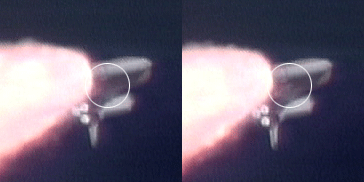 STS-114:  Per i video: http://24.73.239.154:8081/wwwroot_45...divx_video.htm  Spero di essere stato abbastanza chiaro...
__________________
Cosmos Pure | Core i7 860 | P7P55D-E Deluxe | 16GB DDR3 Vengeance | HD5850 | 2x850PRO 256GB | 2xRE3 250GB | 2xSpinPoint F3 1TB Ultima modifica di GioFX : 01-03-2006 alle 20:30. |
||||
|
|
|
|
|


| Strumenti | |


|
|

Tutti gli orari sono GMT +1. Ora sono le: 04:42.