Torna indietro   Hardware Upgrade Forum > Off Topic > Discussioni Off Topic > Scienza e tecnica

Recensione HUAWEI Mate X7: un foldable ottimo, ma restano i soliti problemi
Mate X7 rinnova la sfida nel segmento dei pieghevoli premium puntando su un design ancora più sottile e resistente, unito al ritorno dei processori proprietari della serie Kirin. L'assenza dei servizi Google e del 5G pesa ancora sull'esperienza utente, ma il comparto fotografico e la qualità costruttiva cercano di compensare queste mancanze strutturali con soluzioni ingegneristiche di altissimo livello
Nioh 3: souls-like punitivo e Action RPG
Nioh 3 aggiorna la formula Team NINJA con aree esplorabili più grandi, due stili di combattimento intercambiabili al volo (Samurai e Ninja) e un sistema di progressione pieno di attività, basi nemiche e sfide legate al Crogiolo. La recensione entra nel dettaglio su combattimento, build, progressione e requisiti PC
Test in super anteprima di Navimow i220 LiDAR: il robot tagliaerba per tutti
La facilità di installazione e la completa automazione di tutte le fasi di utilizzo, rendono questo prodotto l'ideale per molti clienti. Ecco com'è andata la nostra prova in anteprima
Tutti gli articoli Tutte le news

Vai al Forum
Rispondi
 
Strumenti
Old 03-04-2008, 10:44   #1
lowenz
Bannato
 
L'Avatar di lowenz
 
Iscritto dal: Aug 2001
Città: Berghem Haven
Messaggi: 13528
Trovata la fonte del vento solare LENTO

Prima di tutto ecco il video, perchè so che correreste subito al link

http://www.esa.int/esaSC/SEMJQK5QGEF_index_1.html

Articolo:

http://www.universetoday.com/2008/04...d-found-video/


The solar wind comes in two modes: fast and slow. Solar astronomers have a good idea as to where the fast solar wind comes from: polar coronal holes of open magnetic field lines, blasting solar particles at speeds of over 3 million km/hr. But what about the slow solar wind which fires particles into space at a pedestrian 1.5 million km/hr? We know it comes from the streamer belt above equatorial regions of the Sun, but we have never been able to look lower. But now, with the help of the Hinode observatory, stunning high-resolution images and video have been captured showing solar dynamics previously overlooked. The point at which the Sun ejects slow wind particles into space can now be studied in unparalleled detail to help us understand the dynamics of space weather and solar storms.

The Sun is a complex, magnetic body. Its magnetic field is highly dynamic, varying in activity throughout the 11-year solar cycle. We have just witnessed the Sun entering "Solar Cycle 24" (although some old sunspots from the previous cycle have just been seen) and it will gradually build in energy before reaching "solar maximum" in a few years time (looks like the solar storms will be bigger than 2003's flare excitement).

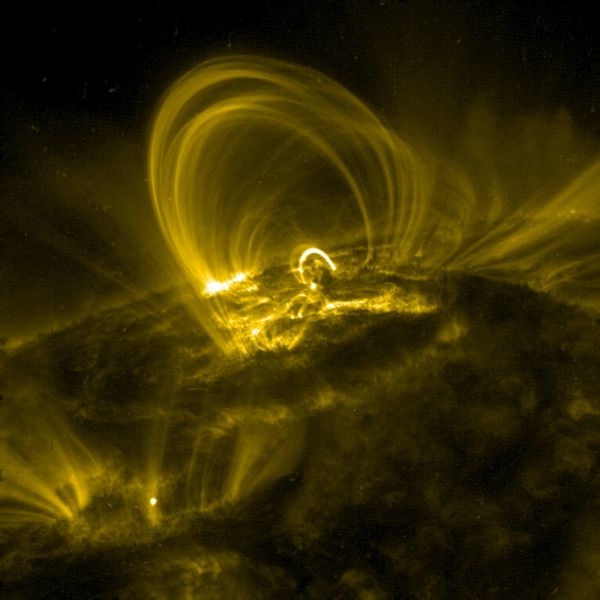
Transition Region and Coronal Explorer image of coronal loops (credit: NASA)

This time of relative calm (known as "solar minimum") allows solar physicists to study the less explosive dynamics in the lower corona (the Sun's atmosphere), chromosphere and photosphere. It is in this region that magnetic field lines (or magnetic flux) are pushed through the photosphere and the plasma from the solar interior is guided by the magnetic flux high into the corona. These hot and bright arcs of magnetism and superheated plasma are known as coronal loops, the scene of rapid reconnection events, sometimes sparking flares and coronal mass ejections (CMEs). But this time the Hinode science team have observed a steady release of solar plasma, venting from the solar interior around a cluster of bright coronal loop footpoints. The location of this steady release of plasma forms the origin of the slow solar wind.

These dazzling images were captured by the Extreme Ultraviolet Imaging Spectrometer (EIS) on board the Japanese Hinode solar observatory. The observatory, which orbits the Earth, constantly looking at the Sun, has given us unrivaled observations of the Sun in X-ray and EUV wavelengths. Launched by Japan, the project also has collaborators in the UK and US.

These new discoveries are of vast importance to us. The solar wind carries a stream of highly energetic particles from the Sun and into space. The solar wind bathes the Earth in a radioactive stream, carrying the remnants of the solar magnetic field with it. The magnetic field can interact with the Earth's magnetic field, allowing solar particles to rain down on our Polar Regions, creating vast light displays: the Aurora. However, these particles are also highly dangerous to any unprotected astronaut or sensitive satellite orbiting our planet. It is of paramount importance that as we venture further and further into space that we forecast the characteristics of the solar wind before it hits us. These new observations will aid our understanding of the conditions at the solar wind source and greatly improve our space weather-predicting ability.


lowenz è offline   Rispondi citando il messaggio o parte di esso
Old 04-04-2008, 19:23   #2
GUSTAV]<
Bannato
 
Iscritto dal: Jun 2007
Messaggi: 460
Quote:
Originariamente inviato da lowenz Guarda i messaggi
Prima di tutto ecco il video, perchè so che correreste subito al link
CVD

infatti 0 risposte in 24h
GUSTAV]< è offline   Rispondi citando il messaggio o parte di esso
Old 04-04-2008, 19:25   #3
GUSTAV]<
Bannato
 
Iscritto dal: Jun 2007
Messaggi: 460
Quote:
Originariamente inviato da lowenz Guarda i messaggi
Prima di tutto ecco il video, perchè so che correreste subito al link

http://www.esa.int/esaSC/SEMJQK5QGEF_index_1.html

Articolo:

http://www.universetoday.com/2008/04...d-found-video/
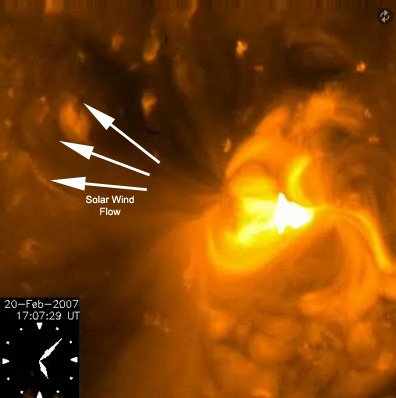


The solar wind comes in two modes: fast and slow. Solar astronomers have a good idea as to where the fast solar wind comes from: polar coronal holes of open magnetic field lines, blasting solar particles at speeds of over 3 million km/hr. But what about the slow solar wind which fires particles into space at a pedestrian 1.5 million km/hr? We know it comes from the streamer belt above equatorial regions of the Sun, but we have never been able to look lower. But now, with the help of the Hinode observatory, stunning high-resolution images and video have been captured showing solar dynamics previously overlooked. The point at which the Sun ejects slow wind particles into space can now be studied in unparalleled detail to help us understand the dynamics of space weather and solar storms.

The Sun is a complex, magnetic body. Its magnetic field is highly dynamic, varying in activity throughout the 11-year solar cycle. We have just witnessed the Sun entering "Solar Cycle 24" (although some old sunspots from the previous cycle have just been seen) and it will gradually build in energy before reaching "solar maximum" in a few years time (looks like the solar storms will be bigger than 2003's flare excitement).

Transition Region and Coronal Explorer image of coronal loops (credit: NASA)

This time of relative calm (known as "solar minimum") allows solar physicists to study the less explosive dynamics in the lower corona (the Sun's atmosphere), chromosphere and photosphere. It is in this region that magnetic field lines (or magnetic flux) are pushed through the photosphere and the plasma from the solar interior is guided by the magnetic flux high into the corona. These hot and bright arcs of magnetism and superheated plasma are known as coronal loops, the scene of rapid reconnection events, sometimes sparking flares and coronal mass ejections (CMEs). But this time the Hinode science team have observed a steady release of solar plasma, venting from the solar interior around a cluster of bright coronal loop footpoints. The location of this steady release of plasma forms the origin of the slow solar wind.

These dazzling images were captured by the Extreme Ultraviolet Imaging Spectrometer (EIS) on board the Japanese Hinode solar observatory. The observatory, which orbits the Earth, constantly looking at the Sun, has given us unrivaled observations of the Sun in X-ray and EUV wavelengths. Launched by Japan, the project also has collaborators in the UK and US.

These new discoveries are of vast importance to us. The solar wind carries a stream of highly energetic particles from the Sun and into space. The solar wind bathes the Earth in a radioactive stream, carrying the remnants of the solar magnetic field with it. The magnetic field can interact with the Earth's magnetic field, allowing solar particles to rain down on our Polar Regions, creating vast light displays: the Aurora. However, these particles are also highly dangerous to any unprotected astronaut or sensitive satellite orbiting our planet. It is of paramount importance that as we venture further and further into space that we forecast the characteristics of the solar wind before it hits us. These new observations will aid our understanding of the conditions at the solar wind source and greatly improve our space weather-predicting ability.

Beh dai, questo è interessante, 11 years, ora nel 2008 a che punto siamo ?
GUSTAV]< è offline   Rispondi citando il messaggio o parte di esso
Old 04-04-2008, 21:47   #4
killercode
Senior Member
 
L'Avatar di killercode
 
Iscritto dal: Jun 2007
Messaggi: 1625
Quote:
Originariamente inviato da GUSTAV]< Guarda i messaggi
Beh dai, questo è interessante, 11 years, ora nel 2008 a che punto siamo ?
Il punto di massima intensità sarà nel 2012...come se non bastasse il calendario maya per far contento Giacobbo
killercode è offline   Rispondi citando il messaggio o parte di esso
Old 04-04-2008, 23:23   #5
lowenz
Bannato
 
L'Avatar di lowenz
 
Iscritto dal: Aug 2001
Città: Berghem Haven
Messaggi: 13528
Quote:
Originariamente inviato da killercode Guarda i messaggi
Il punto di massima intensità sarà nel 2012...come se non bastasse il calendario maya per far contento Giacobbo
La piramide di Cheope rivelerà lo ZED che è un'antenna di comunicazione con gli Alieni che faranno risorgere Elvis
lowenz è offline   Rispondi citando il messaggio o parte di esso
Old 08-04-2008, 08:32   #6
User111
Senior Member
 
Iscritto dal: Mar 2007
Città: Pe-Ch
Messaggi: 19343
Quote:
Originariamente inviato da lowenz Guarda i messaggi
La piramide di Cheope rivelerà lo ZED che è un'antenna di comunicazione con gli Alieni che faranno risorgere Elvis
User111 è offline   Rispondi citando il messaggio o parte di esso
 Rispondi


Recensione HUAWEI Mate X7: un foldable ottimo, ma restano i soliti problemi Recensione HUAWEI Mate X7: un foldable ottimo, m...
Nioh 3: souls-like punitivo e Action RPG Nioh 3: souls-like punitivo e Action RPG
Test in super anteprima di Navimow i220 LiDAR: il robot tagliaerba per tutti Test in super anteprima di Navimow i220 LiDAR: i...
Dark Perk Ergo e Sym provati tra wireless, software via browser e peso ridotto Dark Perk Ergo e Sym provati tra wireless, softw...
DJI RS 5: stabilizzazione e tracking intelligente per ogni videomaker DJI RS 5: stabilizzazione e tracking intelligent...
Starfield per Nintendo Switch 2 potrebbe...
Un MacBook Pro a -300€, i MacBook Air M4...
Amazon abbassa i prezzi sugli iPhone: sc...
Amazon, ancora sconti sugli smartphone A...
iPhone Air 2 'riciclerà' alcuni c...
Offerta Amazon da non perdere: lo speake...
Nioh 3 debutta alla grande su Steam: pri...
Al centro della Via Lattea ci potrebbe e...
Elon Musk ora guarda alla Luna: SpaceX p...
La Cina ha lanciato nuovamente lo spazio...
Blue Origin potrebbe realizzare il lande...
Artemis II: il prossimo Wet Dress Rehear...
Il nuovo HONOR 600 sta arrivando e avr&a...
La crisi delle memorie non coinvolger&ag...
Windows domina su Steam, ma molti utenti...
Chromium
GPU-Z
OCCT
LibreOffice Portable
Opera One Portable
Opera One 106
CCleaner Portable
CCleaner Standard
Cpu-Z
Driver NVIDIA GeForce 546.65 WHQL
SmartFTP
Trillian
Google Chrome Portable
Google Chrome 120
VirtualBox
Tutti gli articoli Tutte le news Tutti i download

Strumenti

Regole
Non Puoi aprire nuove discussioni
Non Puoi rispondere ai messaggi
Non Puoi allegare file
Non Puoi modificare i tuoi messaggi

Il codice vB è On
Le Faccine sono On
Il codice [IMG] è On
Il codice HTML è Off
Vai al Forum


Tutti gli orari sono GMT +1. Ora sono le: 11:04.


Powered by vBulletin® Version 3.6.4
Copyright ©2000 - 2026, Jelsoft Enterprises Ltd.
Served by www3v